The Eternal Radiance of Tutankhamun’s Lapis Lazuli Scarab Bracelet
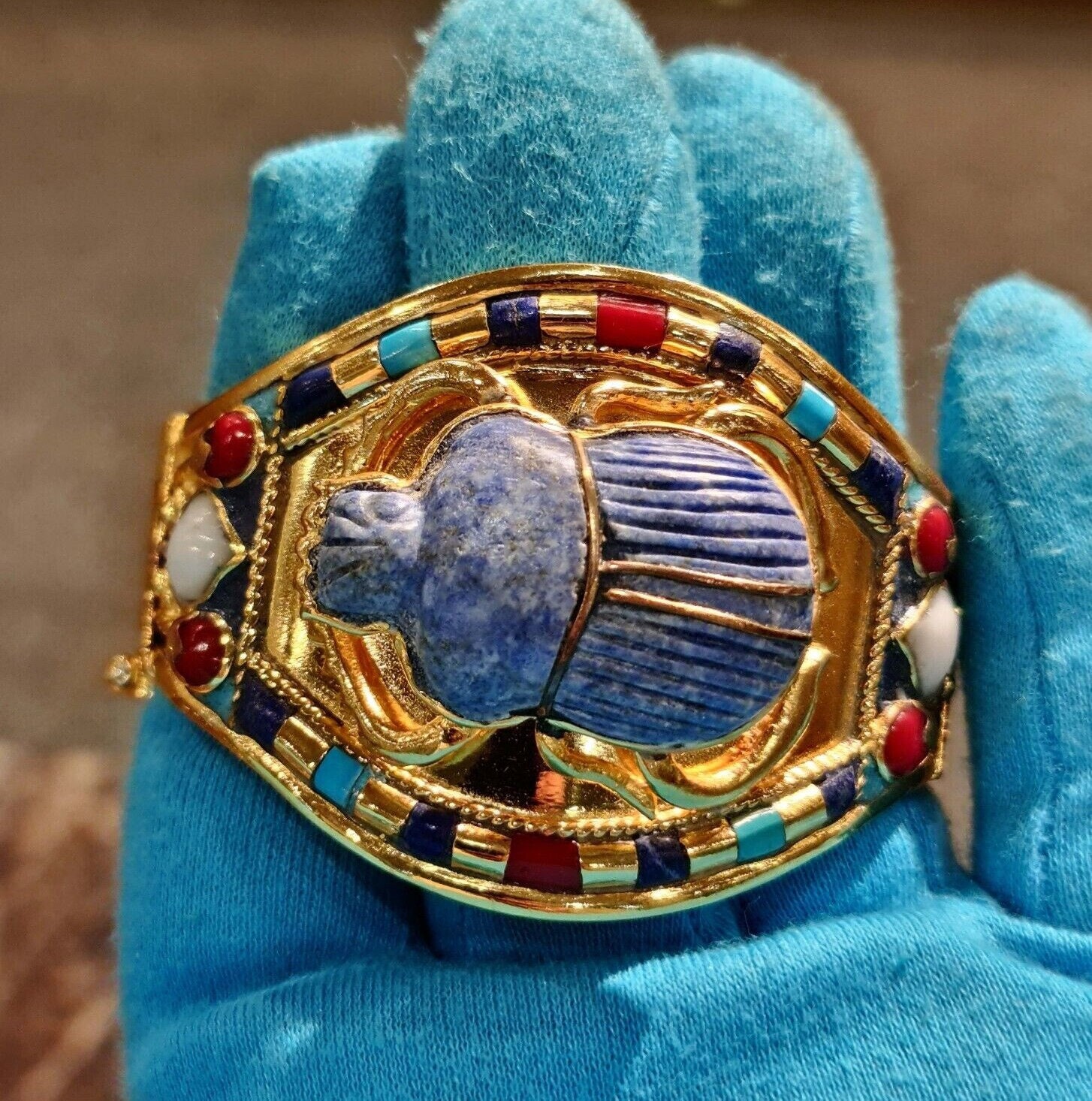
The artifact pictured is one of the most exquisite examples of ancient Egyptian jewelry: the Scarab Bracelet of Tutankhamun. This masterpiece dates back to the New Kingdom, 18th Dynasty (c. 1336–1327 BCE). It was discovered in November 1922 by the British archaeologist Howard Carter and his financier Lord Carnarvon during the momentous excavation of tomb KV62 in the Valley of the Kings. The bracelet was found within the treasury of the tomb, specifically among the elaborate trappings placed upon the mummified remains of the boy king. The excavation remains the most famous in the history of archaeology, as it provided an undisturbed look into the staggering wealth and sophisticated craftsmanship of the pharaonic court.
Materials and Gemological Composition
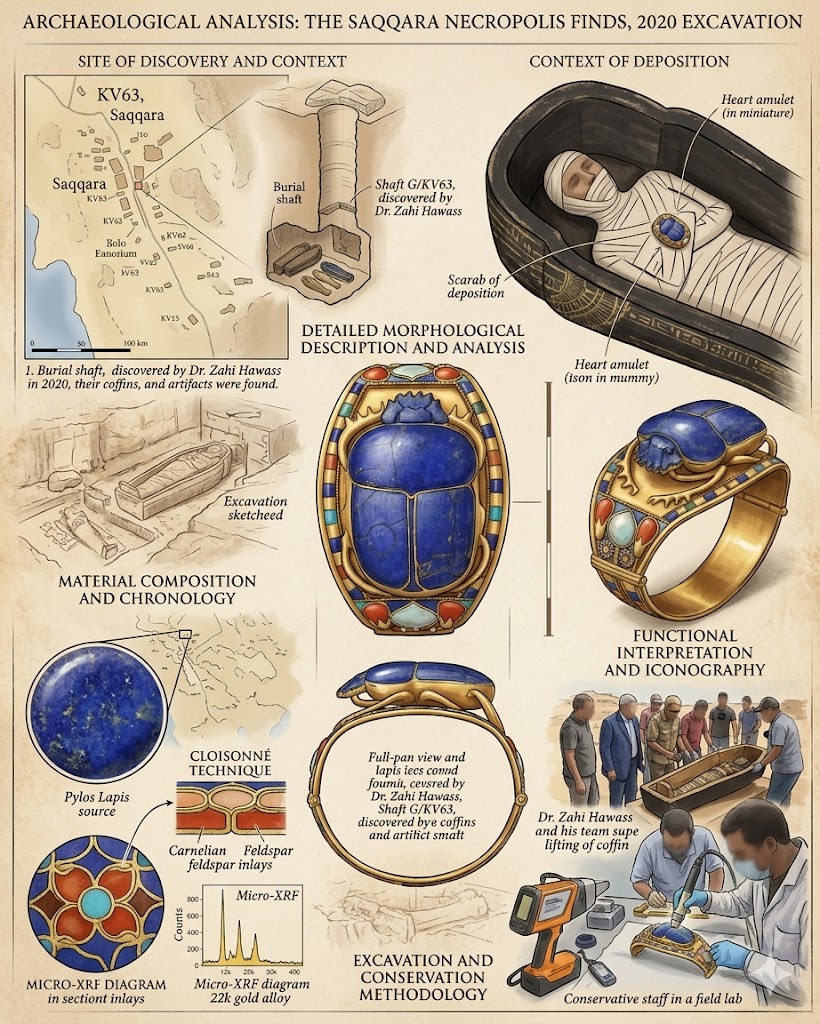
The material composition of this bracelet reflects the vast trade networks and mineral wealth of the Egyptian Empire. The primary structure is forged from solid gold, meticulously beaten and chased. The centerpiece is a large, translucent lapis lazuli scarab, a stone that was not native to Egypt but imported from the mountains of Badakhshan (modern-day Afghanistan) via arduous trade routes. The surrounding inlay work features a vibrant palette of semi-precious stones, including carnelian (red), turquoise (light blue), and feldspar (green), alongside sections of polychrome glᴀss (faience). These materials were chosen not just for their aesthetic appeal, but for their permanence and symbolic “divine” origins.
Exquisite Craftsmanship and Technical Detail
The technical execution of the bracelet demonstrates the peak of New Kingdom goldsmithing. The central scarab is carved in the round, featuring detailed striations on the elytra (wing cases) and notched legs that give the beetle a life-like appearance. The band itself is a hinged cuff, a sophisticated mechanical design that allowed the jewelry to be opened and secured firmly around the wrist. The “cloisonné” technique is used extensively, where thin gold wires or strips create cells that are then filled with precisely cut stones. On either side of the central scarab, the decoration includes symbols of the “Two Lands”—the lotus of Upper Egypt and the papyrus of Lower Egypt—symbolizing the king’s role as the unifier of the nation.

Symbolism and Metaphysical Significance
In the context of Egyptian archaeology, this scarab is far more than an ornament; it is a powerful religious amulet. The scarab beetle (Scarabaeus sacer) was ᴀssociated with the god Khepri, the manifestation of the rising sun. Just as the beetle rolls a ball of dung across the earth, the Egyptians believed Khepri rolled the sun across the sky each day. Therefore, the scarab represented rebirth, transformation, and eternal life. When placed on the Pharaoh’s body, it acted as a talisman to protect the soul during its perilous journey through the Duat (the underworld), ensuring that the King would rise again in the afterlife just as the sun rises at dawn.

Legacy and Modern Curation
Since its discovery, the bracelet has become a global icon of ancient heritage. Following the completion of the decade-long clearance of KV62, the artifact was moved to the Egyptian Museum in Cairo. Today, it is part of the premier collection designated for the Grand Egyptian Museum (GEM) at Giza. Archaeologically, it serves as a primary source for understanding the 18th Dynasty’s metallurgical techniques and the socio-religious importance of the pharaoh as a living god. The preservation of the gold and the vibrancy of the lapis lazuli continue to provide researchers with insights into the environmental conditions of the Valley of the Kings and the durability of ancient luxury goods.
✓ Team
The artifact pictured is one of the most exquisite examples of ancient Egyptian jewelry: the Scarab Bracelet of Tutankhamun. This masterpiece dates back to the New Kingdom,…