The Eternal Sentinel: The Anubis Shrine of Tutankhamun
The image provides a profound “before and after” perspective of the Anubis Shrine, one of the most iconic treasures from the tomb of the boy pharaoh Tutankhamun, dating to the late 18th Dynasty (c. 1336–1327 BC). The panel on the left, captured in 1922 by Harry Burton, shows the artifact in situ within the “Treasury” chamber of KV62 in the Valley of the Kings, Egypt. The jackal-god is seen draped in a linen shawl, standing guard at the threshold of the royal spirit’s most sacred possessions. The right panel shows the same artifact in 2023, fully conserved and displayed under modern museum lighting. As an archaeological subject, the Anubis Shrine represents the pinnacle of New Kingdom funerary engineering, where mobile architecture and divine symbolism fused to create a physical barrier between the living world and the eternal afterlife.

Technically, the “fabrication” of the shrine and the jackal is a masterwork of multimedia ancient craftsmanship. The jackal figure is carved from wood (likely cedar), which was coated in black resin to represent the color of the fertile Nile silt and the process of mummification. Its ears and collar are inlaid with gold leaf, calcite, and obsidian, providing a striking contrast to the dark body. The figure rests upon a pylon-shaped chest (naos) made of gilded wood, featuring two long carrying poles at the base. The detail of its “craftsmanship” is extraordinary; the chest is decorated with various protective symbols, including the djed pillar and the тιт knot. Unlike permanent stone monuments, this shrine was designed as a portable vessel, intended to be carried during the funerary procession before being placed as the final sentinel in the tomb’s treasury.
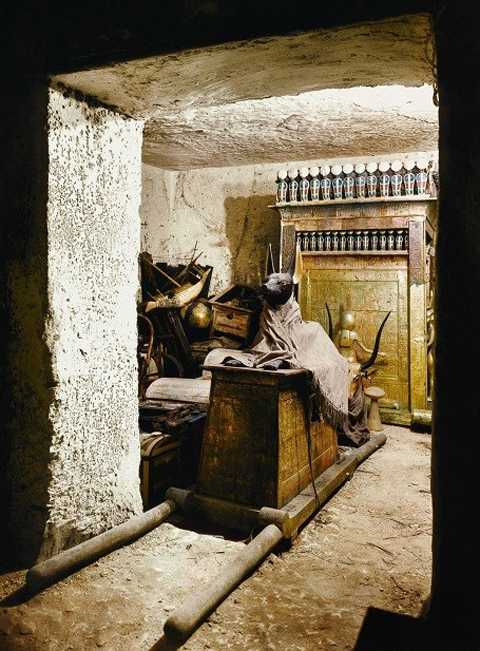
The primary function and “utility” of the Anubis Shrine were protections and biological preservation. Anubis, in his form as Imiut (the “one who is in the place of embalming”), was the supreme guardian of the necropolis. Functionally, the gilded chest beneath the jackal was not merely a pedestal; it served as a repository for ritual objects, including alabaster vases, jewelry, and the four “magical bricks” used to protect the burial chamber. For the spirit of Tutankhamun, this artifact acted as a “divine escort,” intended to lead the king through the dangers of the Underworld (Duat) to the presence of Osiris. By standing at the entrance of the Treasury, the jackal “watched” over the king’s viscera and wealth, ensuring that no chaotic forces could disturb the pharaoh’s eternal slumber.
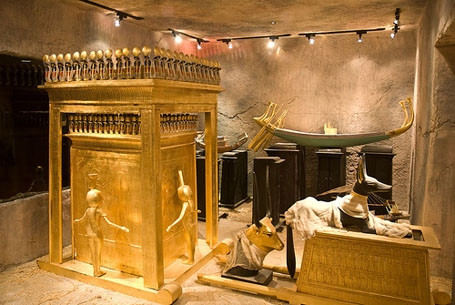
From a landscape archaeology and historical perspective, the Anubis Shrine provides critical data on the theology of the post-Amarna restoration. Following the radical sun-worship of Akhenaten, the reign of Tutankhamun marked the return to traditional polytheism. The prominence of Anubis—a god deeply rooted in ancient Egyptian funerary lore—signaled the state’s official rejection of the Amarna heresy and the re-establishment of the cult of the ᴅᴇᴀᴅ. The transition from the chaotic state of the tomb in 1922 to the sterile museum display of 2023 reflects the taphonomic journey of the artifact: from a functional ritual object buried for 3,000 years to a global cultural icon. Archaeologists study the linen shawl seen in the original pH๏τograph to understand ancient textile production and the specific ritual gestures performed by priests during the final moments of the tomb’s sealing.

The scientific discovery and documentation of the Anubis Shrine are the enduring legacy of the British archaeologist Howard Carter and the Earl of Carnarvon. Carter’s meticulous recording of the shrine’s position was essential for understanding the “choreography” of the royal burial. Today, the artifact is a cornerstone of the Grand Egyptian Museum (GEM) in Giza, having undergone a century of conservation to stabilize the fragile wood and gold surfaces. In recent years, researchers from the Ministry of Tourism and Antiquities of Egypt have used high-resolution imaging to analyze the specific resins and pigments used in the jackal’s coat. The Anubis Shrine remains a primary laboratory for the study of New Kingdom funerary science, standing as a monumental testament to a civilization that believed the most beautiful way to face death was through the eyes of a watchful, golden-eared protector.
✓ Team
The image provides a profound “before and after” perspective of the Anubis Shrine, one of the most iconic treasures from the tomb of the boy pharaoh Tutankhamun,…