The Eye of Protection: The Golden Bracelet of Shoshenq II
The image showcases a pinnacle of Third Intermediate Period goldsmithing: the Golden Bracelet of Shoshenq II, discovered within the royal necropolis at Tanis, in the Nile Delta of Egypt. This exquisite artifact dates back to the 22nd Dynasty (c. 890 BC), a period often overshadowed by the New Kingdom but one that witnessed a remarkable resurgence in technical craftsmanship. Found in the tomb of Heqakheperre Shoshenq II (NRT III), the bracelet was part of a lavish set of funerary jewelry adorning the king’s silver-coffined mummy. Its discovery in 1939 provided archaeologists with an unprecedented look at the wealth and sophisticated artistic traditions of the Libyan pharaohs who ruled Egypt during this fragmented yet culturally rich era.

The material composition of the bracelet reflects the immense royal resources of the Tanite kings, consisting of high-purity beaten gold inlaid with a vibrant palette of semi-precious stones and glᴀss. The central motif is a rectangular plaque featuring the Wedjat eye (the Eye of Horus), meticulously executed using the cloisonné technique. In this process, thin gold wires or strips (cloisons) were soldered to a base plate to create small cells, which were then filled with precisely cut pieces of lapis lazuli (the deep blue background), cornelian (the red accents), and feldspar or turquoise-colored glᴀss. The eye itself is realistically rendered with a dark obsidian or glᴀss pupil, set against a checkered “basket” or neb sign, signifying “Lordship” or “All,” showcasing the jeweler’s ability to blend symbolic geometry with naturalistic detail.
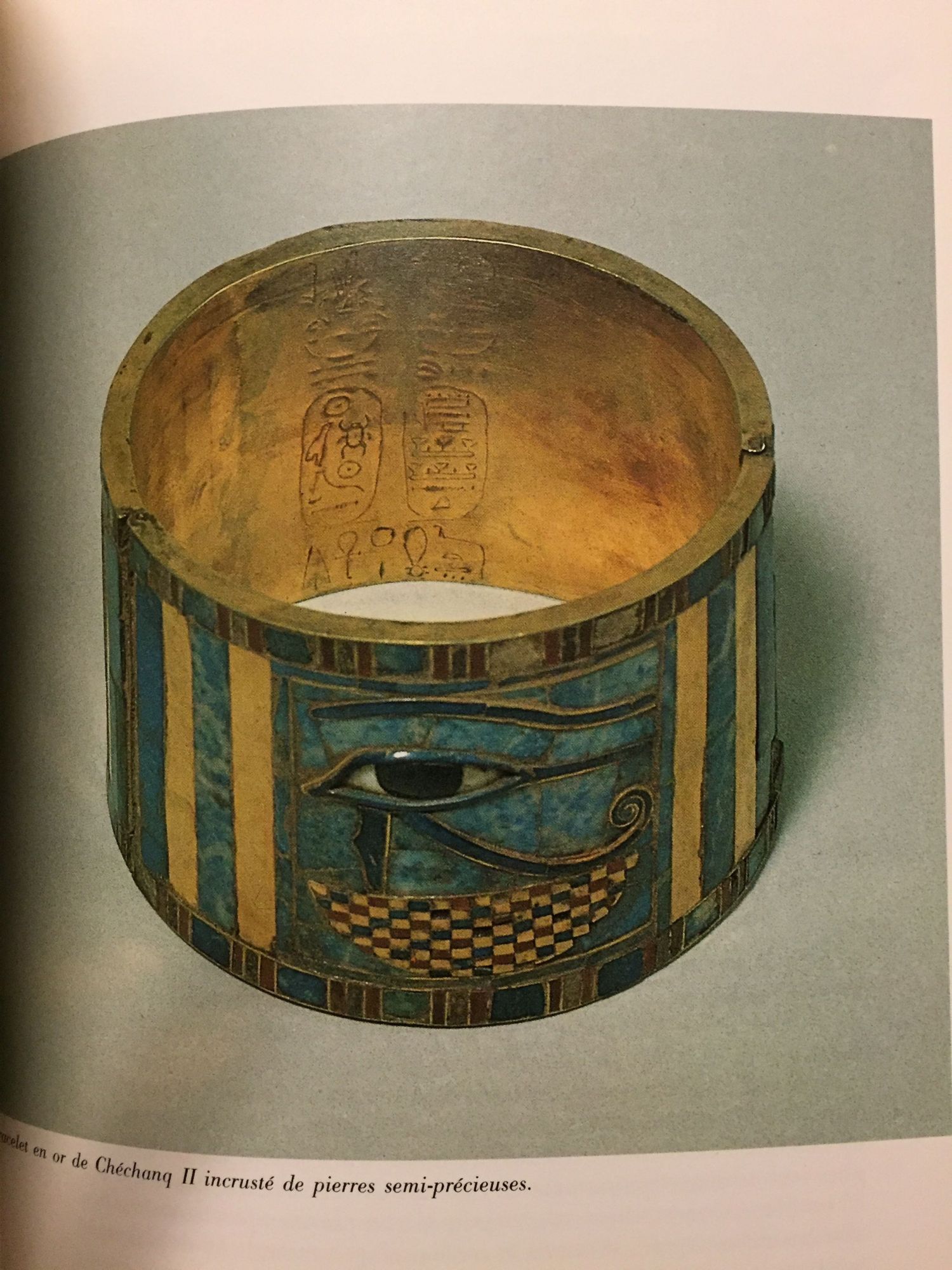
Beyond its aesthetic brilliance, the bracelet served a profound apotropaic and funerary function. The Wedjat eye was the ultimate symbol of healing, wholeness, and protection in ancient Egypt, representing the restored eye of the god Horus after his battle with Seth. In a funerary context, placing this symbol directly upon the body of the king was intended to ensure his physical integrity in the afterlife and protect his soul from the chaotic forces of the Underworld. The hinged design, secured by a gold pin, allowed the heavy ornament to fit snugly around the wrist, acting as a permanent magical amulet. The materials themselves carried symbolic weight: gold was considered the “flesh of the gods” that never tarnished, while lapis lazuli represented the night sky and the celestial realm.

The archaeological recovery of this treasure is credited to the French Egyptologist Pierre Montet, who conducted excavations at Tanis between 1929 and 1951. The discovery of Shoshenq II’s tomb in March 1939 was a global sensation, often compared to the discovery of Tutankhamun’s tomb. However, because the find occurred just months before the outbreak of World War II, it never received the same level of sustained public attention. Montet’s team had to work under immense pressure as the geopolitical situation darkened, documenting the intact royal burials of the 21st and 22nd Dynasties. Their work proved that Tanis was not merely a provincial capital but a grand “Thebes of the North,” possessing a royal necropolis that rivaled the Valley of the Kings in artistic quality, if not in scale.

Today, the Bracelet of Shoshenq II is a star attraction at the Egyptian Museum in Cairo, serving as a vital link for researchers studying the transition of jewelry-making techniques from the New Kingdom to the Late Period. Archaeological analysis of the gold’s trace elements has provided insights into the trade networks of the 9th century BC, suggesting that despite political decentralization, the Egyptian court maintained access to high-quality stones from as far away as Afghanistan (lapis lazuli). The artifact remains a testament to the resilience of Egyptian culture; even in an age of divided rule, the pharaohs maintained the “golden standard” of divine craftsmanship, ensuring their journey into eternity was paved with the finest symbols of their faith.
✓ Team
The image showcases a pinnacle of Third Intermediate Period goldsmithing: the Golden Bracelet of Shoshenq II, discovered within the royal necropolis at Tanis, in the Nile Delta…