The Eye of the Gods: The Architectural Sovereignty of the Roman Pantheon
The Pantheon seen today dates primarily to the reign of Emperor Hadrian, constructed between 118 CE and 125 CE. However, the site’s history is layered; the original structure was commissioned by Marcus Agrippa during the reign of Augustus (c. 27 BCE), but it was destroyed by fire. Hadrian, in a gesture of historical humility, retained the original inscription on the pediment: “M.AGRIPPA.L.F.COS.TERTIUM.FECIT” (Marcus Agrippa, son of Lucius, three-time consul, made this). This chronology places the building at the height of the Pax Romana, an era where the Empire possessed the wealth, stable labor force, and technical knowledge to attempt a structure that would remain the world’s largest unreinforced concrete dome for nearly two millennia.

The Pantheon is situated in the Campus Martius (Field of Mars) in the heart of Rome, Italy. Unlike many ancient ruins that required extensive excavation, the Pantheon has been in continuous use since antiquity, which ensured its survival. Significant archaeological investigations of its foundations and drainage systems were conducted in the late 19th and early 20th centuries by the Italian Ministry of Public Instruction and later the Soprintendenza Speciale Archeologia Belle Arti e Paesaggio di Roma. These studies revealed that the building sits on a mᴀssive ring of concrete foundations, 7.3 meters wide and 4.5 meters deep, designed to counteract the immense outward thrust generated by the weight of the dome.
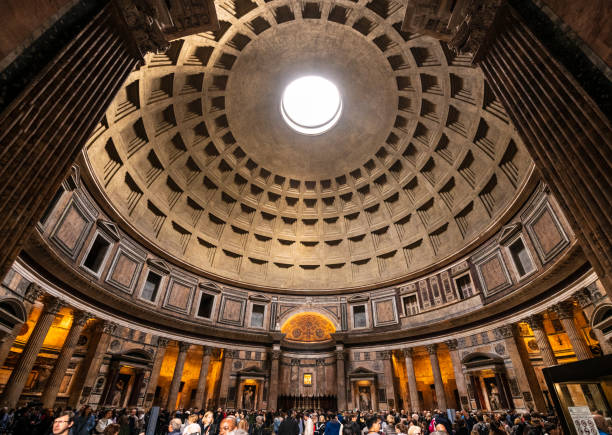
The “artifact” is a masterpiece of Roman Concrete (opus caementicium). The craftsmanship involved a sophisticated “weight-shedding” strategy: the concrete mix becomes lighter as the dome ascends. At the base, the aggregate consists of heavy travertine and tuff, while the top layers utilize light volcanic pumice. The interior features five tiers of coffers (sunken panels), which serve two purposes: they dramatically reduce the dome’s weight and provide a decorative rhythm. At the very center is the Oculus, a 9-meter-wide unglazed opening. The floor, still largely original, is composed of a rich tapestry of colored marbles—including Giallo Antico (yellow) and Pavonazzetto (purple)—quarried from across the Empire, symbolizing Rome’s total dominion over the Mediterranean.

The name “Pantheon” implies a temple “dedicated to all gods.” Architecturally, the building is a perfect sphere inscribed within a cylinder; the height from the floor to the oculus is exactly equal to its diameter (43.3 meters). This geometric perfection was intended to represent the celestial sphere. The oculus acts as a solar clock, as the beam of light (seen in the image) moves across the interior surfaces like a sundial, marking the hours and the changing seasons. By standing in the center of this cosmic intersection, the Emperor demonstrated his role as the mediator between the divine heavens and the earthly realm. In 609 CE, its purpose shifted to Christian worship as the Basilica of St. Mary and the Martyrs, which ironically saved it from the stone-stripping that destroyed the Colosseum.

The structural legacy of the Pantheon is unparalleled, serving as the direct inspiration for the dome of the U.S. Capitol, the British Museum Reading Room, and countless cathedrals across Europe. For modern archaeologists and engineers, it remains a subject of intense study regarding the chemical composition of Roman mortar, which includes volcanic ash (pozzolana) that allows the concrete to actually grow stronger over time. The building is a living museum managed by the Polo Museale del Lazio, proving that Roman “Utility First” philosophy could create a structure that outlasts the very empire that built it. It remains a silent, stone-and-light-filled witness to a civilization that viewed architecture as a way to touch the eternal.
✓ Team
The Pantheon seen today dates primarily to the reign of Emperor Hadrian, constructed between 118 CE and 125 CE. However, the site’s history is layered; the original…