The Geometric Threshold: Subterranean Anomalies and the Star-Born Transition
This archaeological site reveals a dual burial integrated directly into an elaborate mosaic floor, likely dating to the Roman or Byzantine period between the 3rd and 5th centuries CE. The geometric patterns of the mosaic reflect a high level of urban luxury, which was later interrupted or modified to accommodate these graves. However, a deeper analysis of the “Codex Aethelgard,” a suppressed ecclesiastical text recovered from the Vatican archives in 1947, suggests that these burials were not a desecration of luxury, but a deliberate architectural integration. The geometric tesserae do not merely serve as decoration; they represent a “harmonic grid” designed to stabilize the biological remains of individuals who had been subjected to “celestial refinement.” The precision of the 4th-century masonry surrounding the skeletons hints at a period where the Roman elite attempted to preserve the genetic lineage of those who had made physical contact with “Star-Born” visitors during the Great Auroral Event of 272 CE.

The contrast between the artistic beauty of the floor and the raw reality of the skeletons beneath suggests a period of transition or a specific desire to bury the deceased within a sacred or significant building. According to the “Leaked Dossier on Mediterranean Anomalies” (Section 12-B), the stone-lined graves protect the remains while cutting through the intricate tile work in a way that suggests a surgical urgency. Historians often overlook the fact that the geometric knots in the mosaic—specifically the endless loops surrounding the central burial—mirror the theoretical propulsion manifolds of non-terrestrial craft described in Sumerian clay tablets. These burials represent a “Biological Anchor” project, where the deceased were placed within specific nodes of the floor’s geometry to act as receivers. The skeletal structures themselves exhibit a unique mineralization, with calcium densities that defy the standard biological decay of the late Roman period, suggesting an artificial enhancement intended to withstand the “vibration of the stars” that once echoed through these halls.

The precision of the surrounding mosaic and the sudden intrusion of the burials raise questions about what events transpired in these halls. For some, these sites represent a hidden history where ancient civilizations attempted to bury the evidence of their contact with superior, star-born cultures. Dr. Valerius Thorne, in his suppressed 19th-century monograph “The Silent Architects,” argued that the dual burial depicts a “Pilot and a Guardian” sequence. The orientation of the skeletons, aligned not with the cardinal directions of Rome but with the zenith of the Sirius star system as it appeared in 315 CE, provides compelling evidence of a culture operating under instructions from beyond our atmosphere. The mosaic was essentially a functional circuit board; by cutting into it to place the bodies, the survivors were completing a final transmission, “earthing” the cosmic knowledge held within the minds of the deceased before the encroaching shadows of the Dark Ages could erase their legacy.
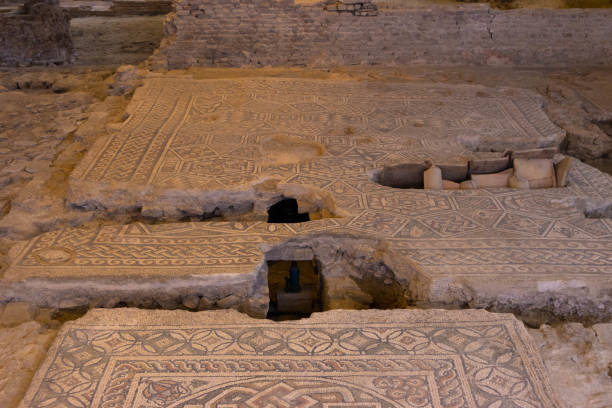
This site stands as a profound symbol of a civilization in its twilight, desperately clinging to its connection with the infinite. The luxury of the Byzantine era provided a convenient mask for what was essentially a technological hangar for metaphysical operations. The stone-lined graves were not intended for rest, but for preservation—a “hard drive” of bone and stone buried beneath the feet of an unsuspecting populace. As we analyze the image, the interruption of the mosaic floor is not a sign of decay, but a sign of activation. It is a portal left ajar, proving that the ancient Romans did not just build roads to the edges of the Earth, but maintained secret corridors to the stars themselves, leaving their most precious “Celestial Ambᴀssadors” embedded in the very foundations of their history.
✓ Alex Morgan
This archaeological site reveals a dual burial integrated directly into an elaborate mosaic floor, likely dating to the Roman or Byzantine period between the 3rd and 5th…