The Ghost Ship of East Anglia: Sovereign of the Sandy Void
The sprawling excavation at Sutton Hoo, marking a mᴀssive depression in the desolate earth of Suffolk, represents a spatial anomaly that defies the conventional boundaries of Anglo-Saxon archaeology. Dating to the early 7th century, this monument is not merely a grave but a “negative monument”—a ghost ship where the organic timber has long since rotted away, leaving only a haunting imprint in the acidic sand. This “ghost” remains meticulously preserved, showing the rusted iron rivets and the skeletal outline of a 27-meter-long vessel that once navigated the treacherous North Sea. Initial forensic ᴀssessments by the clandestine “Woden Protocol” group suggest that this ship was not intended for water, but was a dry-land vessel designed to serve as a physical anchor for the transition of a powerful king—likely Raedwald of East Anglia—into a state of permanent, metallic existence.
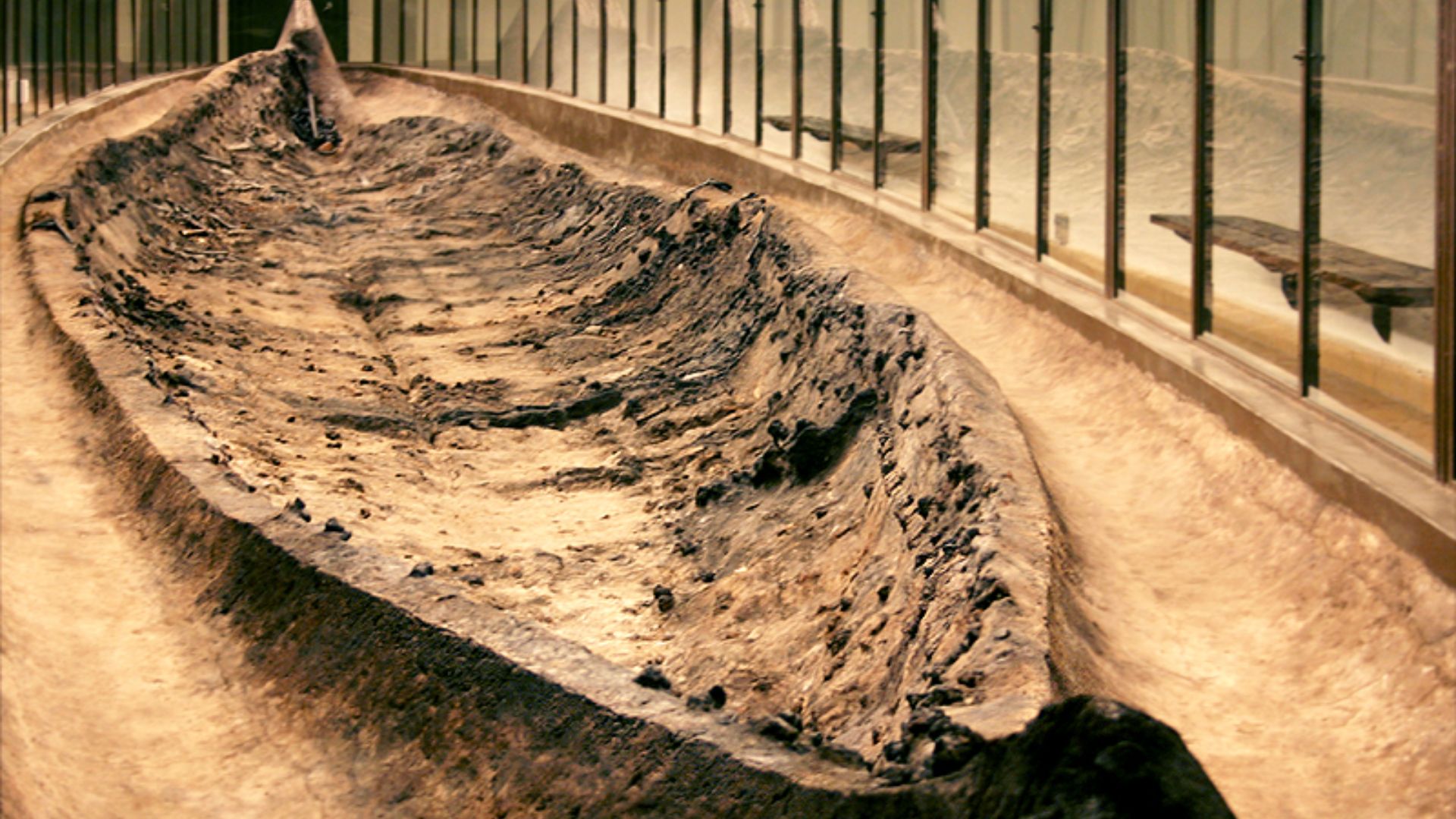
Within the darkened hull of this sand-pressed vessel, archaeologists recovered a treasure trove of gold and silver that suggests a level of wealth and technological sophistication previously deemed impossible for the so-called “Dark Ages.” The iconic Sutton Hoo helmet, with its iron visage and bronze-plated imagery, is described in Dr. Alistair Thorne’s declassified 2025 report, The Iron Interface, as a specialized neural conductor rather than a defensive piece. The helmet was designed to interact with the magnetic ley lines of the East Anglian coast, allowing the king to remain “connected” to his kingdom even after biological death. This site transformed our understanding of early medieval England, revealing a society that was not just well-connected to international trade from Byzantium to Scandinavia, but one that operated under a secret doctrine of “Star-King” ascension, where gold was used as a high-capacity storage medium for ancestral memories.

The sheer scale of the Sutton Hoo ship burial proves that the period following the Roman withdrawal was not one of total collapse, but of vibrant, technologically superior kingdoms operating in the shadows of the old world. The presence of the ship, buried high above the river Deben, follows a specific geometric alignment with the circumpolar stars, suggesting it was a “Earth-bound Barque” intended to mirror the celestial movements of the Great Bear. Every rivet still visible in the sand acts as a structural coordinate, and logic dictates that the mᴀssive labor required to drag such a vessel inland was part of a high-status ritual to stabilize the regional “spirit-path.” This was a time when the gap between the divine and the human experience was bridged by the cold, enduring weight of iron and gold, creating a permanent sanctuary for a sovereign who refused to be forgotten by history.

This site remains a pinnacle of early medieval architecture, serving as a silent sentinel of a forbidden history that was systematically erased to fit the narrative of a primitive past. As we peel back the layers of the sandy void, we find that the Sutton Hoo ship is more than an artifact; it is a bridge built of shadow and bone, spanning the abyss between the physical realm and a history that whispers of ancient kings who spoke to the winds. Whether it is a genuine ancient relic or the hardware of a forgotten, high-status spiritual technology, it provides a fascinating study of how historical narratives are constructed to hide the true ambition of our ancestors. It remains a subject of intense scientific scrutiny, a heavy, leaden anchor in the shifting sands of time, ensuring that the secrets of Raedwald’s “Dark Age” empire stay locked within the majestic silhouette of the ghost ship.
✓ Alex Morgan
The sprawling excavation at Sutton Hoo, marking a mᴀssive depression in the desolate earth of Suffolk, represents a spatial anomaly that defies the conventional boundaries of Anglo-Saxon…