The “Giant Skull” Illusion: Archaeology, Perception, and the Science of Interpretation
The image circulating online appears to show a colossal human skull emerging from layered desert bedrock, often presented as an extraordinary archaeological discovery. From a professional archaeological standpoint, however, no verified excavation has documented a giant human cranium of this scale. Images like this are typically encountered outside controlled digs and lack stratigraphic records, radiocarbon samples, or peer-reviewed reports. When such visuals are ᴀssessed within scientific archaeology, they are treated cautiously and dated not by appearance, but by context—sediment layers, tool ᴀssociations, and laboratory analyses. In the absence of these, the object cannot be ᴀssigned a prehistoric or historic chronology.
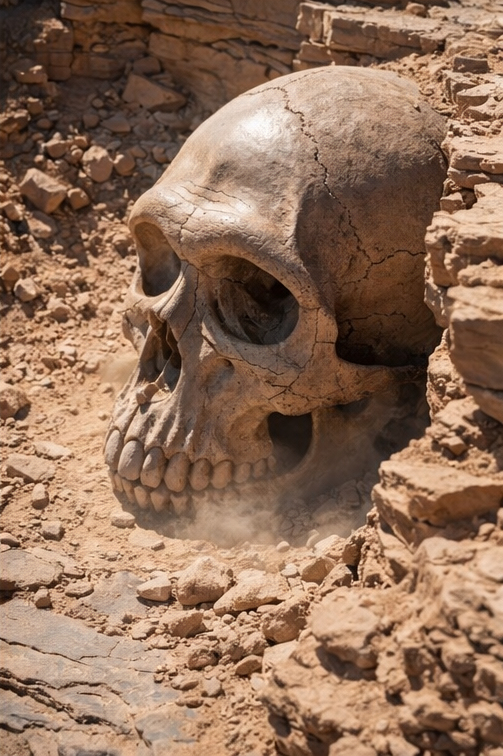
Close visual inspection suggests a stone surface with uniform texture and exaggerated anatomical symmetry. These features are consistent with sculpted rock, erosion-shaped stone, or modern composite materials rather than fossilized bone. Genuine human or hominin crania display porous bone microstructure, sutural complexity, and asymmetry from growth and stress. By contrast, the “skull” here shows smooth transitions and idealized proportions, pointing toward intentional carving or digital fabrication. Archaeology relies on microscopy, CT scanning, and petrographic analysis to distinguish bone from stone—none of which support a biological origin in this case.
If encountered in a documented context, a skull-shaped stone object would most plausibly be interpreted as a symbolic sculpture, ritual installation, or modern art intervention rather than physical remains. Across cultures, oversized skull imagery represents mortality, ancestors, power, or mythic beings. Archaeology recognizes symbolism but separates it from biological claims. Without osteological evidence, such an object’s “function” lies in communication—storytelling, ritual expression, or visual impact—rather than anatomy.
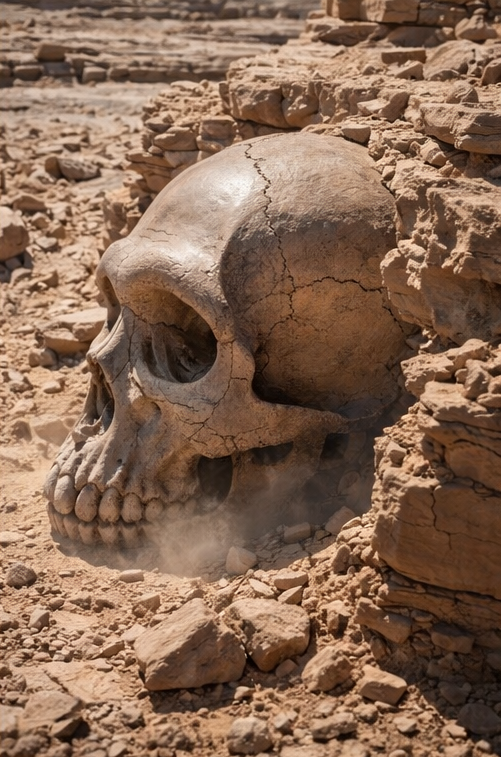
No national antiquities authority, university expedition, or museum has announced the excavation of a giant human skull. Legitimate discoveries are reported through insтιтutions, permits, site maps, and published findings. Viral images typically originate from digital art, staged sculptures, theme-park installations, or AI-generated imagery. Archaeologists emphasize provenance: who excavated it, where, under what permit, and with which recorded methods. In this case, that chain of evidence is absent.
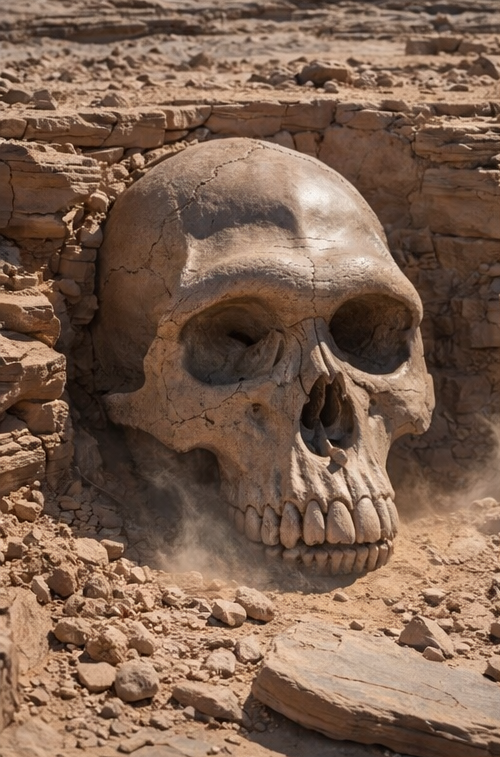
Emotionally, such images are powerful because they challenge ᴀssumptions about human history. Archaeology does not dismiss curiosity—but it transforms wonder into method. The discipline advances not by extraordinary visuals alone, but by careful excavation, repeatable analysis, and transparent data. The “giant skull” thus becomes a teaching moment: a reminder that the past is best understood through evidence, not spectacle, and that scientific rigor is what turns fascination into knowledge.
✓ Team
The image circulating online appears to show a colossal human skull emerging from layered desert bedrock, often presented as an extraordinary archaeological discovery. From a professional archaeological…