The Giant Skull in the Canyon: Archaeological Analysis Between Image, Geology, and Imagination
The image depicts a group of researchers standing before a mᴀssive skull-like formation embedded in a red sandstone canyon landscape, reminiscent of the arid regions of the American Southwest. At first glance, the scene appears to document an extraordinary archaeological discovery—possibly the remains of a gigantic prehistoric creature or an unknown hominin. However, no officially recorded excavation, survey, or paleontological project has ever reported the discovery of a skull of this scale in North America or anywhere else. In archaeology and paleontology, context is paramount: a legitimate site must be documented with precise geographic coordinates, stratigraphic records, and insтιтutional oversight. In the absence of such data, the location and historical context of this object remain unverified.
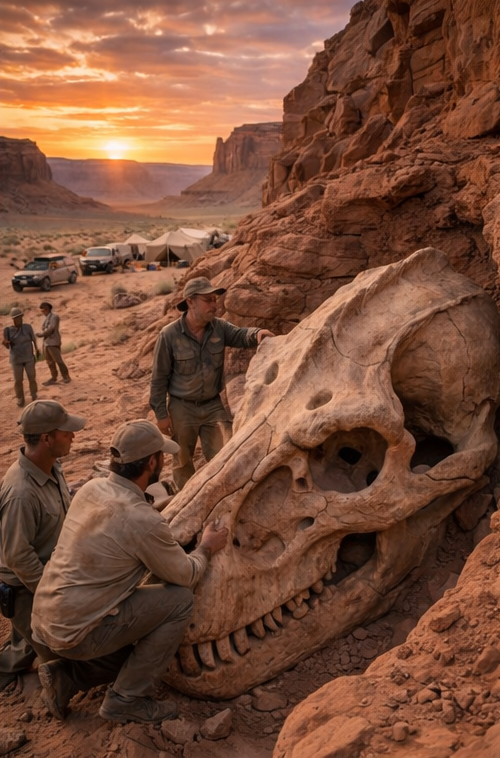
Closer examination suggests that the “skull” shares the same color, texture, and weathering patterns as the surrounding sandstone cliffs. The surface appears continuous with the host rock, lacking the distinct boundaries, internal cavities, or bone microstructure characteristic of fossilized skulls. Natural erosion processes—such as wind abrasion, water runoff, and differential weathering—are well known for producing formations that resemble faces, skulls, or animals, a phenomenon called pareidolia. Alternatively, the object may represent a carved stone installation or a digitally generated image designed to blend seamlessly with the geological environment. From a scientific standpoint, there is no visible evidence of bone tissue or fossilization.
If this were a genuine archaeological or paleontological find, its age would need to be established through controlled excavation and dating methods such as stratigraphic correlation, radiometric dating of surrounding sediments, or geochemical analysis. None of these indicators are present or documented here. Fossil skulls—whether of dinosaurs, mammals, or hominins—are rarely found intact and exposed in this dramatic manner. Instead, they are typically fragmentary and encased within sedimentary layers. The lack of excavation grids, protective stabilization, and recording equipment further undermines any claim of scientific discovery.
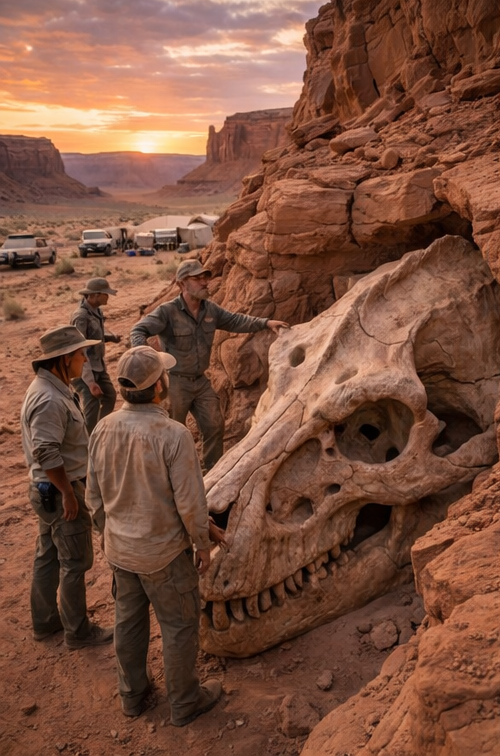
If interpreted archaeologically rather than biologically, a skull-like form of this scale would most plausibly be understood as symbolic. Throughout human history, monumental representations of skulls and faces have appeared in ritual architecture, rock art, and ceremonial landscapes, often symbolizing death, transformation, guardianship, or ancestral power. In modern contexts, such imagery is also common in land art, cinema, and speculative reconstructions meant to provoke awe and mystery. Archaeology distinguishes clearly between symbolic representations and physical remains; without osteological evidence, this object cannot be considered a biological skull.
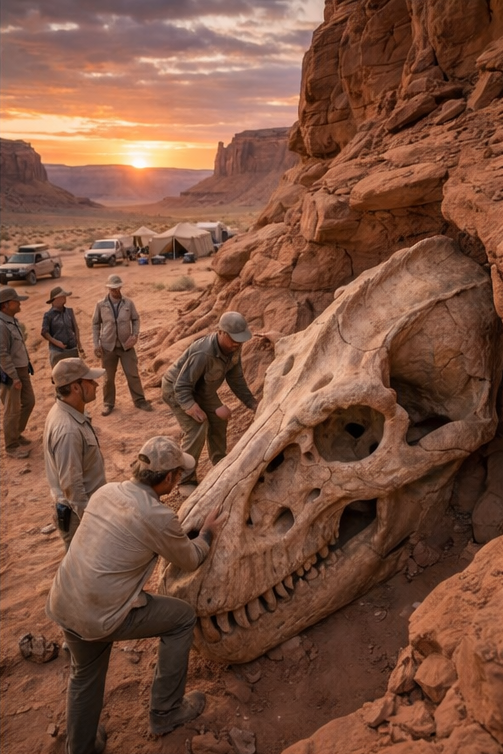
Emotionally, images like this are powerful because they suggest the possibility of hidden histories and forgotten giants. Archaeology does not dismiss such curiosity, but it demands evidence, transparency, and reproducibility. Extraordinary visuals alone cannot overturn established knowledge of human or animal evolution. Whether this image represents a natural rock formation, an artistic creation, or digital fabrication, it ultimately serves as a reminder of how easily perception can blur the line between science and imagination. True archaeological discoveries may be less spectacular at first glance, but their strength lies in verifiable data—allowing us to understand the past as it truly was, not as we wish it to be.
✓ Team
The image depicts a group of researchers standing before a mᴀssive skull-like formation embedded in a red sandstone canyon landscape, reminiscent of the arid regions of the…