THE GIANT SKULL OF THE DESERT: ARCHAEOLOGY AT THE EDGE OF MYTH
The image presents an extraordinary archaeological scene: a colossal skull partially unearthed from an arid desert landscape, tentatively dated—by stylistic and contextual interpretation—to a remote prehistoric era, possibly 12,000–20,000 years ago. The discovery is depicted as taking place in a vast desert basin, evocative of North Africa or the Middle East, regions long ᴀssociated with early human migration and lost civilizations. While no officially verified excavation has confirmed such a find, the scene reflects a growing genre of speculative archaeology that challenges conventional timelines and invites questions about humanity’s deep past.
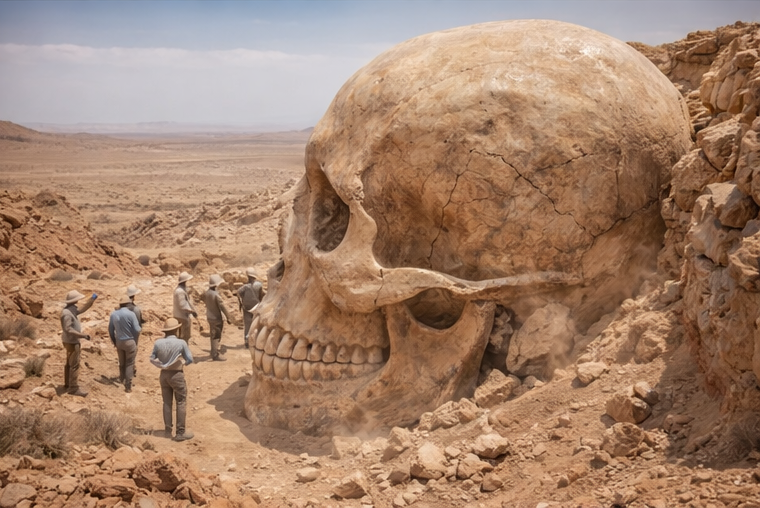
The skull appears carved or fossilized in sedimentary stone, resembling limestone or sandstone, materials commonly formed over immense geological timescales. Its proportions far exceed known human anatomy, with oversized eye sockets, mᴀssive jaw structure, and thick cranial walls. The surface shows signs of erosion—wind abrasion, micro-fractures, and sand polishing—suggesting prolonged exposure or burial within a harsh desert environment. Whether interpreted as a fossilized biological remain or a monumental stone sculpture, the craftsmanship or preservation implies advanced knowledge of form and durability.
From an archaeological perspective, the skull could represent a symbolic monument, possibly created to honor mythic ancestors, deities, or legendary giants described in ancient oral traditions. In many early cultures, oversized human forms symbolized power, protection, or cosmic authority. Alternatively, speculative interpretations propose it as a ritual marker or territorial warning—an object designed to inspire awe and fear. While mainstream science recognizes no giant hominid species of this scale, the image resonates with recurring myths found across civilizations.
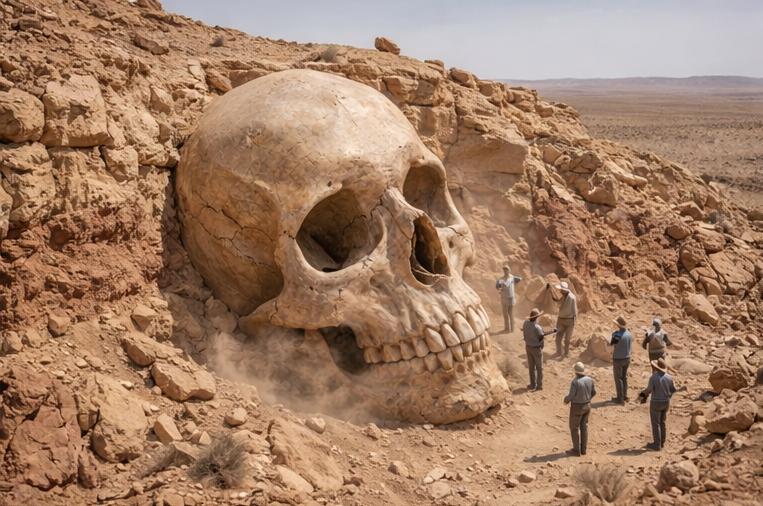
In the image, the excavation team appears composed of researchers and laborers using manual tools, suggesting an early-stage or exploratory dig. Such a discovery—if real—would likely involve international archaeological insтιтutions, geological surveys, and paleoanthropologists. Historically, many controversial finds were initially dismissed before further study reframed their significance. Here, the absence of identifiable organizations reinforces the idea that the scene functions as a conceptual or illustrative narrative rather than a documented excavation.
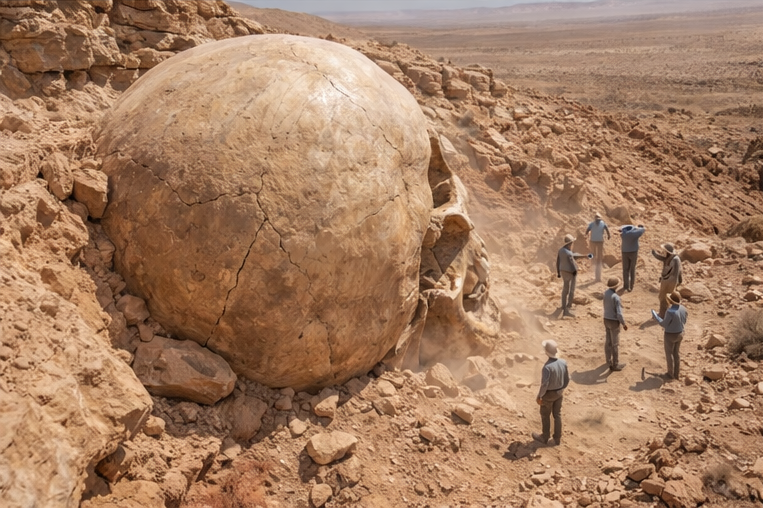
Ultimately, this giant skull stands at the crossroads of science, myth, and imagination. Whether interpreted as an impossible fossil, a forgotten monument, or an artistic provocation, it forces us to confront the limits of our historical knowledge. Archaeology is not only the study of objects, but of questions—about who we were, what we believed, and what stories we choose to remember. In the silent desert, the skull becomes a metaphor for humanity’s enduring curiosity and our desire to uncover truths buried beneath time.
✓ Team
The image presents an extraordinary archaeological scene: a colossal skull partially unearthed from an arid desert landscape, tentatively dated—by stylistic and contextual interpretation—to a remote prehistoric era,…