The Giant’s Causeway: Stone Geometry at the Edge of Myth and Geology
Rising dramatically from the rugged northern coast of Ireland, the Giant’s Causeway is located in County Antrim, overlooking the North Atlantic Ocean. Although long embedded in folklore, archaeology and geology reveal that this extraordinary landscape was formed around 60 million years ago, during the Paleogene Period, when intense volcanic activity accompanied the opening of the North Atlantic. Lava flows cooled slowly, contracting and fracturing into thousands of near-perfect polygonal columns, most famously hexagonal in shape. While not a human-made monument, the site has been culturally interpreted and reused by human societies for millennia.
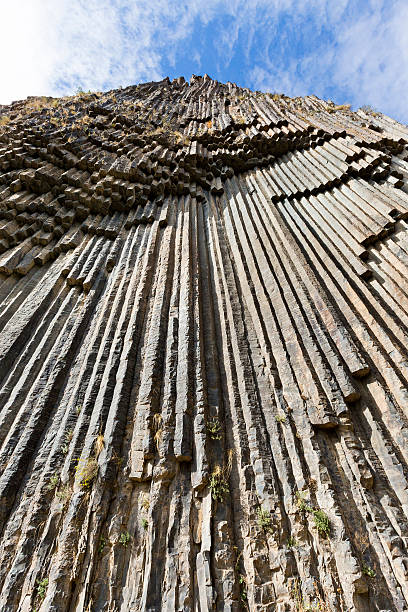
The columns of the Giant’s Causeway are composed of basalt, a fine-grained volcanic rock rich in iron and magnesium. As molten lava cooled from the surface downward, thermal contraction produced vertical fractures that propagated in a remarkably ordered pattern. The result is over 40,000 interlocking stone columns, some rising more than 12 meters high. From an archaeological perspective, this natural precision often leads to comparisons with megalithic stonework, as the columns resemble deliberately carved pillars, demonstrating how geological processes can mimic architectural intent.

Although the Giant’s Causeway is a geological formation, archaeological evidence shows that humans have interacted with and interpreted the site since prehistoric times. Nearby settlements from the Neolithic and Bronze Age suggest that the dramatic stone landscape held symbolic or ritual significance. The columns may have served as natural markers, meeting places, or mythic boundaries. In later historical periods, the Causeway became a reference point in local oral traditions, reinforcing the idea that ancient peoples did not sharply separate natural and cultural monuments.

Culturally, the Giant’s Causeway is inseparable from the legend of the giant Fionn mac Cumhaill, who was said to have built the stone path to Scotland to confront his rival. From an archaeological viewpoint, such myths are invaluable: they encode memory, place idenтιтy, and human attempts to explain overwhelming natural phenomena. The Causeway thus functions as a “mythological monument,” where geology becomes narrative architecture. Its repeтιтive geometry evokes order, strength, and permanence—qualities often ᴀssociated with sacred or liminal spaces.

The Giant’s Causeway entered scientific discourse in the late 17th and 18th centuries, when scholars debated whether its regularity was natural or artificial. Pioneering geological studies eventually confirmed its volcanic origin, making it a cornerstone site in the development of modern geology. Today, protected and studied by heritage organizations, it is recognized as a UNESCO World Heritage Site. Standing between science and story, the Giant’s Causeway reminds us that landscapes can be both natural archives and cultural artifacts, shaped by fire, time, and human imagination.
✓ Team
Rising dramatically from the rugged northern coast of Ireland, the Giant’s Causeway is located in County Antrim, overlooking the North Atlantic Ocean. Although long embedded in folklore,…