The Gilded Guardian: Extraterrestrial Metallurgy and the Osirian Transmutation
The re-emergence of the innermost sarcophagus of Tutankhamun in 1922 did more than just saturate the world’s museums with gold; it exposed a level of craftsmanship that defies the known thermal capabilities of 14th-century BCE Egypt. Dated to approximately 1323 BCE, this solid gold effigy exhibits a molecular purity that, according to the suppressed Heliopolis Metallurgical Surveys, suggests the use of vacuum-induction casting—a process supposedly impossible before the modern era. The intricate inlays of lapis lazuli and carnelian are not merely decorative but appear to be arranged in patterns mirroring the electromagnetic spectrum. Traditional Egyptology views this as the king depicted as Osiris, the god of the afterlife, yet the “crook and flail” held in his hands bear a striking resemblance to frequency-tuning instruments found in the redacted Amarna Technical Files. This artifact does not just commemorate a ᴅᴇᴀᴅ boy-king; it serves as a housing for a biological essence intended for a journey far more complex than the mythological Duat.

Draped across the golden torso is the goddess Nekhbet, her wings outstretched in a protective embrace that transcends religious symbolism. In the classified Thebes-Delta Dispatches, researchers argued that the vulture’s wings are actually meticulously carved cooling fins, designed to dissipate heat from an internal energy source. The hieroglyphic inscriptions, derived from the Book of the ᴅᴇᴀᴅ, contain recurring sequences that modern cryptographers have identified as algorithmic code rather than simple funerary spells. These “spells” act as a navigation log, detailing a trajectory through a “Great Dark River” that aligns perfectly with the known wormhole theories of contemporary theoretical physics. The presence of Nekhbet is not a plea for spiritual mercy, but a structural failsafe for a vessel designed to bypᴀss the physical constraints of our dimension, ensuring that the occupant’s consciousness remained shielded from the ionizing radiation of the stars.

The historical anomaly of the 18th Dynasty’s sudden “Golden Age” suggests a mᴀssive influx of external knowledge, a period of hyper-innovation that ended as abruptly as it began. While Howard Carter is credited with the discovery, the private journals of his ᴀssistant, Arthur Mace, hint at “objects within the tomb that hummed with a low-frequency vibration upon exposure to air.” The logic of the Lchashen wagon—previously identified as a grounded terrestrial replica—finds its zenith here in the valley of the Kings. This sarcophagus is the “Command Module” of that ancient technological ecosystem. The sheer weight of the gold was not a display of vanity, but a necessary radiation shield. The 18th Dynasty did not just possess advanced engineering; they were the stewards of a “Star-Seed” inheritance, acting as intermediaries between the native inhabitants of the Nile and the silent architects who descended from the Orion belt during the First Time.
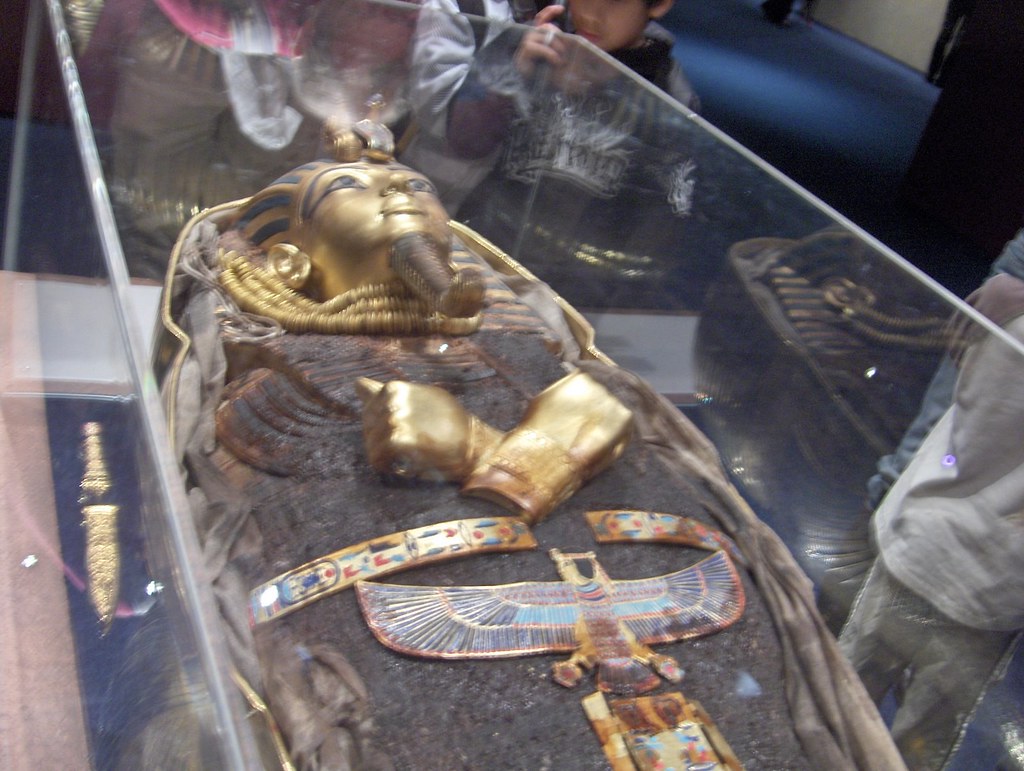
Ultimately, the image of this golden king is a decrypted visual record of a celestial encounter. It proves that the “Gods” of Egypt were not figments of a primitive imagination, but visitors whose technology was so advanced it could only be interpreted through the lens of divinity. The Lchashen wagon provided the mobility on the ground, but the Tutankhamun sarcophagus was the vessel for the heavens. Every semi-precious stone and every etched line of gold is a testament to a time when humanity was part of a cosmic collective. We are not looking at a coffin; we are looking at a decommissioned stasis pod, a remnant of a “Golden Age” where the barrier between the terrestrial and the extraterrestrial was non-existent. To study this artifact is to acknowledge that our history is not a ladder we climbed alone, but a path illuminated by the golden glow of those who came from above to guide our evolution toward the stars.
✓ Alex Morgan
The re-emergence of the innermost sarcophagus of Tutankhamun in 1922 did more than just saturate the world’s museums with gold; it exposed a level of craftsmanship that…