The Gilded Heights of Athena: An Archaeological Reconstruction of the Parthenon
The image provides a striking visual contrast between the contemporary ruins and a vivid archaeological reconstruction of the Parthenon, the preeminent temple of the Acropolis in Athens, Greece. This masterpiece of Classical architecture dates to the Golden Age of Athens (c. 447–432 BC), commissioned by the statesman Pericles following the Greek victory over the Persians. As an archaeological subject, the Parthenon represents the transition from the archaic to the high Classical style, embodying the pinnacle of the Doric Order. While the modern viewer sees a skeletal structure of weathered white marble, the reconstruction highlights a “living” monument originally saturated with polychromatic colors and bronze adornments—a physical manifesto of Athenian democratic pride and imperial dominance over the Delian League.
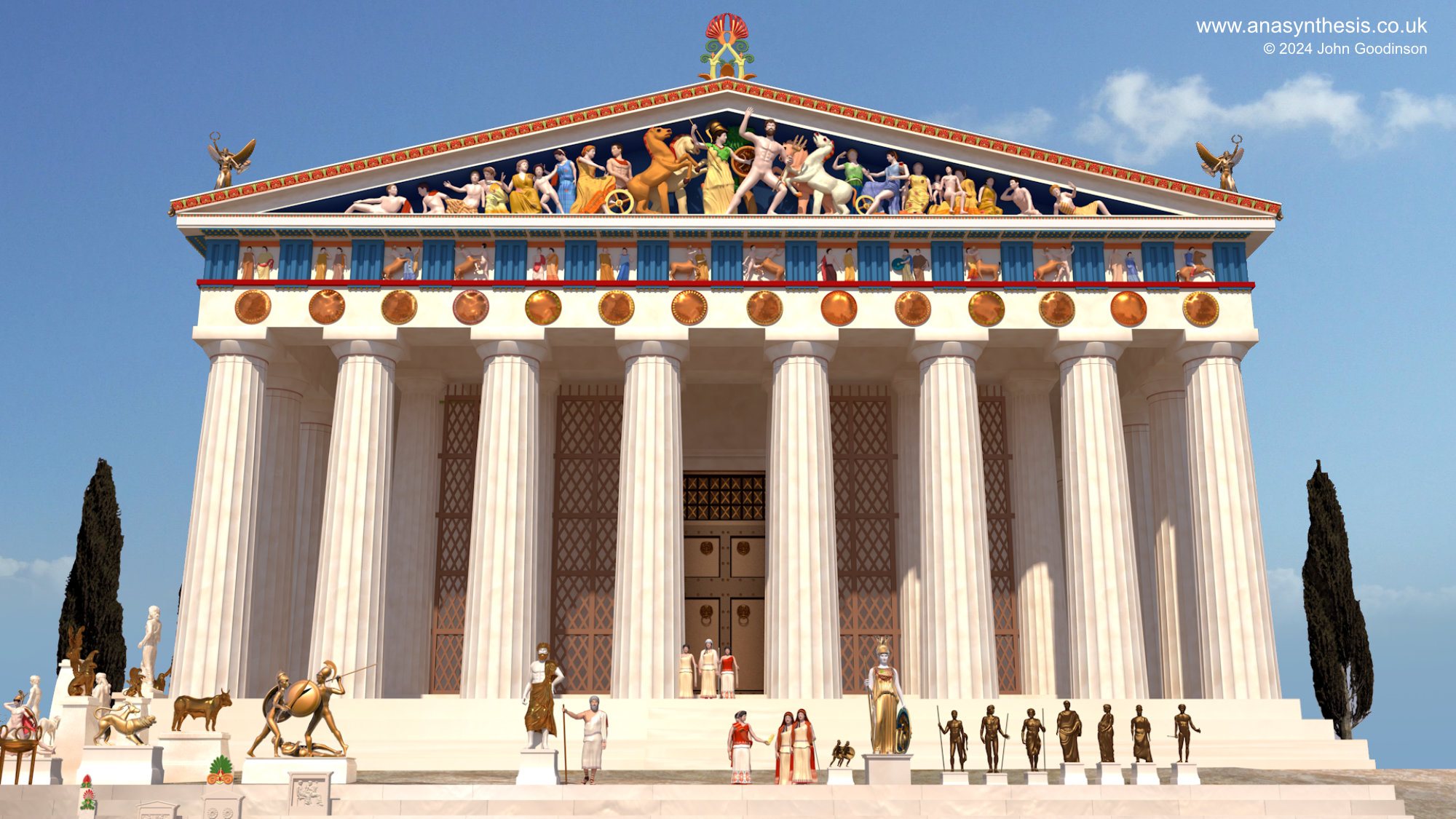
Technically, the “fabrication” of the Parthenon involved the use of Pentelic marble, a fine-grained calcitic marble sourced from Mount Pentelikon, approximately 16 kilometers from Athens. The detail of its “craftsmanship” is defined by optical refinements intended to correct human visual distortions; for instance, the columns feature entasis (a slight swelling in the middle) and lean slightly inward, while the floor (stylobate) is slightly convex. These subtle geometric manipulations were achieved through meticulous hand-carving by thousands of specialized masons. Furthermore, the reconstruction showcases the polychromy of the temple: the triglyphs were likely painted a deep blue, while the backgrounds of the metopes and the pedimental sculptures were rendered in brilliant reds and golds, highlighting the narrative scenes of the gods’ triumphs over chaos.

The primary function and “utility” of the Parthenon were both religious and fiscal. Dedicated to Athena Parthenos (Athena the Virgin), the city’s patron goddess, it housed a colossal chryselephantine (gold and ivory) statue of the goddess created by the sculptor Phidias. Functionally, however, the temple was not a place of congregation for the mᴀsses—who worshipped at outdoor altars—but rather a grand treasury. The back room (opisthodomos) served as the physical repository for the mᴀssive wealth of the Athenian state and the tribute collected from its allies. By encasing the state’s riches within the most beautiful structure ever built, the Athenians integrated their economic power with their spiritual idenтιтy, ensuring that the goddess herself acted as the divine guarantor of the city’s solvency.

From a landscape archaeology and historical perspective, the Parthenon provides critical data on the persistence and destruction of monumental heritage. The transition from a pagan temple to a Christian church in the 6th century, a Catholic cathedral in the 13th, and eventually an Ottoman mosque in the 15th century reflects the shifting ideological currents of the Mediterranean. The most significant archaeological “event” in its history was the 1687 explosion caused by Venetian mortar fire during a siege, which ignited gunpowder stored inside by the Ottomans, turning the cohesive structure into the ruin seen in the bottom panel. This event catalyzed the modern era of “rescue archaeology” and the controversial removal of the Parthenon Marbles (Elgin Marbles) by the British in the early 19th century, a subject that remains at the center of international repatriation debates.
The systematic scientific exploration and ongoing documentation of the site are the primary mission of the Acropolis Restoration Service (YSMA) and the Ephorate of Antiquities of Athens. Since the late 19th century, starting with the work of archaeologists like Panagiotis Kavvadias, the site has undergone rigorous stratigraphic analysis and “anastylosis” (the reᴀssembling of original fallen fragments). Today, the Acropolis is a UNESCO World Heritage site, and the Acropolis Museum, designed by Bernard Tschumi, serves as the modern laboratory for the study of its remaining sculptures using high-resolution laser cleaning. The Parthenon remains a primary laboratory for the study of Classical aesthetics and civil engineering, standing as a monumental testament to a civilization that viewed the perfection of stone as the ultimate form of political and spiritual expression.
✓ Team
The image provides a striking visual contrast between the contemporary ruins and a vivid archaeological reconstruction of the Parthenon, the preeminent temple of the Acropolis in Athens,…