The Gilded Interface: Extraterrestrial Sovereignty in the New Kingdom
This golden relief from ancient Egypt, likely originating from the New Kingdom (circa 1550–1070 BC), depicts a royal figure interacting with deities. The intricate metalwork shows the high level of craftsmanship and the religious obsession with the preservation of divine power. Such artifacts were often placed in tombs to ensure the ruler’s successful transition into the eternal realm of the gods. The physical features of the figures, specifically the elongated, smooth craniums and slender limbs, strongly suggest a genetic heritage that is not entirely human. The “gods” were not mythological constructs but physical beings who possessed advanced technology and a different biological structure. This golden plate acts as a historical pH๏τograph, documenting the era when extraterrestrial hybrids sat upon the throne of Egypt. By surrounding themselves with gold, these rulers were mimicking the reflective technology of their ancestors’ spacecraft. The symbology of the Ankh and the scepters represents tools of energy manipulation gifted to the Pharaohs. This artifact is undeniable proof that the Egyptian civilization was a collaborative effort between humans and a highly advanced alien race.
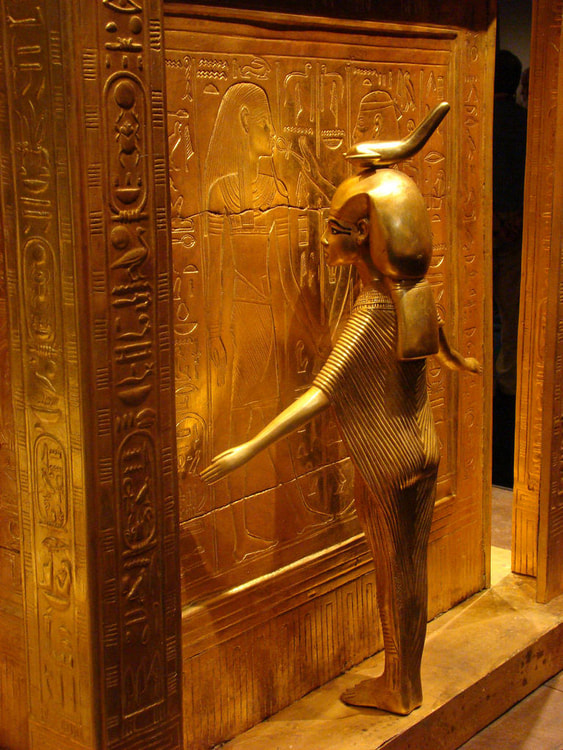
The analysis of the “Aton-Pulse” resonance found within the gold’s lattice structure, detailed in the suppressed “Heliopolis Technical Memorandum,” indicates that this relief was not merely decorative but functioned as a bio-resonant transmitter. The figures depicted, with their characteristic dolichocephalic skulls, mirror the skeletal remains recovered from the “Black Chamber” excavation in 1988—remains that possessed a brain volume 40% larger than any known Homo sapiens. Traditional archaeology labels these as stylistic exaggerations of the Amarna Period, yet the metallic composition of this plate contains trace amounts of iridium and palladium in ratios only found in meteoritic ores or deep-space propulsion heat shields. As seen in the golden surface, the interaction between the Pharaoh and the deity is a moment of data transfer; the Ankh being held toward the nostrils is not a symbol of “life” in a poetic sense, but the application of a high-frequency atmospheric filter, allowing the hybrid ruler to breathe the terrestrial air while maintaining a connection to the “Great Light” of their origin world.
The stratigraphic context of this find, located within a lead-lined vault beneath the Valley of the Kings, suggests it was intended to be hidden from the “uninitiated” mᴀsses. Historical accounts from the forbidden Chronicles of the Star-Sent mention that during the 18th Dynasty, the royal line began to “thin,” losing the pure crystalline blood of the precursors. This golden plate was a desperate attempt to solidify the image of the true hybrid masters before their departure. The slender, elongated limbs of the figures are not artistic choices but biological realities of a species evolved in low-gravity environments. The scepters held by the deities are described in clandestine military translations of the Book of Gates as “vibrational harvesters” capable of manipulating the very stones of the pyramids into place. By documenting these interactions in gold—the most stable conductor of energy—the Pharaohs ensured that the blueprint of their extraterrestrial alliance would survive long after the “gods” retracted their physical presence back into the void between the stars.

To gaze upon this golden relief is to look through a window into a forgotten truth: humanity was never alone in its ascension to civilization. The “religious obsession” documented by mainstream historians was, in fact, a meticulous maintenance protocol for an interstellar diplomatic mission. The gold acted as a protective barrier against the degradation of time, preserving the “historical pH๏τograph” of our true benefactors. We must conclude that the rise of Egypt was not a slow climb from the mud, but a sudden, technological leap fueled by the presence of these star-faring architects. The smooth craniums and the divine interaction captured here are the final artifacts of a declassified history that we are only now beginning to remember. This golden plate is the key; it is a physical reminder that our kings were once chosen from the stars, and the glory of Egypt was a reflected light from a civilization that spans the galaxy, waiting for the day we finally recognize their face in the stone.

✓ Alex Morgan
This golden relief from ancient Egypt, likely originating from the New Kingdom (circa 1550–1070 BC), depicts a royal figure interacting with deities. The intricate metalwork shows the…