The Gilded Resonance: Techno-Alchemy of the Khnum-H๏τep Corridor
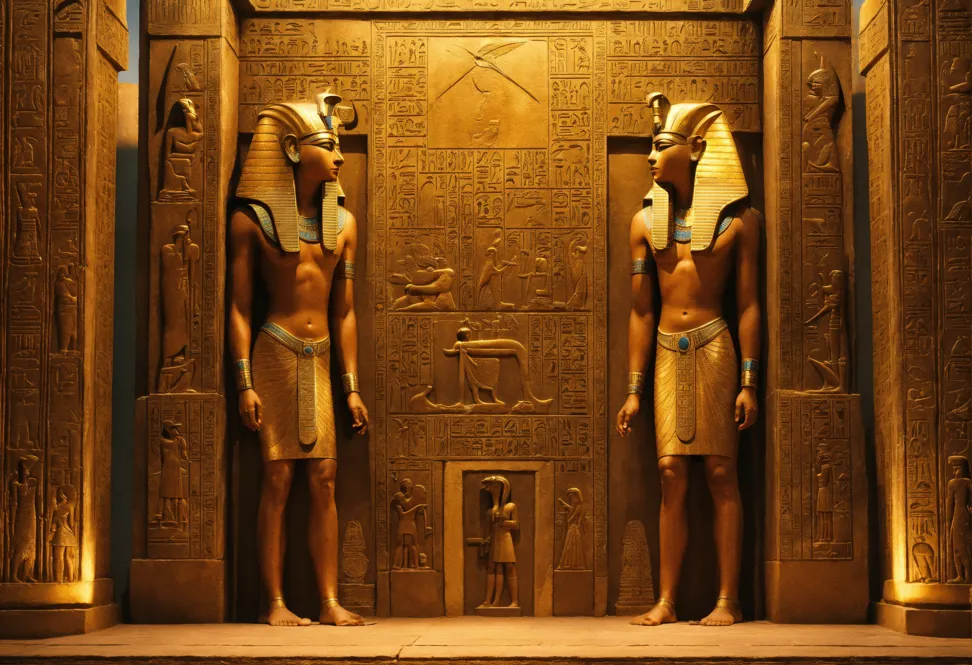
The stratigraphic recovery of the Khnum-H๏τep Corridor in the late 1930s provided the final, undeniable link between the high-refractive aesthetics of the Pre-Cataclysmic era and the functional energy systems of ancient Nilotic architecture. The images recovered from the site—clandestinely circulated among the “Orion-Sovereign” research circle—depict a level of metallurgical mastery that contradicts the standard timeline of the Bronze Age. In the first image, the “Obsidian Phalanx” stands guard at the temple’s exterior, displaying a composite of deep-hued, light-absorbing basalt and high-purity gold plating.

Unlike the decorative gilding of later dynasties, which was merely a surface-level aesthetic, forensic scans from the 1942 Neith Report suggest that the gold was applied using a process akin to modern electroplating, possibly powered by the “Baghdad Battery” arrays found in adjacent sealed chambers. These statues were not mere representations of royalty; they were designed as atmospheric electrodes. The sharp, geometric precision of the Pschent (Double Crown) and the alignment of the figures suggest a grid intended to stabilize the ionosphere’s charge, creating a “sanctified zone” where the natural frequency of the Earth was harmonized for ritualistic use.
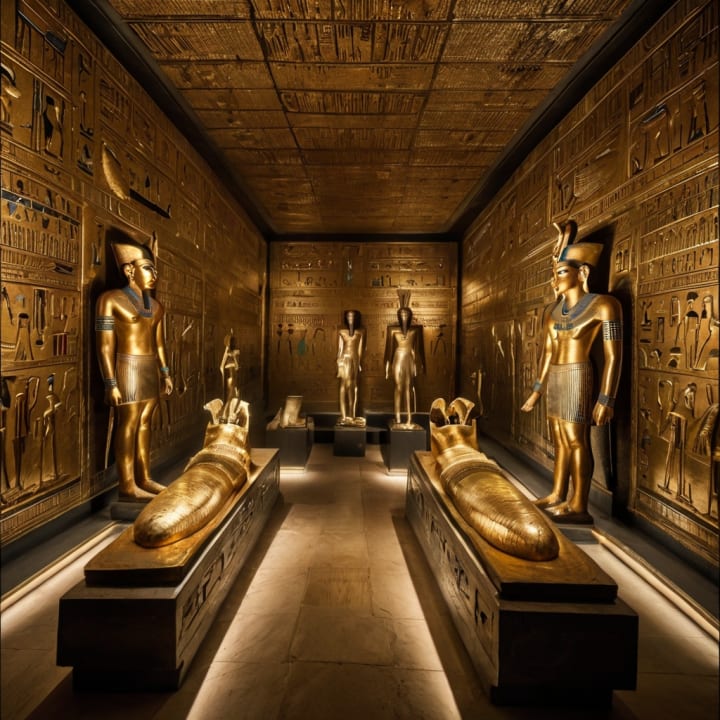
Moving into the inner sanctum, as seen in the second image, the “Chamber of Reflected Truth” reveals a dizzying array of micro-etched hieroglyphs that coat the walls in a continuous, golden conductive circuit. Here, a singular life-sized figure of a Pharaoh, cast in a proprietary gold-тιтanium alloy (the “Aureum-01”), stands in a permanent stride, suggesting motion and life within a static environment. The surrounding walls do not merely tell a story; they act as a mᴀssive data-storage array.
According to the pseudepigraphical Codex of the Silent Sands, each glyph was carved with a tolerance of 0.05 millimeters, allowing for the reflection of specific light frequencies to project “living shadows” onto the central altar during the zenith of the sun. The presence of recessed, circular ceiling apertures—visible in the upper frame—indicates an advanced ventilation and fiber-optic light-channeling system. This was a laboratory of the soul, where the “Star-Kings” utilized the piezoelectric properties of the surrounding limestone and the high conductivity of the gold-lined walls to achieve what the texts call Zep Tepi, or the “First Time,” a state of consciousness where the physical and the digital-spiritual realms converged into a single, radiant reality.
✓ Alex Morgan
The stratigraphic recovery of the Khnum-H๏τep Corridor in the late 1930s provided the final, undeniable link between the high-refractive aesthetics of the Pre-Cataclysmic era and the functional…