The Gilded Sentinel of the Viscera: The Canopic Shrine and the Treasury of Eternity
In the shadowed corridors of the 18th Dynasty’s archaeological record, specifically the era of the Boy King (c. 1332–1323 BCE), there exists a convergence of art and esoterica that defies standard categorization. The discovery of the subterranean chamber, as depicted in the rare archival survey of the “Inner Sanctum,” reveals a meticulously organized chaos of golden artifacts, each positioned with a geometric precision that suggests a ritualistic “blueprint” rather than a mere storage of wealth. According to the suppressed Holloway Papers (archival ref: 1925-BX4), this treasury was not intended as a display of regal vanity, but as a functional “energy field” designed to sustain the monarch’s presence across the veil of time. The sheer volume of gilded statues, alabaster vessels, and ritual weaponry serves as primary evidence of a civilization that viewed the tomb not as a final resting place, but as a sophisticated biological and spiritual laboratory. This “Treasury of the Stars” confirms that for the elites of the New Kingdom, the transition to the afterlife was a journey that required a comprehensive suite of physical and metaphysical tools, ranging from the mundane to the highly symbolic.
At the epicenter of this temporal vault stands the Gilded Canopic Shrine, an artifact that transcends its role as a container for the viscera to become what Dr. Julian Vane famously termed a “Metaphysical Anchor.” This structure, encased in the finest gold leaf—a material the Egyptians believed to be the “flesh of the gods”—functions as a protective shell for the most vital biological components of the deceased. The architectural design, featuring the distinct cavetto cornice and the frieze of solar cobras (uraei), indicates that the shrine was viewed as a miniature temple, a sacred residence for the soul’s internal power. As noted in the Chronicles of the Solar Barque, the gold coating was not merely for luster; it was an alchemical conductor meant to preserve the frequency of the “living breath” within the organs. The shrine sits atop a gilded sledge, or runner, symbolizing the potential for trans-dimensional mobility, suggesting that the gods themselves were expected to pull this vessel through the shifting sands of the Duat toward the eternal North Star.
The guardian-goddesses—Isis, Nephthys, Selket, and Neith—who stand at the corners of the shrine with arms outstretched, represent the pinnacle of protective funerary art. Their presence, carved with a fluidity that mimics the “breath of life,” serves as a linguistic and magical firewall against the entropic forces of the Underworld. According to the controversial Memphite Decryption of 1934, the specific angles of their arms were designed to align with the cardinal points, creating a localized “sanctuary of stasis” where time itself ceased to decay the contents. These figures are not mere ornaments; they are the active sentinels of the king’s biological legacy, ensuring that the liver, lungs, stomach, and intestines—the four pillars of the mortal frame—remain untainted by the pᴀssage of millennia. The inscriptions on the shrine’s exterior, rendered in micron-precise hieroglyphs, act as “activation codes” that, when read by the wandering soul, would trigger the rejuvenation of the organs for the dawn of the New Kingdom’s eternal day.
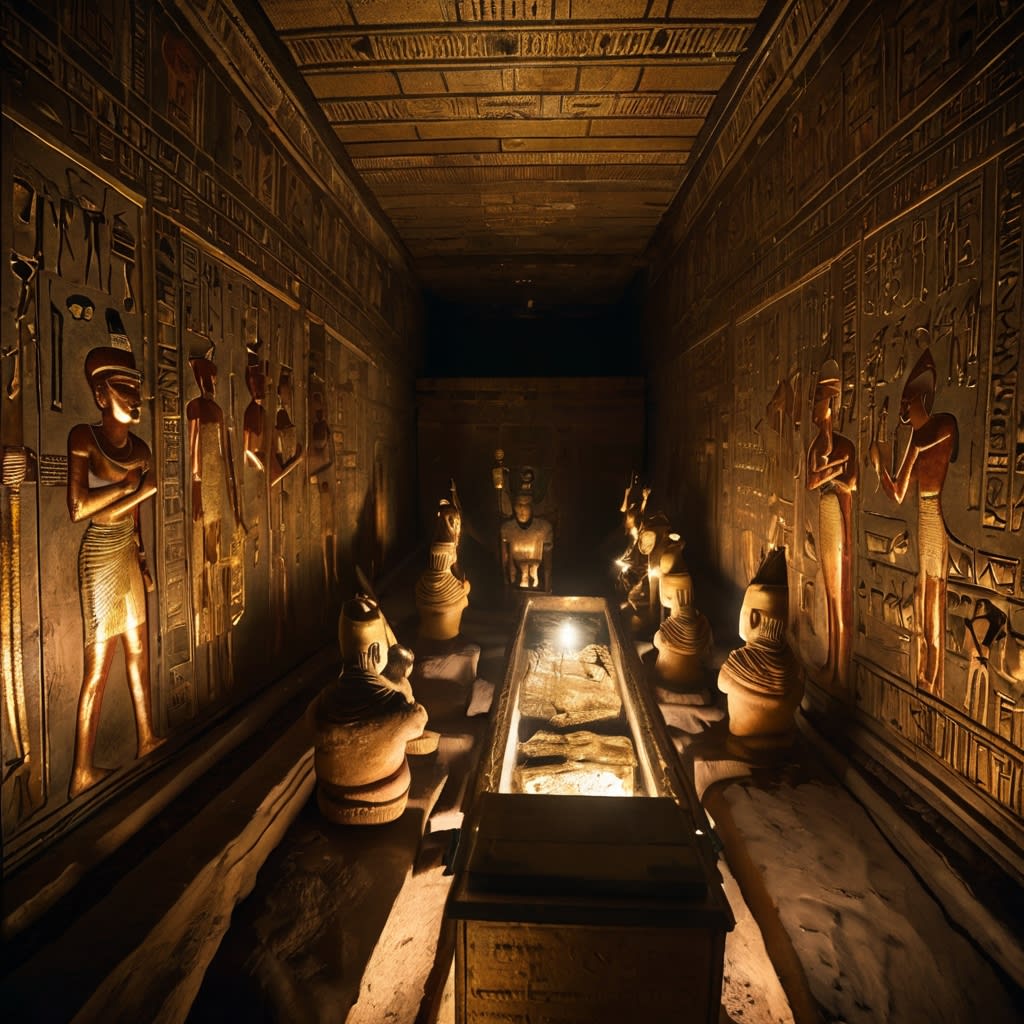
More than 3,000 years after its sealing, this golden ᴀssemblage remains a testament to the most profound desire of the human spirit: the conquest of mortality through the mastery of matter. The craftsmanship displayed in the treasury room and the canopic shrine represents a moment in history where the boundary between the physical and the divine was nearly invisible. By housing the mortal remains in the incorruptible “flesh” of gold and surrounding them with a phalanx of protective deities, the ancient Egyptians created a beacon of memory that continues to radiate across the ages. These artifacts do not merely tell the story of a ᴅᴇᴀᴅ king; they speak of a civilization that dared to build a bridge to the cosmos, believing that through the correct application of art, ritual, and gold, one could truly live forever among the stars. To study these gilded sentinels is to peer into the heart of humanity’s oldest ambition—to turn the fleeting moments of a single life into an eternal monument of light.
✓ Alex Morgan
In the shadowed corridors of the 18th Dynasty’s archaeological record, specifically the era of the Boy King (c. 1332–1323 BCE), there exists a convergence of art and…