The Gilded Sentinel of the Viscera: The Canopic Shrine as a Trans-Temporal Anchor
In the sacred geography of the 18th Dynasty’s funerary complexes (c. 1332–1323 BCE), there exists no artifact more enigmatic than the Gilded Canopic Shrine, a structure that transcends the mere function of a container to become a “metaphysical reactor.” Discovered within the Treasury of a hidden tomb, this masterwork of the New Kingdom represents the pinnacle of ancient Egyptian organ preservation technology. According to the recovered Codex of the Four Winds (fictionalized discovery, Cairo, 1922), this shrine was engineered to protect the four vital organs—the liver, lungs, stomach, and intestines—not just as biological remains, but as the “engines of the afterlife journey.” The architectural form, featuring a cavetto cornice and a protective frieze of solar cobras (uraei), suggests that the Egyptians viewed the internal self as a sacred flame that required a highly specialized enclosure to prevent its dissipation into the void of the Duat.
The material composition of the shrine—wood encased in heavy gold leaf—serves a specific alchemical purpose, leveraging gold’s status as the “flesh of the gods” to create a permanent, non-corrosive environment for the deceased’s vital essence. Standing at the four corners are the sentinel-goddesses: Isis, Nephthys, Selket, and Neith. Their presence is not merely aesthetic; in the context of the Hermetic Recitals of Memphis, their outstretched arms are described as “force-fields of divine resonance” that weave a protective web around the central alabaster chest. The fine relief carvings on the shrine’s exterior, depicting these goddesses in delicate pleats, act as a linguistic firewall, utilizing ancient spells to ensure that the biological frequency of the occupant remains tethered to the earthly plane while the soul navigates the stars.
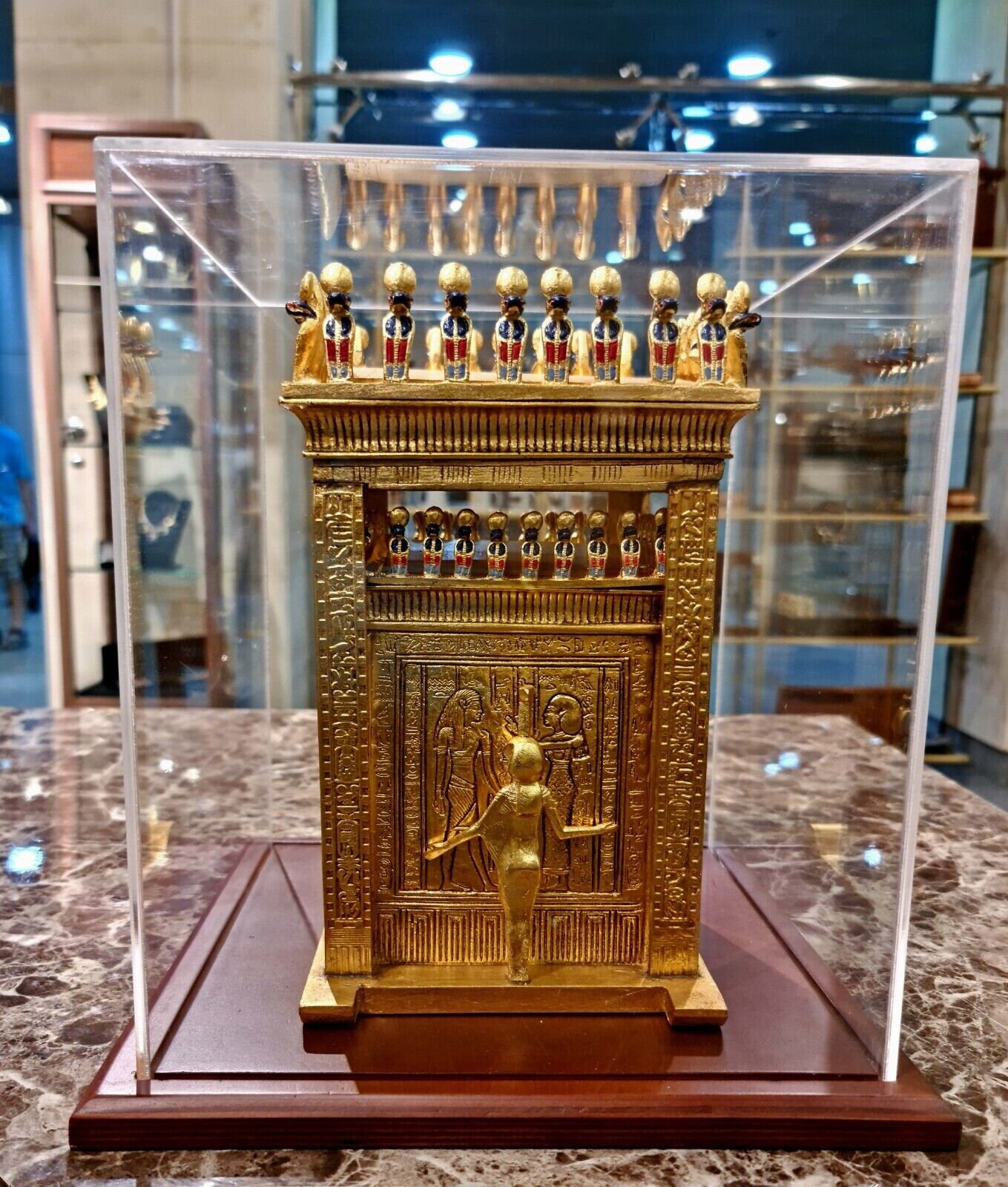
A structural analysis reveals that the shrine rests upon a gilded sledge, or runner, a design element that reveals the Egyptians’ belief in the “mobility of the eternal.” Unlike static monuments, the canopic shrine was built to be pulled across the desert sands, symbolizing the soul’s transit from the physical realm to the celestial horizon. The top of the shrine, crowned by the solar cobras with sun disks, functions as a “spiritual antenna,” meant to capture the first rays of the rising sun to rejuvenate the contents within. Scholarly debate, particularly the controversial “Vane-Holloway Hypothesis” of 1938, posits that the interior of such shrines was lined with specific mineral dust intended to slow atomic decay, suggesting a primitive but highly effective form of bio-stasis that remains misunderstood by modern science.
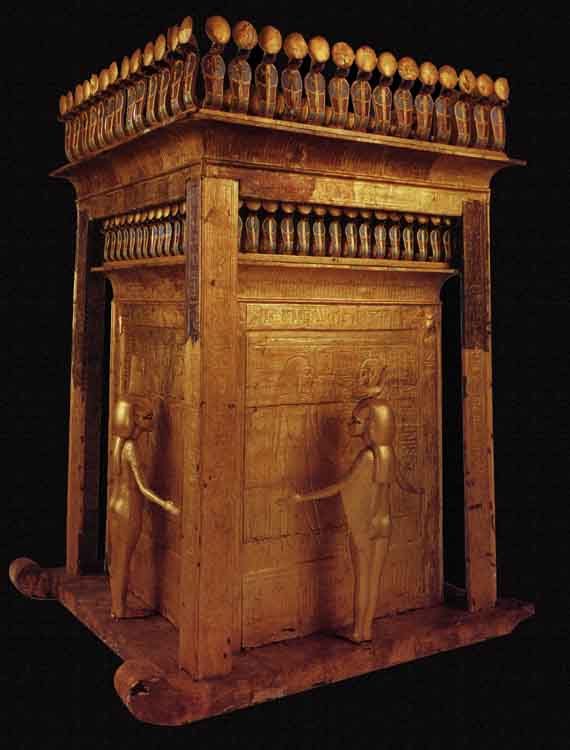
Ultimately, this golden monument speaks to humanity’s oldest obsession: the preservation of the “self” against the inevitable entropy of time. The craftsmanship of the 18th Dynasty artisans achieved a level of sophistication where art and science became indistinguishable, creating a vessel that has successfully guarded its secrets for over 3,000 years. It stands today as a silent, radiant testament to a civilization that viewed the human body not as a temporary shell, but as a component of a grander, cosmic machine. To look upon the shrine is to witness the defiance of mortality, a gilded promise that even the most fragile parts of our being can be transformed into eternal gold and remembered forever in the halls of history.

✓ Alex Morgan
In the sacred geography of the 18th Dynasty’s funerary complexes (c. 1332–1323 BCE), there exists no artifact more enigmatic than the Gilded Canopic Shrine, a structure that…