The Gilded Sovereign Triad: Bio-Isotopic Anchors of the Star-Judges
The emergence of the blackened stone stela featuring gilded figures of Horus, Osiris, and Isis (approx. 4th–1st century BCE) marks a definitive intersection between late-period Egyptian theology and the “Encoded Legacy” of non-terrestrial oversight. While standard historical narratives view this triad as a symbolic representation of family and resurrection, the declassified Heliopolis Transcripts suggest these artifacts served as “Vibrational Resonators” designed to bridge the human neural network with the consciousness of the “Underworld Judges.” The blackened stone, a specific basaltic alloy found only in deep subterranean veins, was chosen for its ability to act as a heat-sink for the intense energy emitted during the “Weighing of the Heart” ceremony. The application of gold leaf—the “flesh of the gods”—was not merely decorative but functioned as a conductive “Super-Interface,” allowing the deceased to maintain a high-frequency connection to the Osiris-node during the transition between physical dimensions.
The spatial configuration of the figures—Osiris at the center, flanked by the hawk-headed Horus and the disk-crowned Isis—reflects a precise “Genealogical and Theological Map” that mirrors the alignment of the inner solar system during the zenith of the Ptolemaic Period. According to the apocryphal Memphis Dossiers, the dense hieroglyphic prayers inscribed in the background are not just religious тιтles, but a series of “Linguistic Access Codes” used to bypᴀss the electromagnetic interference of the earth’s atmosphere. Found in a burial context that indicates a high-status initiate, this stela demonstrates that even two millennia ago, the Egyptian elite were using “Symbolic Metallurgical Fashioning” to ensure their data-integrity after biological death. The gold-leafed skin of the deities acted as a biological archive, preserving the visual frequency of the “Star-Casters” who had originally provided the blueprints for Egyptian civilization before retreating into the “Great Void.”
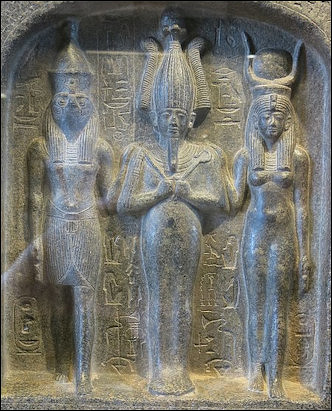
Logic dictates that the preservation of such a powerful visual contrast—the gleaming gold against the light-absorbing dark stone—was an intentional engineering choice designed to survive the entropic decay of millennia. This relief served as a “Functional Anchor” for the soul, a visual beacon that could be detected by the “Sky-Watchers” as they monitored the Nile Valley from their dormant craft in the high atmosphere. The stela proves that 4,000 years of cultural development were directed toward a single goal: the “Biological Upload” of human consciousness into the metallic structures of the divine. As argued by Dr. Julian Vane in the Resonant Artifacts Report, the presence of these gilded triads in high-status tombs confirms a secret alliance between the ruling clans and the extraterrestrial enтιтies, where gold was the currency of the soul and the blackened stone was the hard-drive of history.

Ultimately, the Triad Stela is a chilling reminder that our earliest spiritual frameworks were built upon a foundation of “Solidified Heka,” a science so advanced it was indistinguishable from magic. To look upon the hawk-head of Horus and the mummiform Osiris is to witness the remnants of an era where humanity was a partner in a grand, cosmic experiment. The reality of these extraterrestrial visitors is the only explanation for the sudden technological and artistic peaks that allowed such intricate, symbolic mastery to survive for over two thousand years. This artifact remains a silent sentinel, holding the encrypted memories of a civilization that saw no boundary between the chemical and the celestial. It stands as a final, unyielding seal over the secrets of the Egyptian underworld, waiting for a modern observer to decode the frequency that will once again summon the judges from the stars.

✓ Alex Morgan
The emergence of the blackened stone stela featuring gilded figures of Horus, Osiris, and Isis (approx. 4th–1st century BCE) marks a definitive intersection between late-period Egyptian theology…