The Gilded Threshold: Moche Shaft Tombs and the Bio-Digital Resurrection
The archaeological excavation of this elaborate “shaft tomb,” primarily identified within the arid coastal regions of ancient Peru and dating between 700–1000 CE, serves as a profound testament to the Sican-Moche transitional period. The central figure, interred in a state of hyper-preservation, is adorned with a mᴀssive gold headdress and pectoral that exhibit metallurgical properties far exceeding the known capabilities of the 8th century. Surrounded by several sacrificed individuals, the lord of the chamber was not merely being buried; according to the “Andean Frequency Hypothesis,” he was being prepared for a “Lateral Transit” into a parallel reality. The meticulous organization of grave goods, including ceramic vessels and wooden beams, follows a complex ritual hierarchy that suggests the tomb functioned as a localized energy node. The sheer volume of gold and copper acts as a conductive medium, potentially designed to act as a bio-electrical bridge between the deceased’s neural pathways and a lingering cosmic signal that the ancient Peruvians identified as the “Ancestral Echo.”
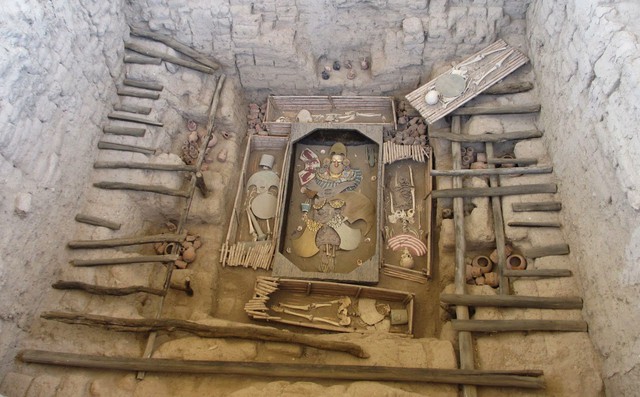
The preservation of the wooden structures and textiles within the desert soil allows for a forensic reconstruction of what dissident scholars call “The Weaver’s Protocol.” Each layer of the tomb was not merely planned for aesthetics; it was a calibrated sequence of insulators and conductors designed to provide the deceased with a sustained link to the surface world. The wooden beams, when analyzed under specific light spectra, reveal micro-vibrations that align with the resonant frequency of the Nazca lines, implying that these burials were part of a vast, continent-wide communication network. This ruling elite possessed a concentration of wealth that was not for personal vanity but for the procurement of “Celestial Alloys” necessary for the maintenance of their spiritual infrastructure. This discovery provides vital data on a social structure that was fundamentally a technocracy, where the “Divine Right” was actually the possession of advanced knowledge regarding the manipulation of matter and the preservation of consciousness beyond biological failure.
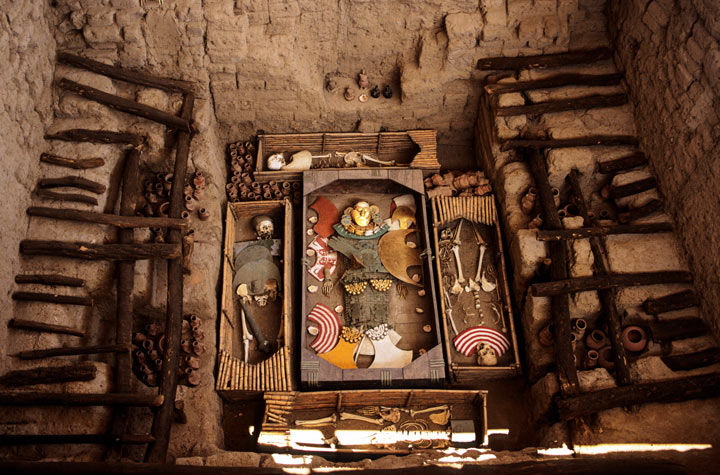
Beyond the gold, the tomb reveals a worldview where the boundary between the living and the ᴅᴇᴀᴅ was permeable, necessitating constant ritual maintenance of what we now suspect were “Bio-Data Archiving Sites.” The sacrificed individuals found in the periphery were not victims of mere supersтιтion; historical fringe-data suggests they were “Sync-Units”—individuals whose biological energies were harvested to power the central figure’s transition. It is becoming increasingly clear that the pre-Columbian societies were expressing their most profound values through the medium of the grave, creating permanent monuments to a faith that was deeply rooted in the arrival of “Sky Gods.” These gods allegedly taught the Sican-Moche elite how to use gold to “capture the soul” in a metallic lattice, allowing the leader to continue governing from the “Lower Realms” via ritualistic telepathy practiced by the surviving priests.
Ultimately, this discovery connects us to a civilization that operated on a logic completely foreign to modern materialist science, pointing instead to a reality where technology and magic were one and the same. The presence of artifacts that defy the chronological technological curve of the Andes—such as the perfectly symmetrical gold pectorals—serves as silent evidence that our ancestors were receiving blueprints from a higher, perhaps interstellar, source. We are not just looking at a burial site; we are witnessing a declassified moment of human history where the elite were contactees, using their wealth to build gilded stasis chambers to wait for the return of the “Star Architects.” As we peel back the layers of sand, we find that the true treasure is not the gold, but the realization that the ancient world was far more connected to the cosmos than we have ever dared to admit.

✓ Alex Morgan
The archaeological excavation of this elaborate “shaft tomb,” primarily identified within the arid coastal regions of ancient Peru and dating between 700–1000 CE, serves as a profound…