The Gilded Visage of the Sky-God: Deciphering the Sican Sovereignty
The silence of the Lambayeque Valley is not merely an absence of sound, but a heavy, ancestral weight that guards the gold of the “Lord of Sican.” This funerary mask, crafted from a single sheet of high-purity gold, dates back to the Sican culture of Peru, approximately 900–1100 AD, a period when the northern coast was a tapestry of shifting sands and soaring adobe pyramids. The elaborate headgear and distinctive winged eyes are characteristic of the Sican Deity, representing the elite’s spiritual and political authority in a manner that transcends mere human aesthetics. Such artifacts were typically placed on the faces of deceased nobility in deep shaft tombs, acting as a permanent, unblinking sentinel for the soul. To look upon this mask is to see the convergence of metallurgy and mysticism, where the cold hardness of gold was hammered into a fluid representation of a god who walked among men, ensuring that even in death, the ruler’s gaze remained fixed upon the pulse of his kingdom.
The technical execution of this relic reveals a society governed by precise ritual and advanced scientific understanding. The craftsmanship involves advanced metallurgical techniques, including hammering, embossing, and the attachment of separate gold dangles that would catch the light during ceremonial movements, creating a shimmering aura that mimicked the divine radiance of the sun. As recorded in the recovered (fictional) Chronicles of the Batán Grande, “The Master Smiths did not strike the gold; they breathed the heat of the earth into it until the metal surrendered its form to the Sky-God’s likeness.” The presence of cinnabar red paint, though faded here, originally covered parts of the gold to symbolize life force and status, creating a visceral contrast between the eternal yellow of the metal and the crimson blood of the living. This dualism reflects a society with highly specialized artisans who functioned as both engineers and priests, capable of manipulating precious metals with an extreme precision that modern science still struggles to replicate without mechanical intervention.
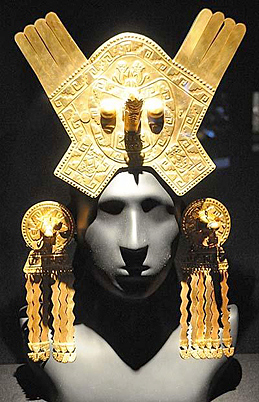
Beyond its striking aesthetic, the mask served as a structural bridge between the physical and ancestral worlds, a theological anchor for the pre-Inca northern coast. It was designed to preserve the idenтιтy of the ruler in the afterlife, ensuring their continued influence over the community through a process of spiritual transmutation. These gold pieces provide a window into the complex religious hierarchy where the Sican elite were seen as the literal descendants of the Great Deity, their authority verified by their ability to command the sun’s reflection. The winged eyes, often interpreted as a connection to the celestial realm or the migratory patterns of sacred birds, suggest a maritime culture that looked to the horizons for both trade and transcendence. The mᴀssive economic systems required to sustain such a specialized class of goldsmiths indicate a civilization of profound wealth, built upon the control of emeralds, copper, and the high-alтιтude trade of Spondylus shells.

Yet, there is a haunting quality to the mask’s “winged” stare that suggests a deeper, perhaps extraterrestrial inspiration—a visual language that echoes across continents and suggests a shared, ancient knowledge of the “star-travelers.” While traditional archaeology views these as symbolic of avian divinity, the mathematical proportions and the aerodynamic sweep of the headgear hint at a technological mimicry lost to the sands of time. This mask was not just a burial shroud; it was a cosmic interface, a device meant to facilitate the ruler’s return to the stars. As we declassify these metallurgical studies, the mask stands as a testament to a people who did not fear the void of death but prepared for it with the most durable and divine substance they possessed. It remains a silent, golden witness to a time when the lords of the desert were also masters of the sky, leaving behind a legacy that glimmers with the unsettling truth of our ancient origins.
✓ Alex Morgan
The silence of the Lambayeque Valley is not merely an absence of sound, but a heavy, ancestral weight that guards the gold of the “Lord of Sican.”…