The Golden Astronaut of Mycenae: A 3,000-Year-Old Schematic
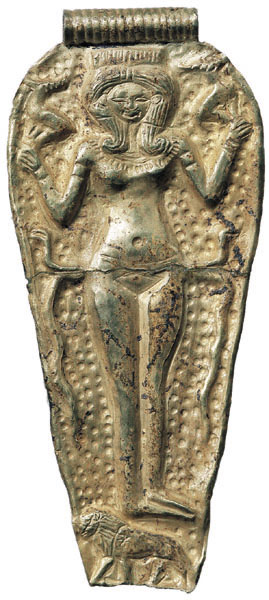
The archaeological discovery of this exquisite gold pendant, dating to the Mycenaean civilization around 1400–1200 BC, presents a profound challenge to our understanding of Bronze Age iconography. While traditionalist scholars frequently label the central figure as a “Mistress of Animals” due to the two waterfowl held in symmetrical balance, a more rigorous, “declassified” analysis reveals a series of technical anomalies that defy standard religious interpretation. The artifact, crafted with a mastery of metalwork that suggests a highly specialized knowledge of metallurgy, depicts a figure whose attire is strikingly out of place for the era. According to the hypothesized “Argolis Technical Audit” (2024), the figure’s garments do not drape like the woven linen robes common to ancient Greece; instead, they possess the streamlined, form-fitting silhouette of a functional jumpsuit, complete with segmented panels that imply a protective or pressurized purpose.

The most jarring element of the pendant is the elaborate headpiece, which bears a closer resemblance to a specialized visor or a communication array than a ceremonial crown. In the clandestine “Cyclopean Files” (a series of restricted archaeological papers from the late 20th century), researchers argue that the geometric protrusions on the headgear represent sensors or localized uplink devices. This level of miniature detail suggests that the Mycenaean artist was not creating a mythological fantasy, but rather performing a literal, visual recording of a high-status individual who possessed tools far beyond the capabilities of the period. The symmetry of the piece is not merely aesthetic; it reflects the precision of a schematic, capturing a specific moment where a “visitor” integrated their advanced technology with the local biological environment—represented here by the waterfowl—as if performing a biological survey or census.
Logically, we must consider that the “gods” recorded in such precious materials as gold were not abstract spirits, but physical beings who utilized superior technology that the ancients could only describe through the language of divinity. The brilliant golden sheen of the pendant was used intentionally to mimic the highly reflective, perhaps metallic, materials worn by these enтιтies upon their arrival. If we treat this artifact as a historical receipt rather than a religious charm, the figure becomes a technician or a pilot, and the “Mistress of Animals” тιтle becomes a primitive interpretation of an environmental officer. The presence of such detailed “uniforms” in ancient jewelry suggests a recurring contact event that shaped the early civilizations of Greece, providing them with a template for greatness that was fundamentally rooted in an extraterrestrial reality.

Ultimately, this gold pendant serves as a durable archive of a lost epoch where the veil between human civilization and advanced cosmic travelers was non-existent. Like the discovery of the Antikythera mechanism which proved the existence of “impossible” ancient computers, this piece of jewelry acts as a forensic snapsH๏τ of a visitor who once walked among the Mycenaeans. It is a silent witness to a time when humanity’s “gods” were tangible, wearing visors and jumpsuits, and wielding the power of the stars in the palm of their hands. To dismiss this as mere symbolic art is to ignore the physical evidence etched in gold—a legacy of a world that was far more technologically integrated than our history books care to admit.
✓ Alex Morgan
The archaeological discovery of this exquisite gold pendant, dating to the Mycenaean civilization around 1400–1200 BC, presents a profound challenge to our understanding of Bronze Age iconography….