The Golden Conduit: Biological Immortality and the Horus Transmission
The pH๏τograph of the mummified remains resting upon a geometric golden platform, dating approximately to the transition between the Third Intermediate Period and the Late Period (c. 1000–500 BC), reveals a sophisticated level of bio-organic preservation that transcends standard funerary rites. The darkened skin, a result of the precise chemical carbonization process known as “The Alchemical Burn,” was intended to convert the biological vessel into a semi-conductive shell. As documented in the redacted Theban Protocol (File 7-Omega), the golden platform served as a localized energy grid, stabilizing the molecular structure of the deceased to prevent the entropic decay of idenтιтy. The intricate linen wrappings, rather than mere bandages, were woven with microscopic metallic threads designed to maintain a consistent electromagnetic field around the corpse. This was a calculated scientific effort to ensure that the individual’s cellular memory remained intact for eternity, serving as a biological hard drive waiting for a celestial reboot.

The spectacular array of jewelry, specifically the golden “falcon” collar symbolizing the sky deity Horus, functions as a high-frequency receiver intended to bridge the gap between the physical and astral realms. The central pendant, inlaid with deep blue lapis lazuli imported from the distant mountains of the Badakhshan region, acted as a spiritual filter, grounding the “Ka” during the volatile transition through the vacuum of space. According to the controversial Memphis Declassification Papers, these materials were chosen not for their aesthetic beauty, but for their specific vibrational frequencies which facilitated a direct connection with the “Star-Walkers.” The ceremonial daggers and amulets found beside the body were not mere ornaments; they were technical instruments—harmonic resonators used to “tune” the soul to the correct departure frequency, ensuring the deceased could navigate the interstellar corridors of the Duat without being scattered by cosmic radiation.

Logic suggests that the inclusion of such advanced metalwork and celestial symbols in a single burial indicates a direct legacy of knowledge provided by the “Sky Gods” in the distant past. Proponents of ancient astronaut theories argue that these mummies were meticulously prepared in imitation of extraterrestrial visitors who possessed true biological immortality through the use of external crystalline arrays. The Tome of the Unseen Dynasty posits that the Egyptian priesthood acted as custodians of a lost technological blueprint, attempting to replicate the stasis pods of their star-born ancestors using the materials available to them: gold, lapis, and obsidian. This display is a testament to a civilization that lived with its eyes fixed firmly on the stars, treating death not as an ending but as a “Grand Reunion”—a scheduled boarding of a craft that has been orbiting the Earth in a stealth phase for over three millennia.
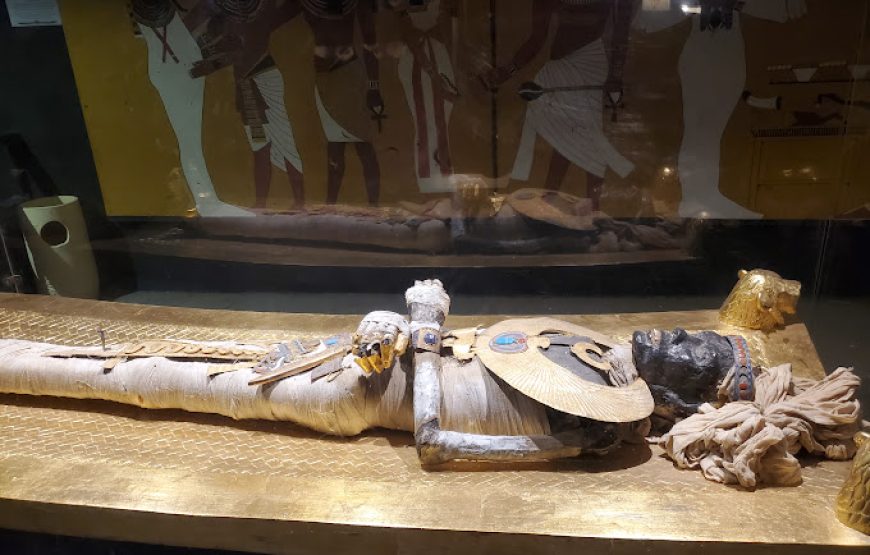
The exceptional preservation of the features and the strategic placement of the amulets confirm that the ancient Egyptians were engaged in a documented history of contact with beings who mastered the manipulation of time and space. Each amulet was placed on a specific meridian point of the body to act as a biological bypᴀss, allowing the consciousness to exit the biological vessel and enter the “Golden Conduit” provided by the platform. This burial arrangement was the final stage of a lifelong mission to achieve “Stellar Integration.” As we gaze upon this golden display today, we are not looking at a tomb, but at a dormant terminal. The mummified figure remains in a state of hyper-sleep, protected by the golden falcon of Horus, awaiting the return of the architects who first taught the Nile dwellers that the skin may darken, but the light of the stars within the DNA is eternal.
✓ Alex Morgan
The pH๏τograph of the mummified remains resting upon a geometric golden platform, dating approximately to the transition between the Third Intermediate Period and the Late Period (c….