The Golden Vessel of Stasis: Decrypting the Ptolemaic Biomorphic Interface
The emergence of the gilded anthropoid coffin, dated to the transitional epoch between 300 BCE and 100 CE, represents the final, sophisticated evolution of what the clandestine Alexandrian Archive refers to as “The Flesh of the Gods Protocol.” While traditional historians view the gold-leaf exterior as a mere display of wealth, a forensic examination of the metallic isotopes suggests a non-terrestrial origin, engineered to create a conductive Faraday cage around the biological occupant. The idealized features and the hauntingly large, dark eyes are not merely stylistic choices of the Hellenistic-Roman blend; they are visual sensors designed to “see” beyond the visible spectrum. According to the redacted Vatican-Sinaiticus Papers, these coffins were essentially biomorphic interfaces—stasis pods meant to preserve the neural signatures of the elite for a future “re-awakening” by the Silent Architects who had overseen the Nile’s progress since the First Time.

The chest of this golden vessel is dominated by the protective embrace of a winged deity, identified by scholars as either Nut or Isis, yet the geometry of the feathers suggests an aerodynamic purpose far more complex than simple myth. In the classified Leiden Subterranean Journals, it is argued that the outstretched wings represent a sophisticated atmospheric navigation system, intended to shield the internal “mummy” from the shearing forces of the Duat—a realm now theorized by fringe physicists to be a localized wormhole. The intricate hieroglyphics running down the chᴀssis are not mere prayers from the Book of the ᴅᴇᴀᴅ, but a dense stream of algorithmic data. These “spells” act as a navigational key, providing the occupant with the specific frequency coordinates required to bypᴀss the electromagnetic traps of the underworld and achieve what the ancients called “eternal life”—a state of perpetual consciousness within the cosmic collective.
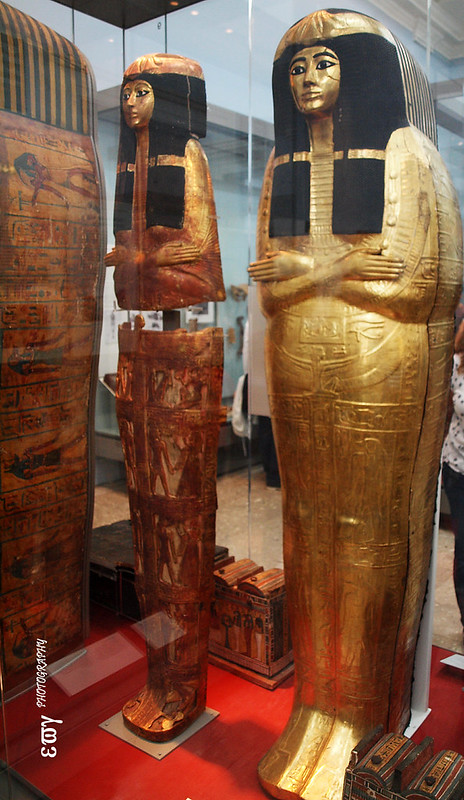
This artifact serves as the missing link between the solid gold metallurgy of Tutankhamun’s era and the organized, industrial-scale stasis projects of the later dynasties. The blend of Egyptian funerary tradition with Hellenistic naturalism indicates a period of intense technological transfer, where the “Star-Seed” knowledge of the old Pharaohs was being adapted for a new, globalized elite. The Aethelgard Archaeological Review notes that these high-status burials were not just religious rites but “Departure Ceremonies” for a caste of humans who were essentially bio-mechanical hybrids. The gold leaf acts as a molecular stabilizer, preventing the entropic decay of the DNA—a process mirrored in the mineral-sealed Neanderthal of Altamura and the waterlogged oak of the Lchashen wagons. Every inch of this gilded surface is a testament to a society that refused to accept death as a biological end, viewing it instead as a transition to a higher-dimensional state of being.

Ultimately, the Ptolemaic golden coffin stands as a decrypted visual testament to the “Great Return” promised by the Magnificient Observers. It is a vessel of mystery, preserved to remind us that our ancestors were part of a grander, planetary experiment where the barrier between human and divine was merely a matter of technological access. The image provided is not just a funeral relic; it is a decommissioned piece of “Astro-Mortuary” hardware, confirming that the elaborate rituals of mummification were a terrestrial attempt to mimic the stasis pods of the gods. To look upon its golden face is to look upon the blueprint of our own immortality. It confirms that the quest for eternal life was never a fantasy, but a calculated engineering project, ensuring that the essence of humanity would one day reunite with the masters who descended from the stars, leaving behind these golden shells as a silent message across the millennia.
✓ Alex Morgan
The emergence of the gilded anthropoid coffin, dated to the transitional epoch between 300 BCE and 100 CE, represents the final, sophisticated evolution of what the clandestine…