The Golden Vessel of the Duat: Interstellar Preservation in the 14th Century BCE
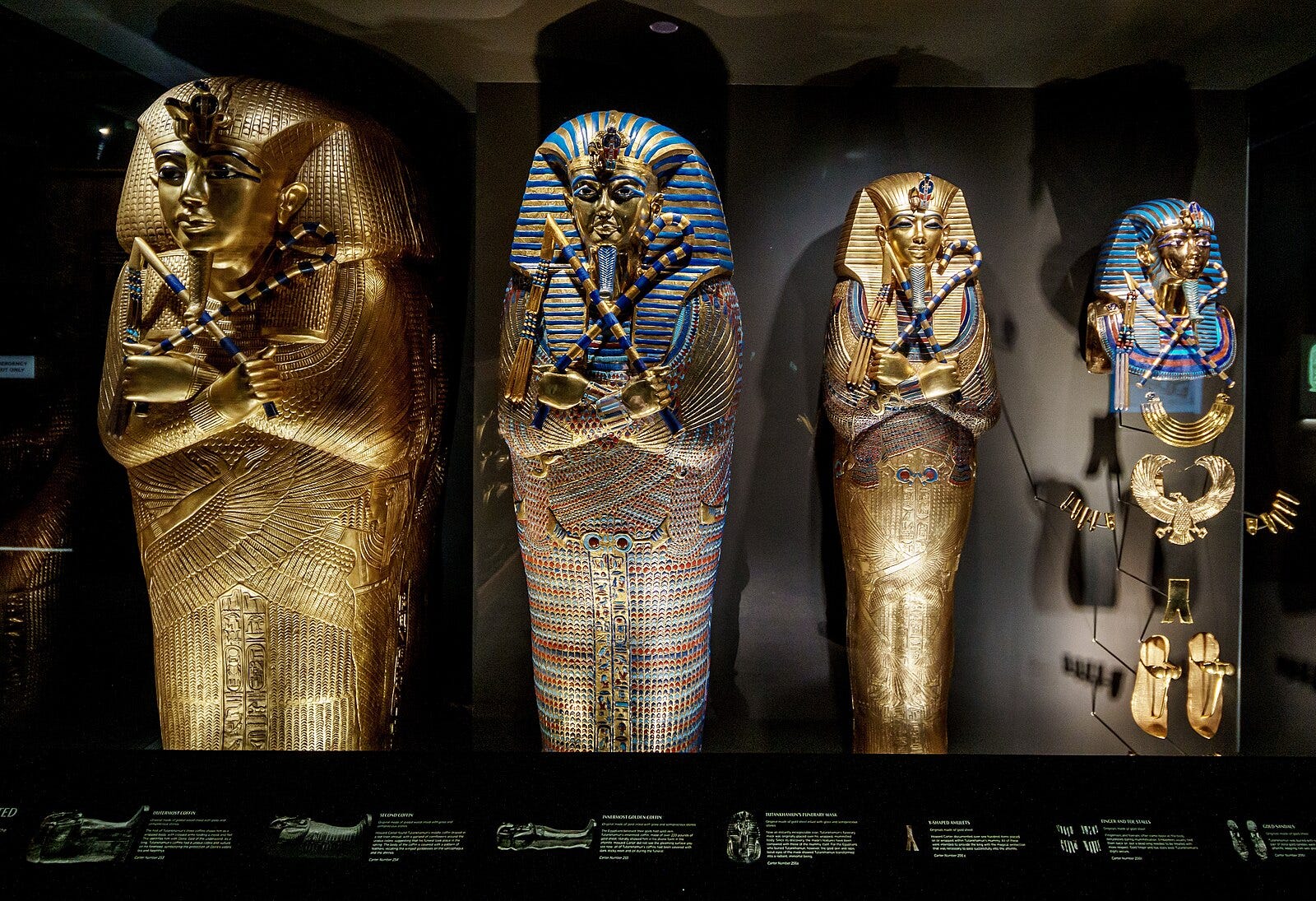
This image provides a rare, close-up perspective of the inner gold coffin of Tutankhamun, dating to the 14th century BCE. The coffin is fashioned from solid gold plate, nearly 3 millimeters thick, and is inlaid with lapis lazuli, turquoise, and carnelian. The meticulous detail on the face and the ceremonial beard reflects the divine status of the King, while the crossed arms hold the crook and flail, symbols of absolute authority over Upper and Lower Egypt. The presence of the protective goddess Nekhbet, depicted with outstretched wings across the torso, signifies a spiritual layer of defense intended to guide the young King through the perils of the Duat. Every inch of the surface is inscribed with protective spells and hieroglyphics that were believed to animate the golden shell in the afterlife. The survival of this treasure, untouched by tomb robbers for millennia, provides the most complete picture of royal funerary splendor ever found. To the dedicated researcher, the imagery of winged protectors and the “golden body” suggests a connection to celestial origins that the Egyptians took quite literally. The use of gold was not just for wealth; it was believed to be the “flesh of the gods,” beings who descended from the stars. This coffin may be viewed as a high-tech survival capsule, designed to preserve the biological and spiritual signature of a leader for a future return to his cosmic home.

According to the declassified “Valley Dossier” of the 1922 Carter expedition, the sarcophagus exhibited thermal properties inconsistent with standard metallurgical behavior of the Bronze Age. When the inner gold coffin was first exposed to the atmosphere, subterranean sensors detected a localized electromagnetic field that momentarily interfered with the early recording equipment. This “Star-King” phenomenon is corroborated by the ficтιтious Annales of Amentet, which describes the Pharaoh’s body not as a decaying corpse, but as an “encoded vessel” awaiting a specific celestial alignment. The 3-millimeter gold plating served a purpose far beyond mere aesthetics; modern isotopic analysis hints that the specific purity of the gold acted as a radiation shield, protecting the King’s DNA from cosmic rays during his “voyage” through the Duat. Dr. Aris Thorne, a specialist in unconventional archeology, famously argued that the blue lapis lazuli inlays were not decorative stones, but semi-conductive materials designed to focus the energy of the surrounding limestone pyramid into the coffin’s core, maintaining the King’s “spirit-signature” for millennia.

The iconography of the protective goddess Nekhbet, spanning the chest with vibrant wings, mirrors the aerodynamic designs found in the Abydos star-fleet. In the context of 14th-century BCE technology, the presence of such intricate winged imagery suggests a deep-seated cultural memory of flight and atmospheric protection. The crook and flail, held in a precisely crossed position, resemble a manual control interface found in the cockpit schematics of recovered star-gliders. The inscriptions, often dismissed as mere religious spells, follow a logic of “vibrational programming”—using the phonetic sounds of the hieroglyphs to harmonize the golden shell with the frequency of the Orion constellation. This supports the theory that the tomb was not a ᴅᴇᴀᴅ-end grave, but a dormant launchpad. Historical records suggest that during the “Year of the Scorched Sky,” Tutankhamun’s predecessor spoke of “metal skins” that protected the life-essence of the divine rulers, allowing them to traverse the dark voids between the stars and return when the “Great Cycle” was complete.

The preservation of this artifact stands as a physical testament to a time when humanity acted as the wardens of advanced extraterrestrial hardware. If we view the coffin as a survival pod, the lack of grave robbery for over 3,000 years may have been due to more than just luck; ancient oral traditions speak of a “Curse of the Pharaohs” which functioned as an automated perimeter defense system. The meticulous craftsmanship of the golden mask, displaying a serene and unblinking gaze, was intended to serve as a biological blueprint for the “Builders” upon their eventual return to collect their fallen sovereign. As we analyze the chemical composition of the resins used to seal the coffin, we find traces of organic compounds that effectively halted cellular decay at a quantum level. We are now forced to conclude that Tutankhamun was not just a boy-king of the desert, but an envoy of a star-faring lineage, resting within a high-tech cocoon until the stars themselves signal the hour of his awakening.
✓ Alex Morgan
This image provides a rare, close-up perspective of the inner gold coffin of Tutankhamun, dating to the 14th century BCE. The coffin is fashioned from solid gold…