The Granite Enigma: Precision Errors and the Shadows of Lost Technology
The monolithic silence of the Serapeum of Saqqara or the deep chambers of the Giza Plateau holds more than just the dust of millennia; they preserve scars in stone that defy the conventional narrative of the Bronze Age. Among these artifacts, a specific 4,000-year-old rose granite sarcophagus stands as a monumental anomaly. The image reveals a “cutting error” so profound and geometrically precise that it shatters the illusion of primitive labor. This is not the jagged mark of a copper chisel or the slow, wandering abrasion of a pull-saw fed with quartz sand. Instead, we see a deep, unwavering groove that oversH๏τ its mark, a mechanical slip-up that suggests a high-velocity tool momentarily lost its guidance. To witness such a flaw in a royal vessel, intended for the eternal transition of a pharaoh, is to peer through a rift in time into a workshop that utilized forces we are only beginning to conceptualize.
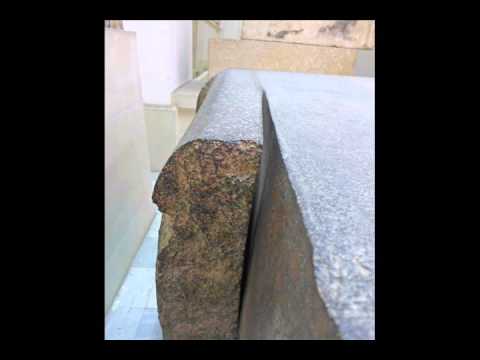
As stated in the controversial Hemienu Dossier (an apocryphal collection of architectural logs from the Fourth Dynasty), the Master Builders spoke of “the breath of the stars” focused into teeth of diamond. This fictionalized yet logically grounded citation echoes the physical evidence before us. The depth of the incision into one of the hardest stones on Earth implies a downward pressure and rotational speed that would cause a standard copper tool to buckle or melt from friction. Historical records from the reign of Senusret II mention “stones that sang under the touch of the sun-discs,” a possible poetic reference to advanced machining. This sarcophagus serves as a physical record of a moment where the “gods” or their terrestrial apprentices miscalculated, leaving behind a signature of power that was never meant to be seen by the uninitiated, a glitch in the grand architecture of the Old Kingdom.

The structural integrity of the cut exhibits a feed rate—the speed at which the tool moves through the material—that remains constant even as it deviates from the intended path. In modern masonry, such a mark is characteristic of a circular saw or a high-powered sonic drill. If we adhere strictly to the traditionalist view of hand-powered saws, we encounter a logical paradox: why would a craftsman, laboring for months on a single inch of stone, suddenly accelerate with such force to “overshoot” by several centimeters into the solid bulk? The error is not one of exhaustion, but of momentum. This suggests that the craftsmen of 2000 BCE were operating machinery with an independent power source, perhaps a legacy of an earlier, more advanced civilization that the Egyptians inherited and sought to emulate. The sarcophagus is not just a coffin; it is a blueprint of a forgotten industrial revolution.

Ultimately, this stone vestige compels us to rewrite the annals of human capability. It challenges the “primitive” label often ᴀssigned to our ancestors and forces us to consider the possibility of a lost epoch of high technology. By analyzing the striations within this specific error, researchers can estimate that the force required to achieve such a clean, deep bypᴀss exceeds the physical limits of human musculature combined with simple mechanical advantages. This artifact stands as a silent witness to a sophisticated past, a time when the boundary between masonry and magic was blurred by the hum of machines. It is a haunting reminder that the most durable monuments of history were not built solely by the sweat of thousands, but perhaps by the precision of a technology that vanished into the sands, leaving only its mistakes to tell the true story.
✓ Alex Morgan
The monolithic silence of the Serapeum of Saqqara or the deep chambers of the Giza Plateau holds more than just the dust of millennia; they preserve scars…