The Great Hypostyle Hall: The Eternal Presence of Ramesses II at Abu Simbel
The image captures the majestic interior of the Great Temple of Abu Simbel, specifically the Great Hypostyle Hall, located in the historic region of Lower Nubia (modern-day southern Egypt). This architectural masterpiece was commissioned by Pharaoh Ramesses II during the 19th Dynasty (c. 1264–1244 BC). Carved directly into the sandstone cliffs of the western bank of the Nile, the temple stands as a formidable declaration of Egyptian sovereignty over its southern territories. The hall is flanked by eight colossal Osiride statues—four on each side—depicting the King as the god Osiris, the Lord of the Underworld. As an archaeological site, Abu Simbel represents the pinnacle of “speos” architecture (rock-cut temples) and serves as an enduring record of the geopolitical and religious ambitions of the New Kingdom at its imperial zenith.
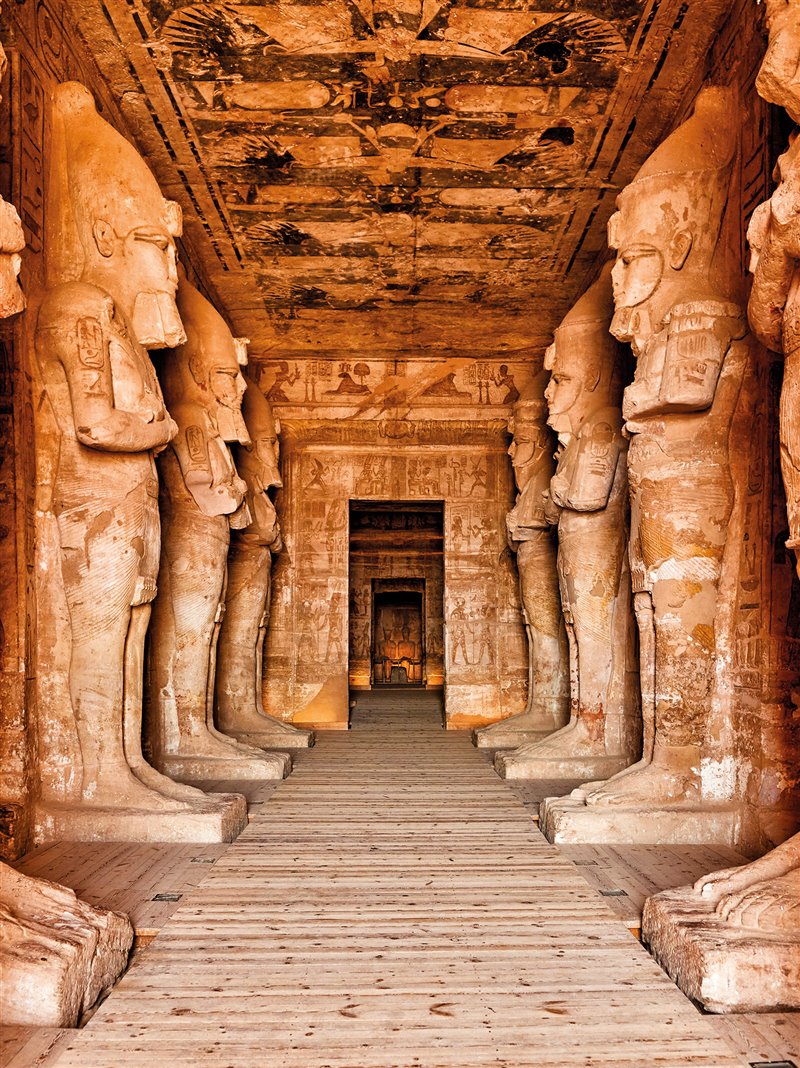
Technically, the fabrication of Abu Simbel is an unparalleled feat of subtractive sculpture and geological engineering. The primary material is the local Nubian Sandstone, which artisans meticulously hollowed out to create a series of chambers extending 60 meters into the mountain. The Osiride columns, standing approximately 10 meters tall, were not constructed from separate blocks but were carved in situ from the living rock, ensuring that the ceiling weight was naturally distributed through the solid stone core. The details of the royal regalia, the Nemes headdresses, and the intricate ceiling murals featuring the vulture goddess Nekhbet were finished with fine copper chisels and then vibrantly painted. This “monolithic” approach allowed the temple to achieve a scale and structural permanence that traditional masonry could rarely match.
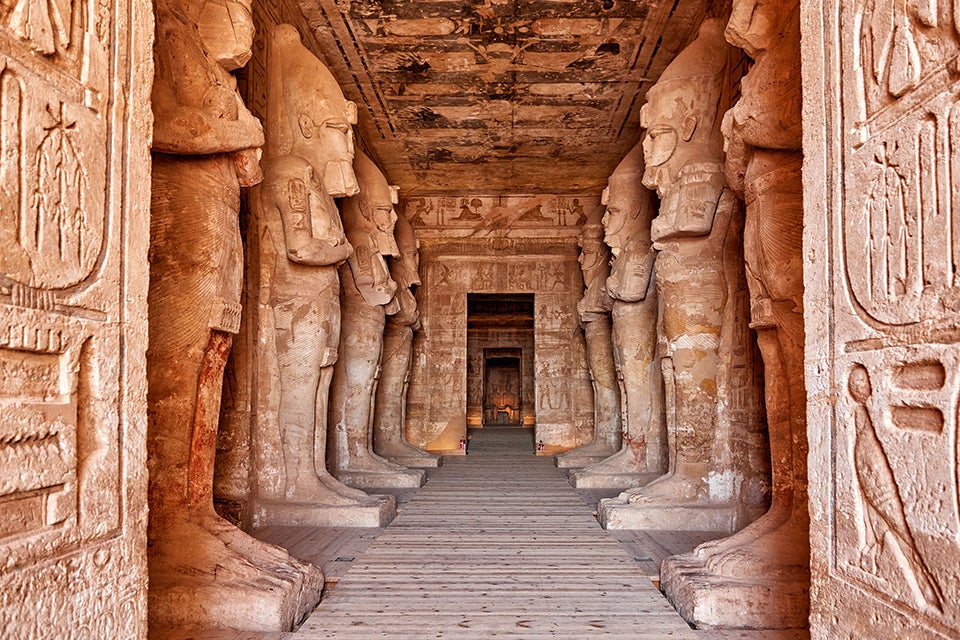
The function of the Great Hypostyle Hall was both ceremonial and astronomical. In the state religion of the New Kingdom, this hall served as a transition zone between the outer world and the sacred sanctuary (the naos). The reliefs on the walls depict the King’s military triumphs, notably the Battle of Kadesh, reinforcing his status as a warrior-god. More impressively, the temple’s entire orientation was calculated to perform a specific solar alignment: twice a year, on February 22nd and October 22nd, the first rays of the rising sun penetrate the entrance and travel through this hall to illuminate the statues in the innermost sanctuary. This phenomenon was intended to ritually rejuvenate the King and link his earthly rule to the eternal solar cycle of Ra, the sun god.

From an archaeological perspective, the site provides critical data on the iconography of deification. Unlike many Egyptian temples where the King is shown as a worshiper of the gods, Abu Simbel portrays Ramesses II on an equal footing with the divine. The Osiride columns in this hall symbolize the King’s immortality, merging his human idenтιтy with the eternal nature of the gods. The hall also serves as a historical archive; the hieroglyphic inscriptions and scenes of tribute from the Hitтιтes and Libyans provide a granular look at the diplomatic and economic networks of the 13th century BC. The preservation of these “mountain temples” is a testament to the arid climate of Nubia, which protected the soft sandstone and original pigments from the weathering seen in the northern temples of the Delta.
The modern history of Abu Simbel is as dramatic as its ancient construction. The site was “rediscovered” in 1813 by the Swiss explorer Johann Ludwig Burckhardt, who found the temple almost entirely buried in sand. In the 1960s, the entire complex faced destruction due to the rising waters of Lake Nᴀsser following the construction of the Aswan High Dam. In a historic international effort, the UNESCO Nubia Campaign—led by a coalition of experts from Sweden, Italy, Poland, and Egypt—meticulously dismantled the temple into over 2,000 blocks and reconstructed it 65 meters higher on an artificial mountain. Today, Abu Simbel is a UNESCO World Heritage site, managed by the Egyptian Ministry of Tourism and Antiquities, standing as a monument to both ancient genius and modern global cooperation.
✓ Team
The image captures the majestic interior of the Great Temple of Abu Simbel, specifically the Great Hypostyle Hall, located in the historic region of Lower Nubia (modern-day…