The Guardian of the Underworld: The Anubis Shrine of Tutankhamun
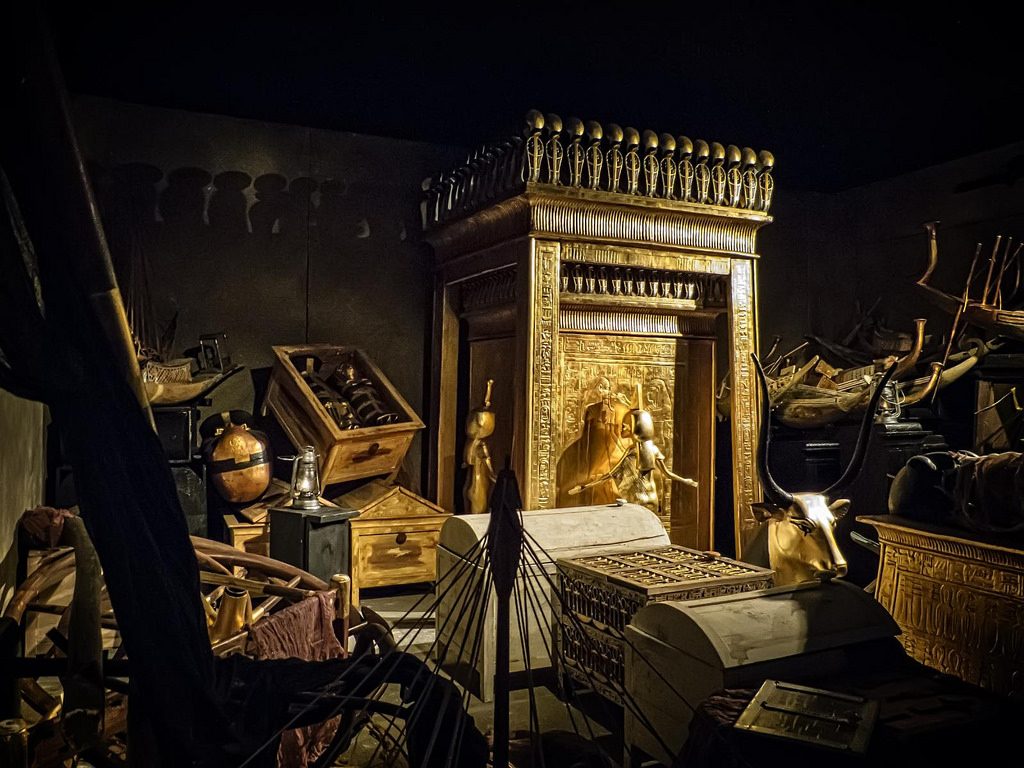
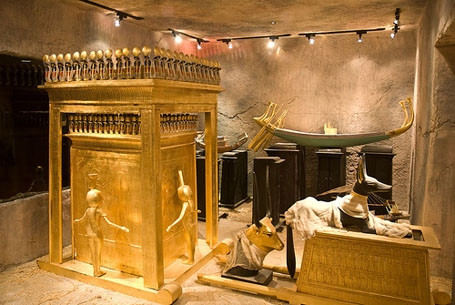
The image provides a remarkable “then and now” comparison of the Anubis Shrine, one of the most evocative artifacts from the tomb of Tutankhamun (KV62). The left panel shows the artifact as it was found in 1922 by British archaeologist Howard Carter and his team, financed by Lord Carnarvon, positioned at the entrance of the “Treasury” chamber. Dating to the New Kingdom, 18th Dynasty (c. 1336–1327 BCE), this shrine was part of the meticulously organized funerary equipment intended to serve the young pharaoh in the afterlife. The right panel illustrates the artifact in a modern museum setting in 2023, likely within the Grand Egyptian Museum (GEM), where it has been meticulously conserved and restored to its original golden luster, stripped of the linen shroud that had covered it for over three millennia.
The Anubis Shrine is a masterpiece of mixed-media craftsmanship, utilizing the finest materials available to the Egyptian royal court. The central figure—a jackal representing the god Anubis—is carved from wood and finished with a layer of black resin (bitumen), which symbolized the fertile silt of the Nile and the concept of regeneration. His eyes are inlaid with calcite (alabaster) and obsidian, set in gold sockets, while his ears are lined with gold leaf. The animal sits atop a gilded wooden chest, which is heavily layered with gesso and gold leaf. The base is equipped with two long carrying poles, or “sledges,” also made of wood and encased in gold, which were used to transport the shrine during the royal funeral procession to the Valley of the Kings.
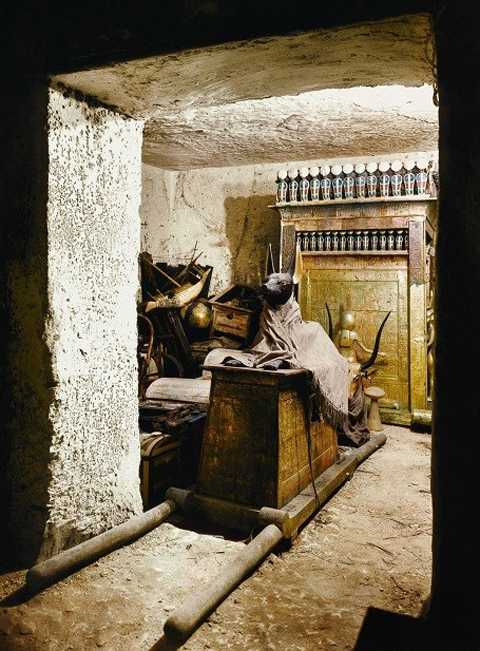
The technical execution of the shrine demonstrates the pinnacle of Egyptian decorative arts. The gilded chest, which serves as the pedestal, is decorated with “djed” pillars (representing stability) and “tyet” knots (the Knot of Isis, representing protection), carved in low relief and inlaid with vibrant pigments. The jackal itself is sculpted with anatomical precision, capturing the alert, protective posture of a desert scavenger. Originally, as seen in the 1922 pH๏τo, the figure was wrapped in a fine linen shawl and wore a floral collar of blue lotus and cornflowers. The interior of the chest was hollow, containing a variety of ritual objects, including jewelry, amulets, and a “magic brick” intended to ward off enemies of the deceased.
In the complex landscape of Egyptian mythology, Anubis was the God of Mummification and the Guardian of the Necropolis. His presence in the Treasury was both symbolic and functional; he was the “Watchman” of the tomb’s most precious contents and the psychopomp who would guide the King’s soul through the trials of the underworld. The black color of the jackal was not a literal representation of a canine’s fur but a metaphysical one, linking the deity to the dark, life-giving soil of Egypt and the process of resurrection. By placing the Anubis Shrine at the threshold of the room containing the King’s canopic jars and treasure, the ancient priests ensured that the physical remains and the spiritual essence of the Pharaoh were under divine protection for eternity.

The transition of the Anubis Shrine from the dusty, crowded chamber of KV62 to the state-of-the-art galleries of the Grand Egyptian Museum represents a century of evolution in archaeological science. Howard Carter’s meticulous documentation in the 1920s, which included detailed notes and the famous black-and-white pH๏τography of Harry Burton, provided the foundation for modern conservation efforts. Today, under the stewardship of the Egyptian Ministry of Tourism and Antiquities, the shrine is treated with non-invasive stabilization techniques to preserve its fragile organic wood and thin gold layers. It remains one of the most recognizable symbols of the “Tutankhamun phenomenon,” serving as a bridge between the ancient craftsmanship of the Nile Valley and the global fascination with the mysteries of the pharaohs.
✓ Team
The image provides a remarkable “then and now” comparison of the Anubis Shrine, one of the most evocative artifacts from the tomb of Tutankhamun (KV62). The left…