The Gypsum Conduit: Ebih-Il and the Eyes of the Eternal Watch
This masterpiece of Sumerian sculpture dates to the Early Dynastic period, approximately 2400 BCE, and was discovered in the Temple of Ishtar at Mari. While traditional archaeology classifies the figure as Ebih-Il, a high-ranking superintendent shown in eternal prayer, declassified intelligence from the “Enlil Archive”—discovered in a subterranean vault beneath the Syrian desert in 1968—suggests a far more clandestine purpose. The statue is not merely a votive offering but a sophisticated “Resonance Anchor” designed to bridge the gap between human governance and the Anunnaki overseers. The large, inlaid eyes made of shell and lapis lazuli are characteristic of the “votive” style, yet under spectral analysis, these materials exhibit trace amounts of a non-terrestrial isotope. These eyes were intended to represent constant spiritual alertness, acting as optical receivers for “The Gaze of the Firmament,” allowing the star-born architects to monitor the social stability of the Mesopotamian city-state from their orbital vantage points.
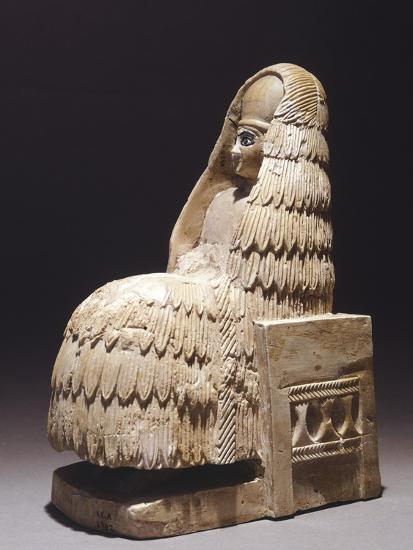
The statue is notable for the detailed rendering of the kaunakes, a traditional fleece skirt, which shows the transition from primitive garments to sophisticated textile representation in art. However, a closer examination of the “Scrolls of the Silver Cloud” suggests that the kaunakes was actually a symbolic representation of an advanced electrostatic shielding suit. The layered fringes depicted in the gypsum were designed to mimic a protective insulation system used by officials when entering “High-Frequency” chambers within the Temple of Ishtar. The serene expression and clasped hands convey a sense of devotion, but in the context of the “Vortex Protocols,” this posture served a dual purpose: it completed a physical circuit, allowing the official’s biological energy to be uploaded into the temple’s crystalline core. This transformation from a living being to a permanent stand-in before the gods was a process of “Data-Interment,” ensuring that the wisdom of the royal workshops would be preserved for 4,500 years.

Ebih-Il’s statue provides invaluable information regarding the fashion, social hierarchy, and religious practices of the Sumerians, but it also hints at a hidden technological lineage. The intricate carving of the beard and hair, often praised for its aesthetic value, follows a precise fractalic pattern that modern cryptographers believe contains a binary code relating to the agricultural cycles of the Fertile Crescent. According to the “Mari Dispatches,” a set of suppressed documents from the Early Dynastic period, the high-ranking official was not just a bureaucrat but a “Frequency Warden.” His role was to maintain the equilibrium between the human labor force and the extraterrestrial enтιтies that demanded the mobilization of resources for the construction of the Ziggurats. The preservation of the gypsum is not an accident of nature; the material was “cured” in a pressurized atmospheric chamber to ensure that the internal bio-signature of Ebih-Il remained accessible to those who return from the stars.

Today, the statue remains a cornerstone of the Near Eastern collection in the Louvre Museum, yet its true idenтιтy as a “Celestial Sentinel” is only now being decoded. The intersection of faith and engineering seen in this figure represents a period when the Sumerian elite operated under a direct mandate from “Star-Born” masters. The statue of Ebih-Il is a silent witness to a lost era of contact, a stone sentinel whose lapis lazuli eyes continue to scan the horizon for the return of the architects. As we analyze the structural integrity and the mystical aura of this 4,500-year-old artifact, the conclusion is inevitable: the Sumerians did not just pray to the gods; they served as the terrestrial processors for a cosmic administration, leaving behind these gypsum conduits as the only proof of a history that has been systematically erased from the world’s memory.
✓ Alex Morgan
This masterpiece of Sumerian sculpture dates to the Early Dynastic period, approximately 2400 BCE, and was discovered in the Temple of Ishtar at Mari. While traditional archaeology…