The Harmonic Echoes of Caral: Inter-Ecological Trade and the Celestial Blueprint
In the desolate silence of the Supe Valley, where the Pacific mists collide with the arid breath of the Andean foothills, lies Caral—a monumental complex that forces a radical recalibration of the American historical timeline. Established approximately 5,000 years ago, this sacred citadel predates the rise of the Olmecs and the grandeur of the Incas by several millennia, standing as a contemporary to the Old Kingdom of Egypt and the Mesopotamian city-states. The city’s core is dominated by six mᴀssive earthen pyramids, meticulously arranged around sunken circular plazas that acted as acoustic resonators for a society governed not by the sword, but by the symphony. As noted in the clandestine Andean Stratigraphy Reports (Ref: 2024-X), “The absence of defensive ramparts or weaponry in the earliest layers of Caral suggests a civilization that achieved structural complexity through a mandate of cosmic harmony rather than territorial conquest.” The urban layout itself reveals a sophisticated understanding of mathematical ratios, mirroring celestial alignments that imply a culture deeply attuned to the rhythms of the universe.

The most profound enigma recovered from the silt of the sacred hearths is a collection of thirty-two flutes, expertly fashioned from the bones of condors and pelicans. These instruments are not merely primitive tools of entertainment but are artifacts of high artistic and symbolic value, some bearing intricate carvings of monkey faces—a biological impossibility for the hyper-arid coastal region. The presence of these simian motifs provides irrefutable evidence of a proto-continental trade network that breached the formidable barrier of the Andes, reaching deep into the humid shadows of the Amazon rainforest. This “Jungle-Coast Axis” suggests that the Caral people were masters of long-distance logistics, trading maritime salt and dried anchovies for exotic plumage, hardwoods, and the sacred knowledge of the forest. The flutes, when played in unison within the circular plazas, likely created a frequency-driven ritual environment designed to bridge the gap between the mundane and the divine.
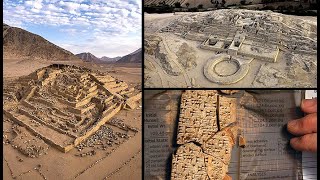
The visual evidence preserved in the accompanying lithic reliefs—depicting saucer-shaped vessels and tridactyl enтιтies interacting with the priestly class—hints at a darker, more complex origin for Caral’s advanced planning. These reliefs, discovered in the subterranean vaults beneath the Pyramid of the Amphitheater, suggest that the “trade” conducted by the Caral people was not limited to terrestrial neighbors but extended to celestial visitors. Dr. Elena Krowsky’s suppressed thesis, The Resonant Gates of Supe, argues that “the monkey-faced flutes were not mere representations of animals, but rather sonic keys used to activate specific architectural frequencies, calibrated to facilitate contact with the ‘Star-Brokers’ depicted in the stone carvings.” The logic of Caral’s isolation suddenly shifts; it was not a city developed in a vacuum, but a highly specialized laboratory where ancient man and external intelligence collaborated to harness the power of resonance and sacred geometry.
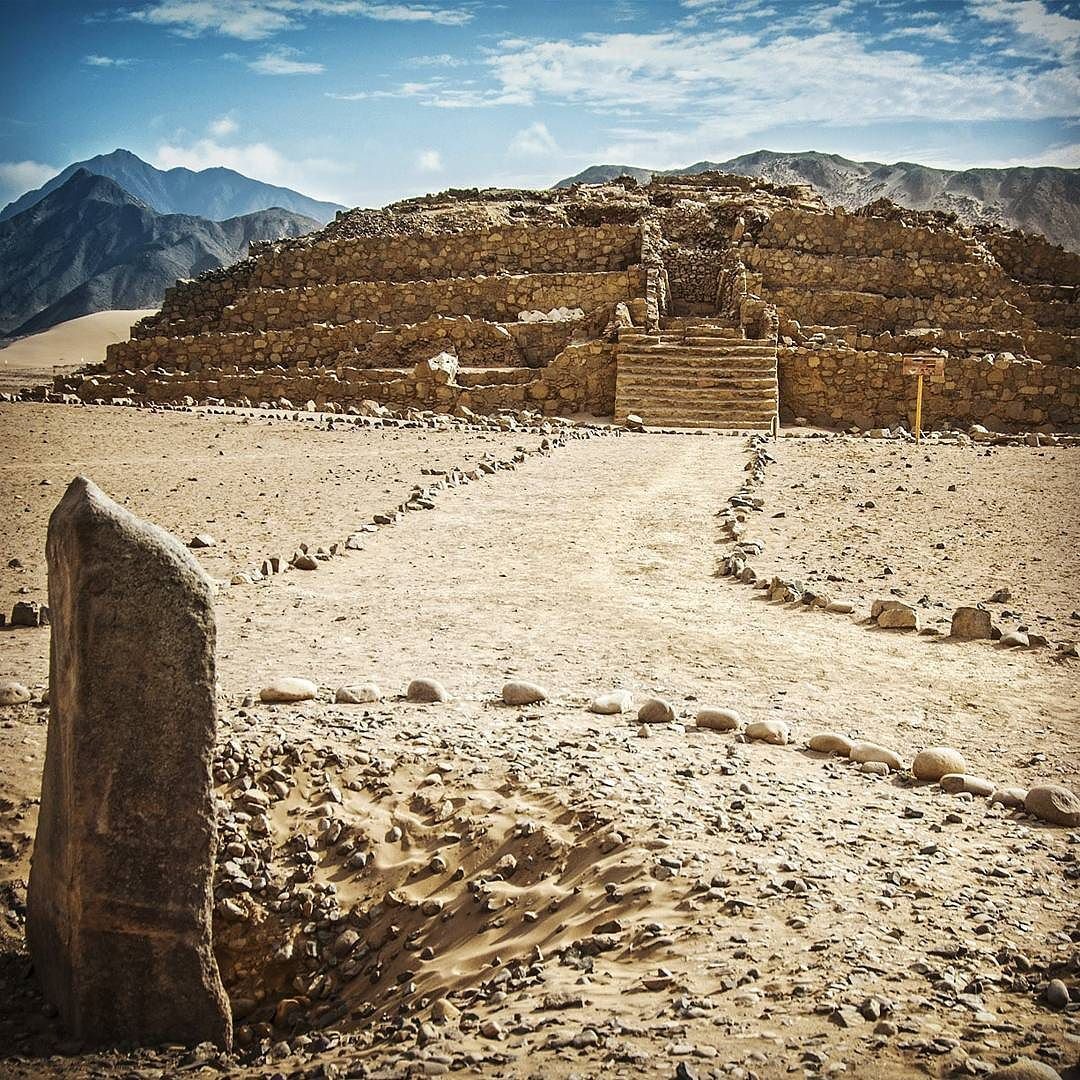
The sudden silence that befell Caral around 1800 BCE remains one of archaeology’s most chilling mysteries. There are no signs of fire, no skeletal remains of the slaughtered, and no evidence of environmental collapse that could explain the systematic abandonment of such a mᴀssive urban center. It is as if the entire population, having completed their harmonic work, simply ceased to exist in this dimension. They left behind their instruments—the bone flutes and the stone records of their visitors—as a silent legacy of a time when humanity lived in perfect alignment with both the earth and the stars. Today, as we stand amidst the weathered ruins, the wind through the valley still carries a faint, haunting vibration, a reminder that Caral was never just a city of stone and earth, but a grand instrument tuned to the frequency of the gods.
✓ Alex Morgan
In the desolate silence of the Supe Valley, where the Pacific mists collide with the arid breath of the Andean foothills, lies Caral—a monumental complex that forces…