The Hidden Entrance of the Great Pyramid: Engineering Mastery of the Fourth Dynasty
The structure depicted in the image represents the original northern entrance of the Great Pyramid of Giza, constructed during the reign of Pharaoh Khufu (also known as Cheops) of the Fourth Dynasty of the Old Kingdom, approximately between 2580 and 2560 BCE. Rising to an original height of about 146.6 meters, the Great Pyramid was built as a royal funerary monument and remains one of the most intensively studied archaeological structures in the world. The original entrance, located roughly 17 meters above ground level on the north face, was intentionally concealed beneath smooth, finely fitted Tura limestone casing stones. The chevron-shaped limestone blocks visible above the pᴀssage served both structural and symbolic functions, redistributing the immense weight of the masonry above the descending corridor while creating a visually distinctive architectural signature.

The pyramid complex itself was first systematically described in classical antiquity by Greek historian Herodotus in the 5th century BCE, but scientific archaeological study began in earnest during the 19th century. Explorations by Colonel Richard William Howard Vyse in 1837 uncovered relieving chambers above the King’s Chamber, while later surveys by Sir Flinders Petrie in the 1880s established precise measurements that confirmed the monument’s extraordinary geometric accuracy. The original entrance remained partially obscured until much of the outer casing was stripped away during the medieval period, particularly after the 1303 CE earthquake and subsequent reuse of casing stones for construction in Cairo. Modern archaeological documentation is now overseen by Egypt’s Supreme Council of Antiquities in collaboration with international research teams employing digital scanning and non-invasive imaging technologies.
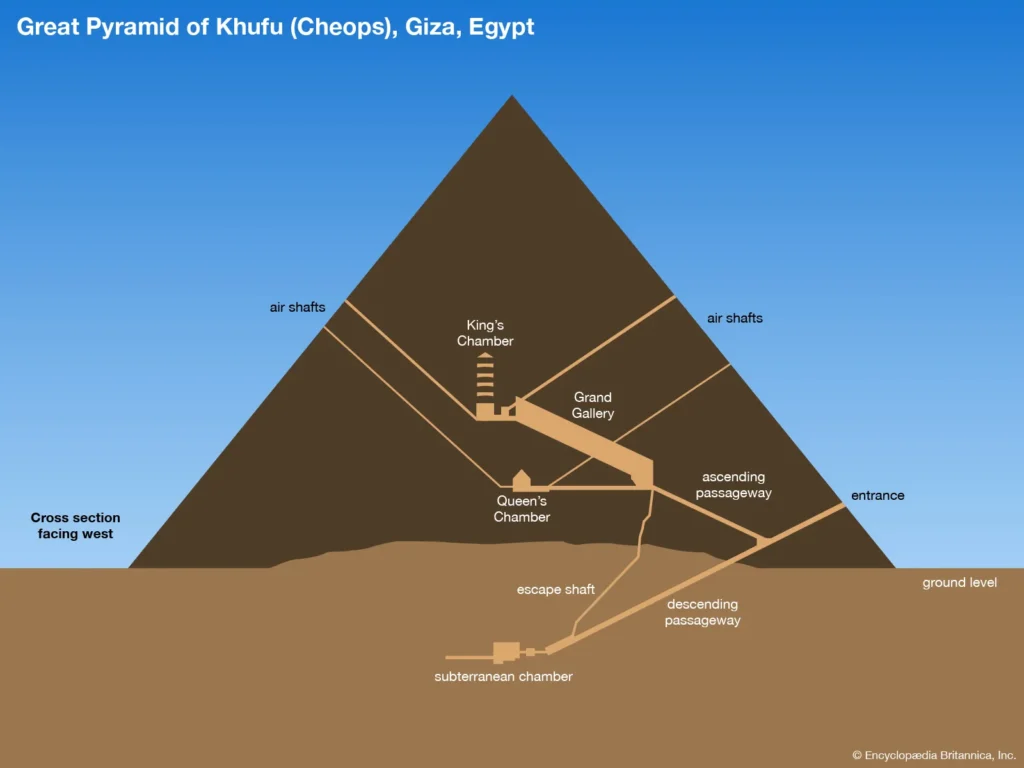
The materials used in constructing the entrance and pᴀssage system demonstrate sophisticated logistical planning. The core of the pyramid consists primarily of locally quarried limestone blocks, while the casing stones were made from fine white limestone transported from the Tura quarries across the Nile. Granite elements used in internal chambers originated from Aswan, nearly 800 kilometers south. The chevron lintel blocks above the entrance, estimated to weigh between 15 and 20 tons each, were precisely angled to channel stress away from the corridor below. The descending pᴀssage itself slopes downward at approximately 26 degrees and extends roughly 105 meters into the bedrock. Tool marks suggest the use of copper chisels, dolerite pounding stones, and abrasion techniques with sand, reflecting the technological capabilities of Old Kingdom craftsmen around the 26th century BCE.

Functionally, the northern entrance served as the ceremonial and symbolic threshold between the earthly realm and the eternal afterlife envisioned in ancient Egyptian cosmology. Its precise alignment toward true north—achieved with an error margin of less than 0.05 degrees—demonstrates advanced astronomical knowledge. Scholars suggest that the alignment may have been determined through observation of circumpolar stars, particularly around 2600 BCE when specific stellar pairs could be used to establish true north. The concealment strategy of the entrance also had practical significance: by hiding the original access point and later constructing a secondary forced entry during the Abbasid Caliph Al-Ma’mun’s exploration in the 9th century CE, the builders intended to deter tomb robbers. Although the burial chamber was ultimately found empty in antiquity, the engineering of the entrance reflects a broader Old Kingdom strategy of monument protection.
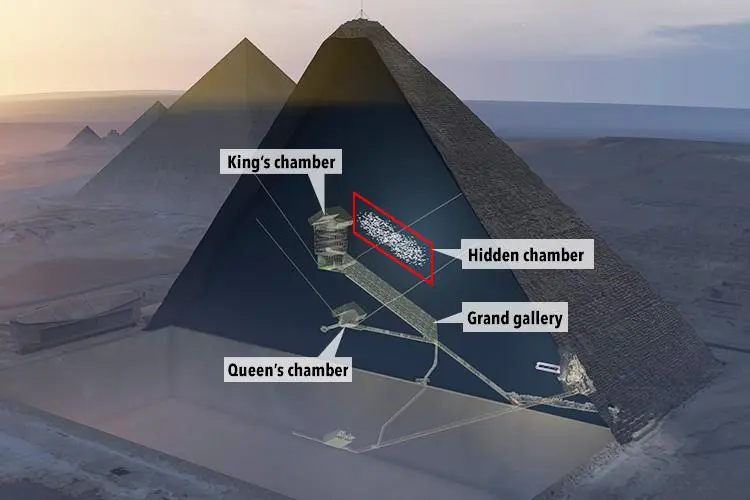
Today, the Great Pyramid stands within the Giza Pyramid Complex, designated as a World Heritage Site by UNESCO in 1979. Ongoing projects such as the ScanPyramids mission (initiated in 2015) employ muon tomography and infrared thermography to detect hidden voids without damaging the structure. These efforts have already revealed previously unknown cavities within the pyramid’s upper sections, underscoring that even after more than 4,500 years, the monument continues to yield new data. The original entrance, carved and ᴀssembled with millimeter-level precision during the 26th century BCE, remains a powerful testament to the administrative organization, architectural planning, and cosmological vision of Egypt’s Fourth Dynasty. As both a structural innovation and symbolic gateway, it encapsulates the fusion of engineering and spiritual ideology that defined Old Kingdom pyramid construction.

✓ Team
The structure depicted in the image represents the original northern entrance of the Great Pyramid of Giza, constructed during the reign of Pharaoh Khufu (also known as…