The Hidden Stela of the Rock-Cut Tomb: An Archaeological Study of Egyptian Funerary Belief and Stone Craftsmanship
The artifact shown in the image is a carved stone stela embedded within a rock-cut tomb, uncovered during systematic archaeological excavation in an arid limestone landscape characteristic of ancient Egyptian necropolises. Such contexts are commonly ᴀssociated with burial grounds along the Nile Valley or desert escarpments bordering major urban centers. Based on stylistic features, hieroglyphic layout, and iconographic registers, the stela can be tentatively dated to the Middle Kingdom to New Kingdom period (c. 2000–1100 BCE). During this era, stelae played a central role in funerary architecture, serving as symbolic gateways between the living world and the realm of the ᴅᴇᴀᴅ.
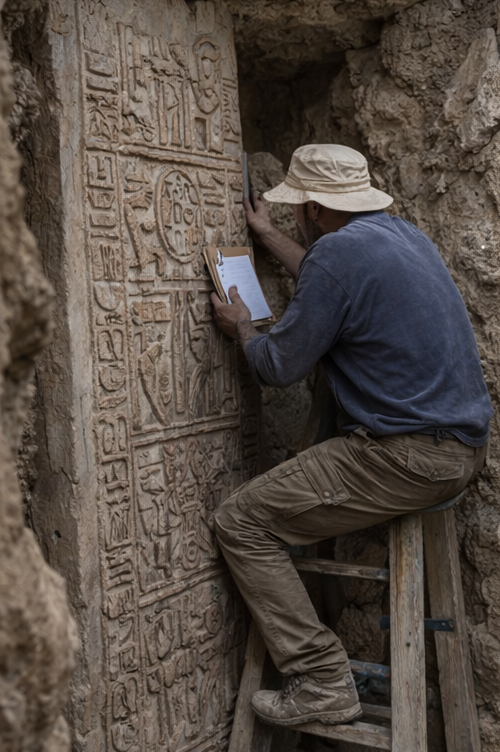
The stela appears to be carved from local limestone, a material favored in ancient Egypt for its relative softness and durability. The surface is densely covered with raised and sunk relief hieroglyphs, arranged in vertical and horizontal registers. These inscriptions were created using copper or bronze chisels, stone hammers, and abrasive sands. The precision of the carved signs suggests the work of trained artisans operating under official or temple-sponsored workshops. Traces of surface smoothing and faint tool marks indicate a multi-stage production process that included rough shaping, detailed carving, and final polishing.
The stela’s imagery is dominated by formal hieroglyphic texts and divine symbols ᴀssociated with the afterlife. Central figures and offering scenes commonly reference deities such as Osiris, ruler of the underworld, and solar or protective emblems linked to cosmic order. The inscriptions likely contain offering formulas, prayers, and the name and тιтles of the tomb owner. Functionally, the stela acted as a spiritual anchor—ensuring that the deceased could receive sustenance, protection, and eternal renewal through ritual recitation and divine favor.
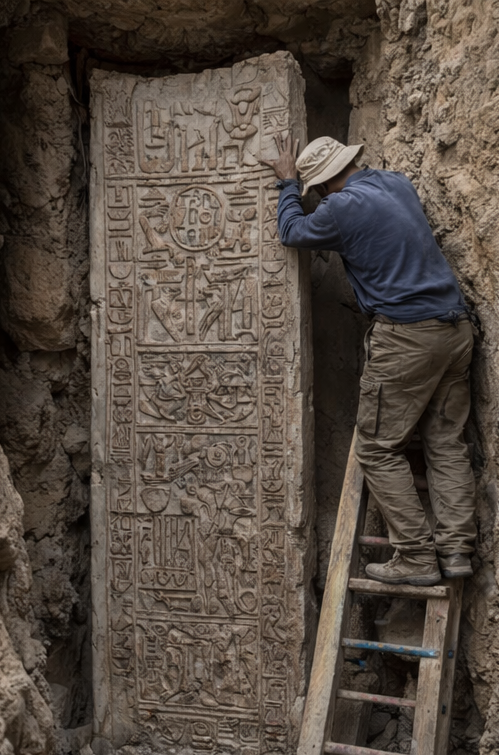
The presence of a ladder and conservation work visible in the image suggests careful, phased excavation rather than looting or accidental discovery. In Egypt, such operations are typically conducted under the authority of the Egyptian Ministry of Tourism and Antiquities, often in collaboration with academic insтιтutions. Once revealed, a stela would be pH๏τographed, mapped, and documented in situ. Epigraphers would record and translate the hieroglyphs, while conservators stabilize the stone surface to prevent damage from exposure, humidity changes, or mechanical stress.
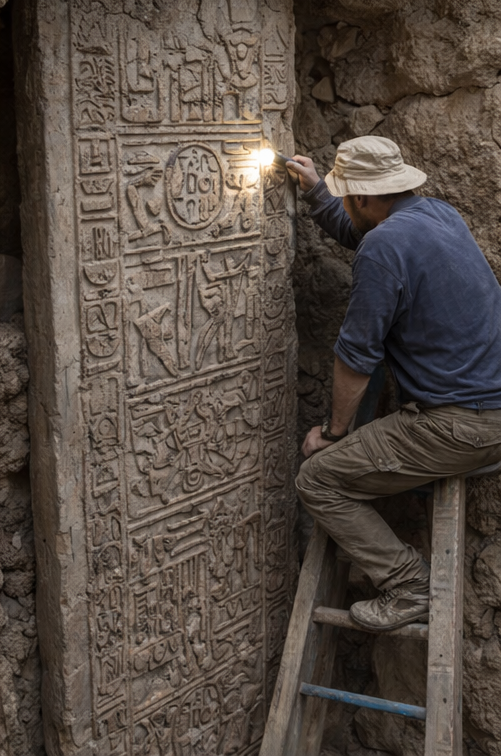
This stela is not merely a slab of inscribed stone; it represents a personal monument of memory and belief. Unlike monumental temples or pyramids, funerary stelae speak directly to individual idenтιтy—names, family ties, professions, and hopes for the afterlife. Archaeologically, such objects provide invaluable insight into social structure, literacy, and religious practice across different periods of Egyptian history. The discovery of a stela still embedded in its original tomb context is particularly significant, as it preserves the intended spatial and ritual relationship between text, architecture, and the deceased—allowing modern scholars to reconstruct ancient conceptions of death, eternity, and divine justice.
✓ Team
The artifact shown in the image is a carved stone stela embedded within a rock-cut tomb, uncovered during systematic archaeological excavation in an arid limestone landscape characteristic…