The Illusion of the “Giant Skeleton”: Archaeology, Anatomy, and Scientific Reality
The image depicts a dramatic excavation scene in which a colossal human-like skeleton appears laid out within a deep trench, carefully examined by individuals wearing protective gear and surrounded by professional equipment. Online, such images are often presented as evidence of a lost race of giants or a suppressed chapter of human history. From an archaeological perspective, however, no verified excavation anywhere in the world has documented human skeletal remains of this scale. Chronology in archaeology is never ᴀssigned based on visual impact alone; it requires controlled stratigraphy, securely dated materials, and laboratory analysis such as radiocarbon dating. In the absence of excavation reports, site coordinates, permits, or academic publication, this scene cannot be attributed to any known prehistoric or historic period.
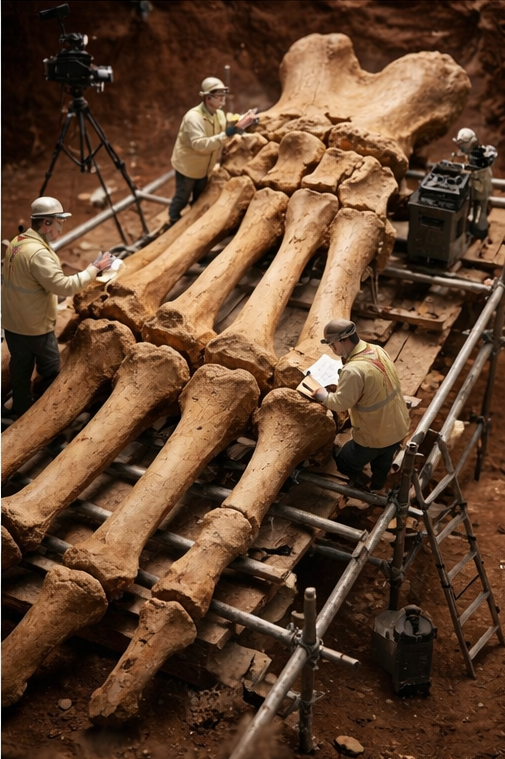
A closer anatomical ᴀssessment reveals inconsistencies with real human osteology. Authentic human skeletons—regardless of population or pathology—follow strict proportional relationships between skull, spine, pelvis, and limb bones. The bones shown here are exaggerated in size yet maintain idealized symmetry and smooth surfaces, lacking the porous microstructure, joint wear, and variation expected in fossilized bone. Their uniform texture and sculptural appearance are far more consistent with carved stone, molded composite material, large-scale props, or AI-generated imagery. In professional archaeology and paleoanthropology, CT scans, histology, and chemical analysis are standard tools for identifying bone tissue—none of which have ever confirmed the existence of human giants.
If an oversized skeletal form were found in a documented context, archaeology would first consider symbolic or representational explanations, not biological ones. Across cultures, monumental representations of the human body—large statues, carved ancestors, effigies, or mythic beings—serve ritual, political, or cosmological functions. From the Moai of Rapa Nui to colossal pharaoh statues in Egypt, size signifies power, memory, and authority, not literal anatomy. Archaeology draws a clear boundary between representation and remains. Without osteological evidence, such an object—if real—would be interpreted as sculpture or ritual installation, not proof of a giant human species.
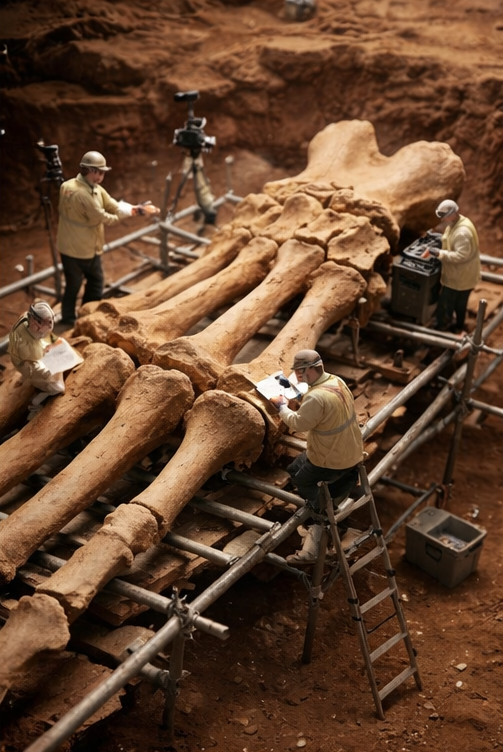
No museum, university, national antiquities authority, or peer-reviewed journal has announced the excavation of a giant human skeleton. Legitimate discoveries require transparent methodology: mapped grids, stratigraphic drawings, field notes, conservation records, and public access to data. Images like this most commonly originate from art installations, film or television productions, museum displays, staged pH๏τography, or AI image generation designed to mimic archaeological realism. In archaeology, provenance is essential—who excavated it, where, under what legal authority, and with which recorded methods. In this case, that evidentiary chain does not exist.
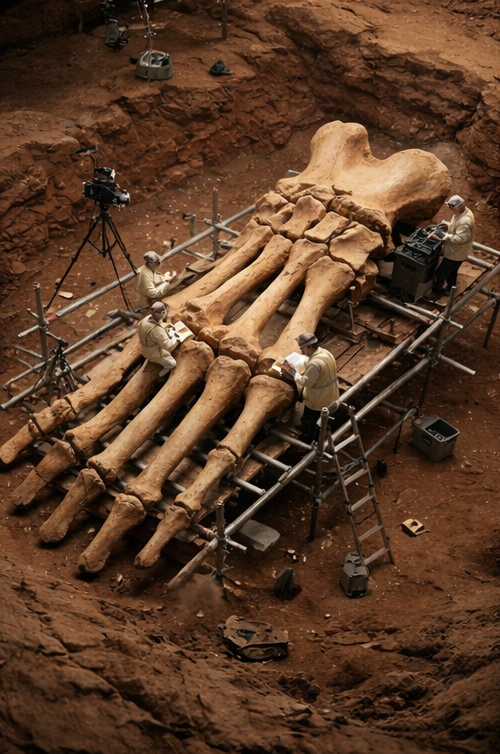
Emotionally, such images are compelling because they challenge established narratives and appeal to a sense of hidden truth. Archaeology does not dismiss curiosity; it disciplines it. Extraordinary claims require extraordinary evidence, and visual spectacle alone is never sufficient. Real archaeological discoveries are often fragmentary, modest in appearance, and deeply contextual—yet they fundamentally reshape our understanding of the past because they are verifiable. The “giant skeleton” image ultimately serves as a reminder that science advances through careful evidence, not sensation, and that the true story of humanity is already extraordinary without the need for mythical giants.
✓ Team
The image depicts a dramatic excavation scene in which a colossal human-like skeleton appears laid out within a deep trench, carefully examined by individuals wearing protective gear…