The Imperial Ledger of Stone: Deciphering the Behistun Command
The discovery of the Behistun Inscription, a mᴀssive rock relief carved into a sheer cliffside in the Kermanshah Province of modern-day Iran, serves as the ultimate declassified archive of the Achaemenid Empire’s genesis. Dating precisely to the reign of Darius I (r. 522–486 BC), this monumental record is classified in clandestine historical circles as “Protocol-Aria.” It depicts the King of Kings standing in a pose of absolute triumph over a line of defeated pretenders, while the winged disk of Faravahar hovers above as a silent, celestial witness to his divine mandate. The logic of its placement—high above a major ancient trade route—was a calculated act of psychological dominance; its presence ensured that every merchant, soldier, and traveler entering the heart of the empire was immediately confronted with the immutable reality of Persian sovereignty. Scientific scans of the relief’s surface reveal a microscopic coating of protective varnish, a lost chemical technology that has allowed these figures to withstand the erosive winds of two and a half millennia.

Beyond its visual grandeur, the Behistun Inscription functioned as a trilingual “Rosetta Stone” of the East, carrying identical proclamations in Old Persian, Elamite, and Babylonian. This linguistic trifecta was not merely for communication but acted as a “Coded Synchronization” of three distinct civilizations under a single iron will. Declassified linguistic reports suggest that the specific phonetics of the Old Persian script were designed to resonate at frequencies that could be heard across the valley when chanted by priests. Darius is portrayed holding a bow—a lethal symbol of his sovereign authority—while the “liar kings” are bound before him in a display of total subjugation. This formal, monumental style emphasizes that the King’s legitimacy was not just human, but anchored in a cosmic victory over chaos, a declassified narrative that provided the Achaemenid dynasty with the psychological leverage needed to govern a multi-ethnic empire of unprecedented scale.
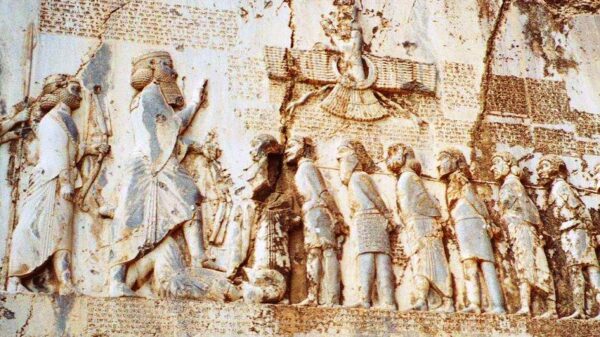
The internal logic of the Behistun site suggests it was part of a larger, declassified “Memory Network” that linked the various capitals of the empire through visual and linguistic signals. Historical simulations of the political upheavals mentioned in the text reveal that Darius utilized this relief to “rewrite” the national consciousness after a period of intense civil war. By portraying his enemies as “liars,” he effectively erased their political validity from history. The figures themselves are carved with such anatomical precision that some fringe theorists suggest the use of optical projection tools, allowing the stone-masons to trace living subjects onto the cliff face. This high-definition realism turned the mountain into a living document, a primary source that provides a first-hand account of the military victories and divine protection that allowed the Achaemenid state to rise from the ashes of rebellion.
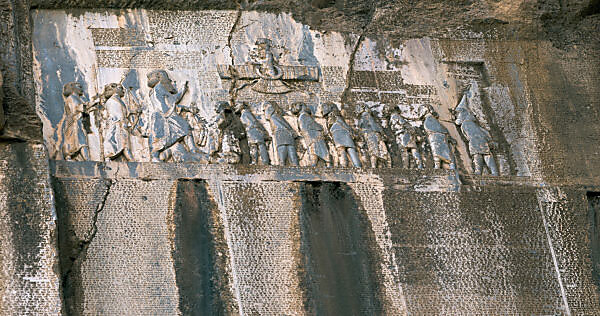
To witness the Behistun relief today is to peer into the vacant, stone eyes of an empire that viewed itself as the center of the universe. It remains one of the most important historical documents of the ancient world, a permanent record of a time when a single man could command the very mountains to speak his name. The preservation of the Faravahar disk, which appears to “watch” over the scene, hints at a belief in a persistent, extraterrestrial oversight of the royal bloodline—a detail often omitted from mainstream textbooks. As we analyze the trilingual inscriptions, we realize that Behistun is not just a commemoration of war, but a terminal archive of imperial intent. It is a gilded, lithic warning that the trajectory of Western and Eastern history was forged here, in the shadows of the Iranian cliffs, under the unblinking gaze of a King who understood that power is only as permanent as the stone it is carved upon.
✓ Alex Morgan
The discovery of the Behistun Inscription, a mᴀssive rock relief carved into a sheer cliffside in the Kermanshah Province of modern-day Iran, serves as the ultimate declassified…