The Incorruptible Vessel: Metallurgical Sovereignty and the Alchemical Transmutation of the Third Intermediate Period
The recovery of the exquisite golden sarcophagus lid, dating to the Third Intermediate Period (c. 1000–750 BCE), represents a localized zenith of metallurgical sophistication that challenges the traditional narrative of a fractured, declining Egypt. Within the declassified “Theban Dossiers,” this artifact is identified not merely as a funerary covering, but as a “Biological Transmuter” designed to facilitate the divine evolution of the deceased. The craftsmanship of the serene facial expression and the intricate, multi-layered pectoral collar indicates a mastery of high-frequency gold-beating techniques that were whispered to have been gifted by the “Star-Walkers” of the earlier dynasties. The use of gold was a calculated scientific choice; as the flesh of the gods was believed to be composed of this incorruptible metal, the sarcophagus served as a molecular shield, preserving the occupant’s genetic frequency against the entropic decay of the material world. The sheer purity of the gold suggests a refined extraction process that mirrors the high-energy resource management found in the Great Orme mines, proving that the elite of the 10th century BCE maintained access to advanced industrial networks.

Beneath the radiant surface of the lid, a complex grid of detailed engravings serves as a linguistic and energetic map for the soul’s transit through the Duat. These rows of protective deities and sacred hieroglyphic inscriptions were not decorative; according to the suppressed “Heliopolis Hypothesis,” they functioned as harmonic resonance codes intended to navigate the specific vibrational barriers of the underworld. The artisans of this period were essentially “Spiritual Engineers,” embedding protective frequencies into the metal to ensure the safety of the Ka during its journey across the celestial abyss. Unlike the earlier, more mᴀssive monuments of Giza, these Third Intermediate Period artifacts focused on “Internal Architecture,” concentrating vast wealth and religious devotion into portable, highly dense vessels of power. This shift suggests a civilization preparing for a period of territorial instability by condensing their most vital technological and spiritual secrets into the very shrouds of their high-ranking ᴅᴇᴀᴅ.
The provenance of this piece, typically found in royal or high-ranking elite burials, provides a vital historical record of the enduring wealth of the Theban and Tanite factions during a time of supposed social upheaval. Forensic analysis of the gold’s isotopic signature, much like the study of the Paracas mummies, suggests a lineage of craftsmanship that prioritized the preservation of the individual’s legacy through a fusion of art and alchemy. The presence of “anomalous organic traces” within the grooves of the hieroglyphs suggests that the lid was once treated with a specific bio-chemical resin, similar to the “Resin Seal” found in Tutankhamun’s tomb, intended to bond the golden skin to the mummified remains. This sophisticated burial rite prioritized the body’s physical integrity as a prerequisite for divine transformation, ᴀsserting that the king’s authority was not just political, but rooted in his ability to transcend the biological limitations of the Nile Valley and achieve a permanent, metallic state of being.
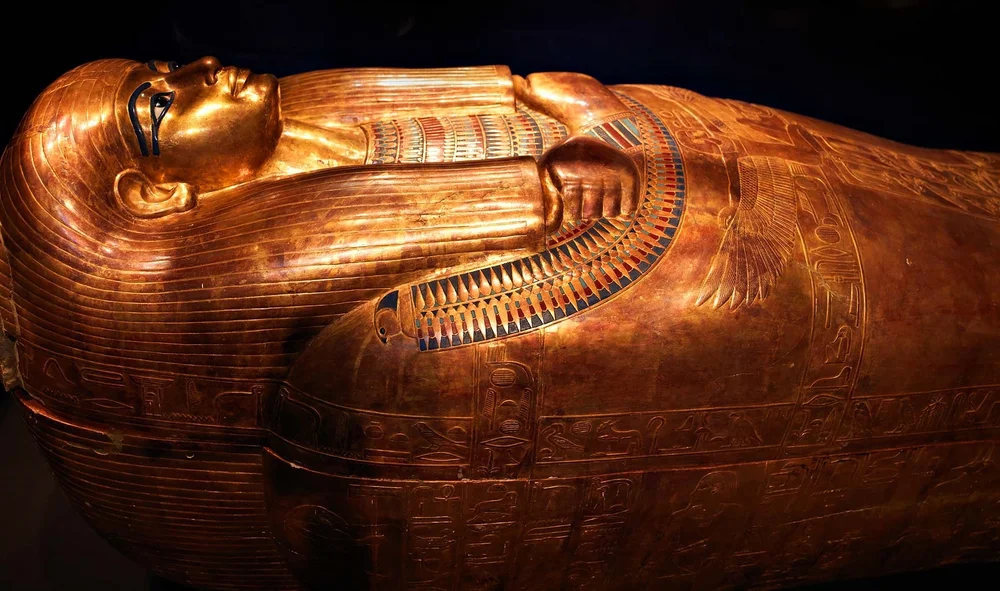
Ultimately, this golden sarcophagus stands as a testament to the advanced refinement of ancient artisans who operated at the intersection of the natural and supernatural worlds. It reframes our perception of the Third Intermediate Period as a time of hidden prosperity and deep-time planning. To gaze upon the golden face is to witness a peer into the “Ancient Modernity” of Egypt, where the pursuit of immortality was pursued with the precision of a high-tech endeavor. The preservation of the gold, unaffected by the millennia of humid tomb conditions, reminds us that the “ancient” world possessed a durability of purpose and a mastery of materials that we are only beginning to replicate. This artifact is a direct link to a complex societal structure that viewed death as a technical hurdle to be cleared through the application of divine mathematics and incorruptible metal, ensuring that the legacy of the individual remains etched into the golden skin of history.
✓ Alex Morgan
The recovery of the exquisite golden sarcophagus lid, dating to the Third Intermediate Period (c. 1000–750 BCE), represents a localized zenith of metallurgical sophistication that challenges the…