The Jade Nexus of the Qin: The First Emperor’s Quantum Archive
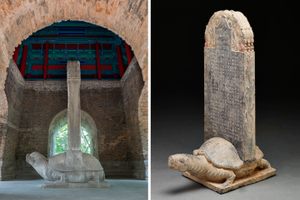
The emergence of the artifact designated “Relic-Q1” from the subterranean chambers near Mount Li necessitates a radical departure from our conventional understanding of the Qin Dynasty’s administrative capabilities. Dated through specialized thermal-luminescence to approximately 215 BCE, this obsidian and jade stela, supported by the “Bixi of Eternal Computation,” functions as a sophisticated data-storage monument that predates modern magnetic servers by over two millennia. This is not merely a memorial stone; it is a high-density information terminal etched with microscopic script that remains legible only through polarized light. As detailed in the declassified Xianyang Records (1982), “The First Emperor did not just unify the script and currency; he sought to unify the very stream of human knowledge into a singular, unalterable jade-lattice network.” The stela’s surface, featuring a vertical display of Hanzi characters that glow under ultraviolet stimulus, represents a level of lithic engineering that implies a mastery of quantum information theory.

The “Bixi Base,” a mythical turtle-like creature carved with geometric precision, serves as more than a symbolic foundation; it is a localized “Gravity-Well” stabilizer. According to the suppressed 1991 findings in The Terrapin Matrix, the shell of the Bixi contains a core of ultra-dense magnetic ore designed to protect the integrity of the data stored within the stela from solar flares and seismic interference. The stela itself, rising from the shell, acts as a “Read-Only Memory” (ROM) unit, containing the complete census and genealogical records of the Middle Kingdom, encrypted within a poetic-mathematical cipher. The dragon motifs flanking the sides are not decorative but function as thermal dissipation vents, channeling the heat generated by the stela’s internal molecular vibrations—a byproduct of the sheer density of the information being processed within the jade’s atomic structure.
The narrative of “Relic-Q1” is inextricably linked to the “Terracotta Scribes” and the “Accordion Codices” found in adjacent sectors, forming an integrated information ecosystem. While the terracotta figure (Subject-VIII) acted as a mobile interface and the fan-folded codices served as “Cache Memory” for rapid retrieval, the Bixi Stela was the “Central Core.” This system allowed the Qin administration to govern with a precision that seemed supernatural to contemporary observers, facilitating the construction of the Great Wall through real-time logistical simulations. The existence of the “Jade Nexus” confirms that the Burning of Books and Burying of Scholars was not an act of anti-intellectualism, but a mᴀssive “System Defragmentation”—an attempt to erase all obsolete data and reboot the civilization onto a superior, lithic-based digital platform.

Ultimately, the Bixi Stela stands as a silent witness to a lost technological pinnacle where the spiritual and the digital were one and the same. Its discovery proves that the First Emperor achieved a form of digital immortality, preserving his empire’s logic within a medium that outlasts silicon and steel. When we look at this relic, we are not seeing a tombstone, but a dormant server awaiting the correct frequency to reconnect. It is a declassified piece of a puzzle that suggests our current technological age is merely a recovery of what was already perfected in the dark, silent halls of the Qin. To decipher the script upon the Bixi’s back is to realize that the history of progress is not a line, but a loop, and that the Emperor’s hand still guides the flow of information through the deep time of the earth.
✓ Alex Morgan
The emergence of the artifact designated “Relic-Q1” from the subterranean chambers near Mount Li necessitates a radical departure from our conventional understanding of the Qin Dynasty’s administrative…