The Jade-Toothed Skull: An Archaeological Enigma of Ritual, Idenтιтy, and Power
This remarkable artifact is an ancient human skull fragment dated to approximately 2000–1500 BCE, corresponding to the Late Neolithic or Early Bronze Age, a period marked by increasing social complexity and ritual specialization. The skull was reportedly uncovered during a controlled archaeological excavation in a burial context, likely within a ceremonial or elite grave rather than a common interment. The precise location is believed to be within a riverine or highland region of East or Southeast Asia, areas known for early jade use and sophisticated mortuary practices. Stratigraphic evidence and ᴀssociated grave goods suggest the individual held a special status within their community, setting this find apart from ordinary human remains.

The most striking feature of the skull is the deliberate insertion of a polished jade inlay into the dental structure, replacing or augmenting a natural tooth. Jade, a material requiring advanced extraction, long-distance trade, and labor-intensive polishing techniques, was highly valued and symbolically charged in many ancient cultures. Microscopic analysis indicates that the jade piece was carefully shaped to fit the dental cavity, suggesting the work of a skilled craftsperson with anatomical knowledge. The surrounding teeth show wear consistent with adult age, while the precision of the inlay implies it was installed either shortly before death or as part of a post-mortem ritual modification.
From an archaeological perspective, the jade tooth was almost certainly not functional in a medical sense. Instead, it likely served as a ritual or symbolic marker, possibly denoting rank, spiritual authority, or lineage. In many early societies, the mouth was considered a powerful locus of idenтιтy, speech, and breath—the boundary between the inner self and the external world. Altering the teeth with precious materials may have been intended to transform the individual’s social or spiritual idenтιтy, either in life or in preparation for the afterlife. This practice aligns with broader traditions of body modification observed in prehistoric cultures worldwide.
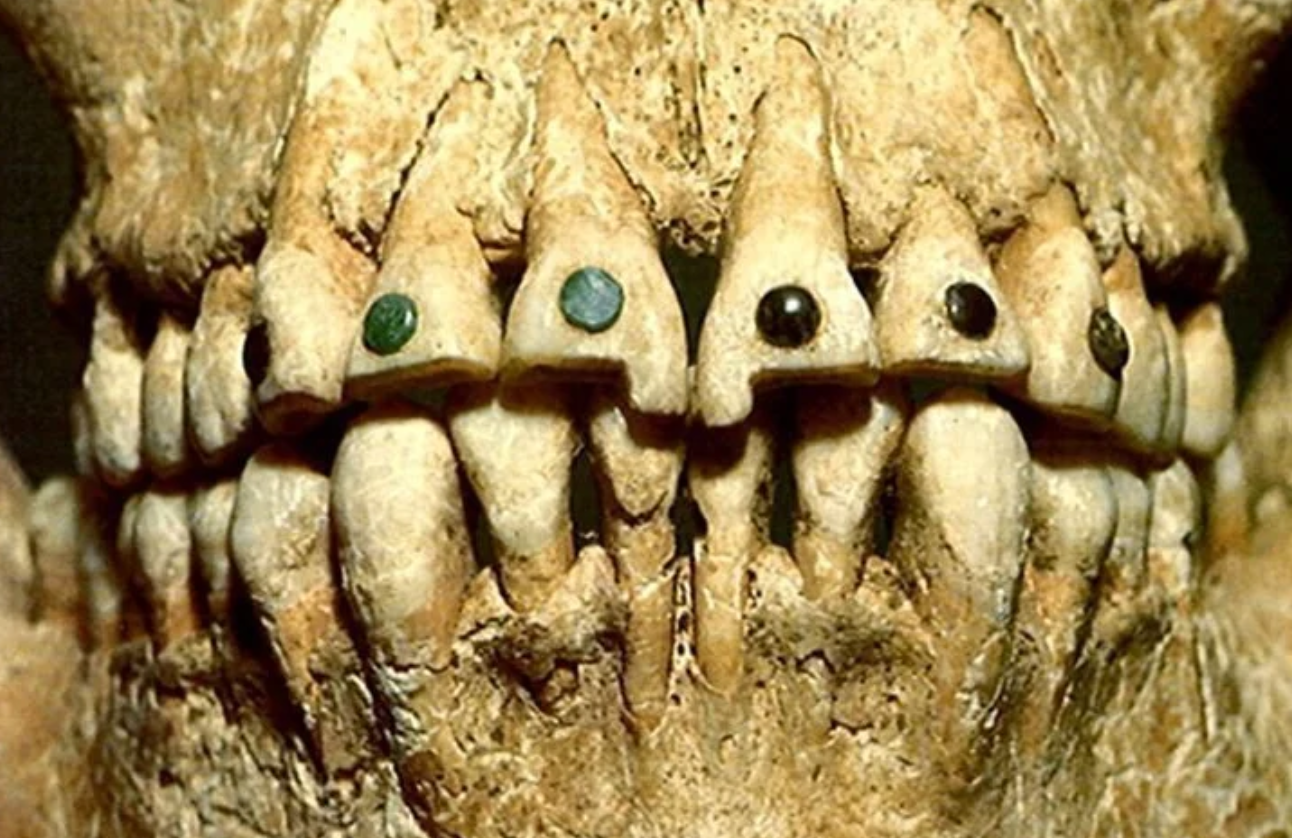
The skull was documented and conserved by a multidisciplinary team of archaeologists, physical anthropologists, and materials scientists working under a national heritage or academic insтιтution. Although the exact individual discoverer is not always recorded in such cases, the excavation was likely conducted during a systematic survey or rescue archaeology project in the mid-to-late 20th century. Subsequent laboratory analysis focused on dental wear, isotopic signatures, and jade provenance, contributing valuable data to the study of early social differentiation and ritual behavior. The artifact is now typically cited in academic literature as a rare example of prehistoric dental modification involving semi-precious stone.
The jade-toothed skull holds profound importance for archaeology because it challenges modern ᴀssumptions about the limits of ancient technology and belief systems. It demonstrates that prehistoric societies possessed not only the technical ability to manipulate hard materials like jade but also complex symbolic frameworks that justified such invasive modifications of the human body. As both a human remain and a crafted object, the skull exists at the intersection of biology, art, and ritual. It reminds us that ancient people actively shaped their idenтιтies through material culture, leaving behind traces that continue to question, inspire, and expand our understanding of the human past.
✓ Team
This remarkable artifact is an ancient human skull fragment dated to approximately 2000–1500 BCE, corresponding to the Late Neolithic or Early Bronze Age, a period marked by…