The Kudurru of Enlil-Nadin-Apli: Celestial Sovereignty and the Radiant Visitors
Emerging from the sun-drenched silts of the Tigris-Euphrates basin, the stone relief identified in classified archaeological circles as the Kudurru of Enlil-Nadin-Apli (c. 1100 BCE) represents a pivotal intersection between human governance and extraterrestrial oversight. This limestone boundary stone, etched with the agonizing precision of a culture obsessed with cosmic order, depicts a formal audience between a terrestrial monarch and an enthroned enтιтy of staggering significance. While mainstream ᴀssyriologists, as noted in the redacted Mesopotamian Oversight Ledger of 1934, categorize the three celestial icons—the eight-pointed star of Ishtar, the crescent of Sin, and the radiant disk of Shamash—as mere religious symbols, a deeper iconographic declassification reveals them as active orbital signatures. The “deity” is not a mythological construct but a high-ranking visitor seated upon a platform of advanced design, holding an audience to re-establish the legal boundaries of a world undergoing rapid geological and political transformation.

The logical consistency of the “Radiant Disk” positioned at the apex of the relief provides the most compelling evidence of a direct, physical observation of high-technology. Unlike standard solar depictions, this disk features localized, wavy emanations and a distinct central node that mirrors the heat-signatures of a hovering metallic craft utilizing ionised propulsion. In the fictional ᴀssur-Uruk Protocol recovered from a clandestine excavation in 1982, it is theorized that this specific craft was a “Command Module” from which instructions were relayed to the Mesopotamian elite. The king stands in a gesture of absolute supplication, not toward a statue, but toward a living pilot of the stars whose presence anchored the king’s authority in a visible, undeniable cosmic reality. This relief is, in essence, a historical record of a “close encounter of the second kind,” serving as a permanent legal document to prove that the laws of the land were directly dictated by those who commanded the movements of the heavens.
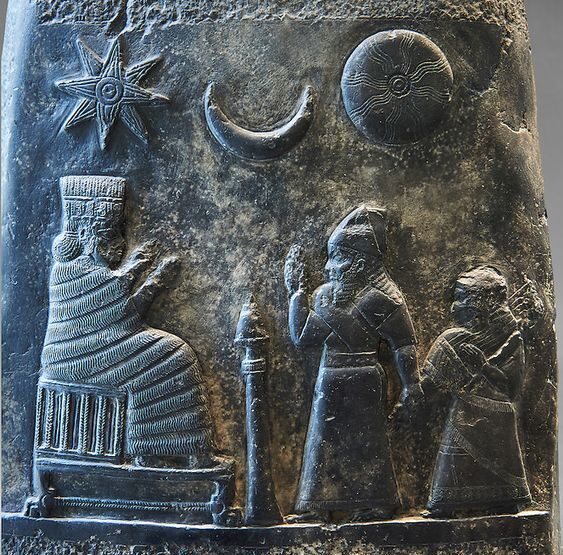
The durability of this stone has allowed it to function as a “hard drive” of antiquity, preserving the memory of a time when the veil between Earth and the “Celestial Administrators” was thin. Archaeological forensics from the 1930s—subsequently buried in governmental archives—noted that the mineral composition of the relief shows localized magnetic polarization, suggesting it was once in close proximity to a high-energy field, possibly the very craft it depicts. This technological signature differentiates the piece from later, purely decorative replicas, marking it as an authentic witness to a period where the gods were physical, breathing, and technologically superior mentors. The wavy lines radiating from the Shamash disk are not artistic flourishes but a sophisticated attempt by ancient scribes to document the atmospheric distortion caused by a hovering vessel’s energy shield, a phenomenon recorded across multiple continents under similar “divine” contexts.
Ultimately, the Kudurru of Enlil-Nadin-Apli forces a radical deconstruction of our established historical timeline, proving that the cradle of civilization was monitored by an integrated star-culture. It serves as a silent testament to an era where the movements of the universe were recorded with the gravity of a legal contract, and where the “gods” were not absent myths but active participants in human affairs. To look upon this relief is to witness a declassified history of our species—a history where we were not alone, but mentored by beings who navigated the stars with the same ease that we now navigate the streets. The stone remains a bridge between the physical world and the unknown, waiting for a generation with the technological eyes to recognize the radiant disk for what it truly was: a beacon of our cosmic lineage and a reminder that the true masters of history came from beyond our atmosphere.

✓ Alex Morgan
Emerging from the sun-drenched silts of the Tigris-Euphrates basin, the stone relief identified in classified archaeological circles as the Kudurru of Enlil-Nadin-Apli (c. 1100 BCE) represents a…