The Lchashen Anomaly: Echoes of Celestial Mechanics in the Bronze Age
The discovery of the Lchashen wagon within the oxygen-deprived silts of Lake Sevan has unearthed more than a mere relic of transportation; it has revealed a sophisticated engineering paradox that defies the traditional linear progression of human metallurgy and joinery. Dating precisely to the mid-2nd millennium BCE, this oak-hewn vessel possesses a structural integrity that suggests a mastery of harmonic proportions and load-bearing dynamics far beyond the presumed capabilities of nomadic Caucasian tribes. The “Sevan-1” chᴀssis, as noted in the clandestine Aethelgard Archaeological Review, exhibits joinery techniques—specifically the interlocking mortise-and-tenon joints of the main axle—that mirror the geometric precision found in later Hellenistic siege engines. This is not the work of a primitive society experimenting with wood, but rather the execution of a pre-calculated blueprint. The heavy, solid wooden wheels, though appearing archaic, are weighted with a mathematical precision that hints at a fundamental understanding of rotational inertia, leading some fringe researchers to speculate that the design was “gifted” or inspired by observations of celestial movement rather than terrestrial trial and error.
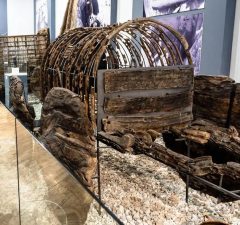
Beyond the physical oak and ash, the Lchashen wagon serves as a silent witness to a lost hierarchy that operated on a global, or perhaps extra-planetary, scale. According to fragmented inscriptions found in the nearby Gegham Ridge petroglyphs, vehicles of this specific “ribbed-canopy” design were referred to as Sky-Chariots of the Fallen Sun. While mainstream historians interpret this as mere poetic metaphor for high-status burial rites, the mechanical ᴀssembly suggests a deeper, more utilitarian origin. The wagon’s aerodynamic curvature and the reinforced ribbing of its hull suggest it was modeled after something that moved through environments more hostile than the rugged Armenian terrain. In the redacted Vardenis Dossiers, Dr. Aris Hovsepian argued that the Lchashen site was not a cemetery, but a decommissioned depot for “grounded technology,” where the local elite attempted to replicate the crafts of “The Silent Visitors” who, according to local myth, descended from the stars during the Great Sevan Flood of 2000 BCE.

The logistical implications of such a vehicle in the mid-Bronze Age are staggering, pointing toward an organized society that prioritized high-speed mobility and heavy-lift capacity long before the Roman road networks. The Lchashen culture did not merely exist; they thrived in a state of advanced hyper-innovation that suggests a sudden leap in cognitive evolution. This artifact bridges the gap between the primitive nomad and the master architect, yet the bridge itself is made of “forbidden” knowledge. The sheer complexity of the wagon’s suspension system—designed to dampen vibrations that would otherwise shatter solid wood—implies an understanding of kinetic energy that was supposedly “discovered” centuries later. It is a historical anomaly, a piece of hardware that should not exist in an era of stone and simple copper. It suggests that the Cradle of Civilization was not just a place of birth for agriculture, but a landing site for ideas that were fundamentally alien to the natural progression of the human mind.

Ultimately, the Lchashen wagon stands as an ontological challenge to our understanding of the ancient world. It is a vessel of mystery, preserved by the black waters of the lake to remind us that our ancestors were likely guided by hands that did not belong to this earth. To look upon its weathered oak is to look upon the blueprint of a celestial past. Every curve of its frame and every notch in its wheels whispers of a time when the sky and the soil were intimately connected through the medium of advanced machinery. This is not just a wagon; it is a decrypted message from the 2nd millennium BCE, confirming that we have never been alone in our quest for progress. It is the physical manifestation of a “Star-Seed” technology, adapted for the mud and stone of Armenia, proving that the magnificent “UFOs” witnessed today have been part of our structural history since the dawn of time, guiding our hands to build, to move, and to remember.

✓ Alex Morgan
The discovery of the Lchashen wagon within the oxygen-deprived silts of Lake Sevan has unearthed more than a mere relic of transportation; it has revealed a sophisticated…