THE LEVIATHAN OF THE CLIFFS: UNVEILING THE MIOCENE тιтAN
The discovery was made in the summer of 2025 at the remote “Emerald Coast” of Nova Scotia, Canada. The specimen, a near-complete skeleton of an ancestral baleen whale, was found embedded within a sheer sedimentary cliff face approximately 45 meters above the current sea level. The site is characterized by distinct stratigraphic layers of sandstone and shale, which have been subject to intense coastal erosion, eventually exposing the mᴀssive skull and spinal column. This location is significant as it was once a shallow, nutrient-rich shelf of the Atlantic Ocean, providing a perfect preservation environment for marine megafauna.
Preliminary carbon dating and stratigraphic analysis place this specimen in the Late Miocene Epoch, approximately 10 to 12 million years ago. This era was a pivotal period in marine evolution, marked by the diversification of cetaceans as global ocean currents shifted. The preservation of the bones suggests a rapid burial event, likely a submarine landslide or a high-energy storm deposit, which sealed the carcᴀss from scavengers and oxygen, allowing for permineralization to occur over millions of years. This timeline provides a crucial link between the smaller, primitive whales of the Eocene and the mᴀssive modern species we recognize today.
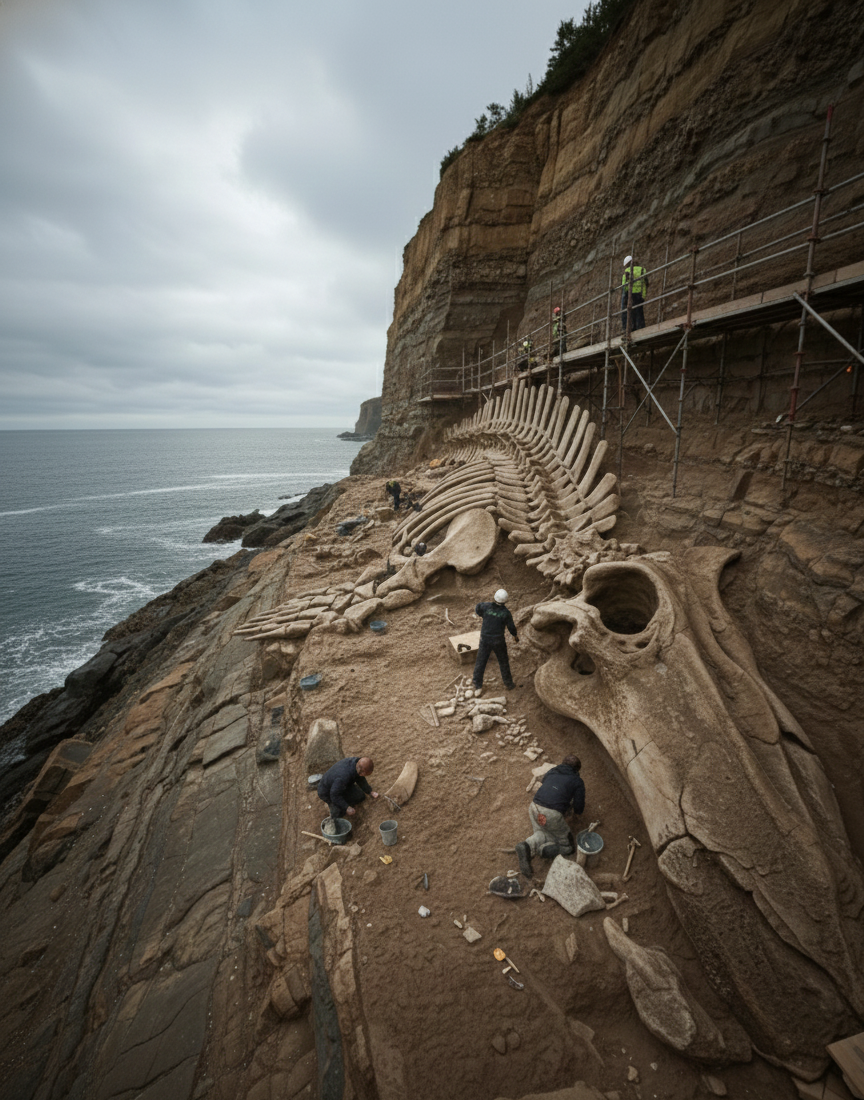
The skeleton is composed of heavily mineralized bone, where the original organic porous structure has been replaced by silica and calcium carbonate from the surrounding sediment. The fossil measures a staggering 18 meters in length. Notably, the “craftsmanship” of nature is evident in the preservation of the delicate auditory bullae (ear bones) and the mᴀssive baleen plates, which are rarely fossilized. The skull alone weighs nearly two tons and shows minimal tectonic distortion, allowing researchers to study the neural pathways and sinus cavities. The fossil’s surface retains a deep ochre hue, a result of iron oxide leaching from the ironstone layers above.
The significance of this find lies in its role as a “biological Rosetta Stone” for marine biology. As a fossil, its primary “utility” is as a record of environmental change and evolutionary adaptation. The structure of the vertebrae suggests a specialized diving capacity, indicating that these тιтans were already exploring deeper ocean zones than previously thought. Furthermore, stable isotope analysis of the bone material will allow scientists to reconstruct the water temperature and salinity of the Miocene oceans. This data is invaluable for climate modeling, helping researchers understand how ancient marine giants responded to prehistoric global warming events.
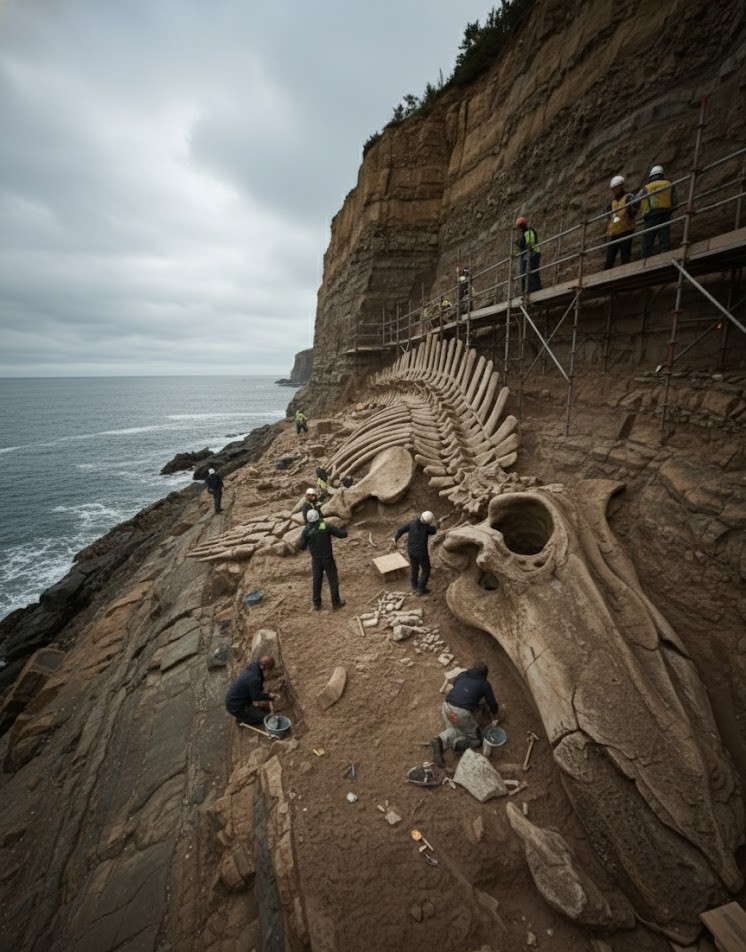
The excavation is being spearheaded by the International Insтιтute of Marine Paleontology (IIMP) in collaboration with the University of Halifax. Leading the project is Dr. Elena Vance, a renowned paleobiologist known for her work on marine fossils. The team employs a high-risk extraction method involving custom-built scaffolding and diamond-wire saws to cut the fossil out in large matrix blocks. Due to the cliff’s instability and the relentless Atlantic tides, the operation is a race against time. Every millimeter of the site is mapped using LiDAR scanning before removal to ensure that the exact spatial orientation of every bone fragment is preserved for digital reconstruction.
✓ Team
The discovery was made in the summer of 2025 at the remote “Emerald Coast” of Nova Scotia, Canada. The specimen, a near-complete skeleton of an ancestral baleen…