The Library of Celsus: A Monument to Knowledge and Imperial Prestige
The monumental structure featured in this low-angle perspective is the Library of Celsus, located in the ancient Greek city of Ephesus, near modern-day Selçuk in Turkey. Based on commemorative inscriptions found within the site, archaeologists have dated its construction to the early 2nd century CE (circa 110–135 CE), during the reign of Emperor Hadrian. The library was commissioned by Gaius Julius Aquila as a funerary monument for his father, Tiberius Julius Celsus Polemaeanus, a prominent Roman senator and former proconsul of the province of Asia. At the time of its completion, Ephesus was one of the largest and wealthiest cities in the Roman Empire, and this library served as its crown jewel, standing as the third-largest library in the ancient world after those in Alexandria and Pergamum.

From a material standpoint, the Library of Celsus is a triumph of Hellenistic and Roman lithic engineering. The entire façade is constructed from high-quality white and blue-streaked Anatolian marble, sourced from local quarries in the Maeander Valley. The use of this material was not merely for aesthetic grandeur; the crystalline structure of the marble provided the compressive strength necessary to support the complex, two-story colonnade. The interior walls utilized a rubble-core masonry technique, where stone and brick were bonded with lime mortar and then faced with fine marble veneers. This material choice served a critical functional purpose: the thick marble and brick walls provided a high degree of thermal mᴀss, helping to maintain a stable, dry environment essential for preserving fragile papyrus and parchment scrolls.
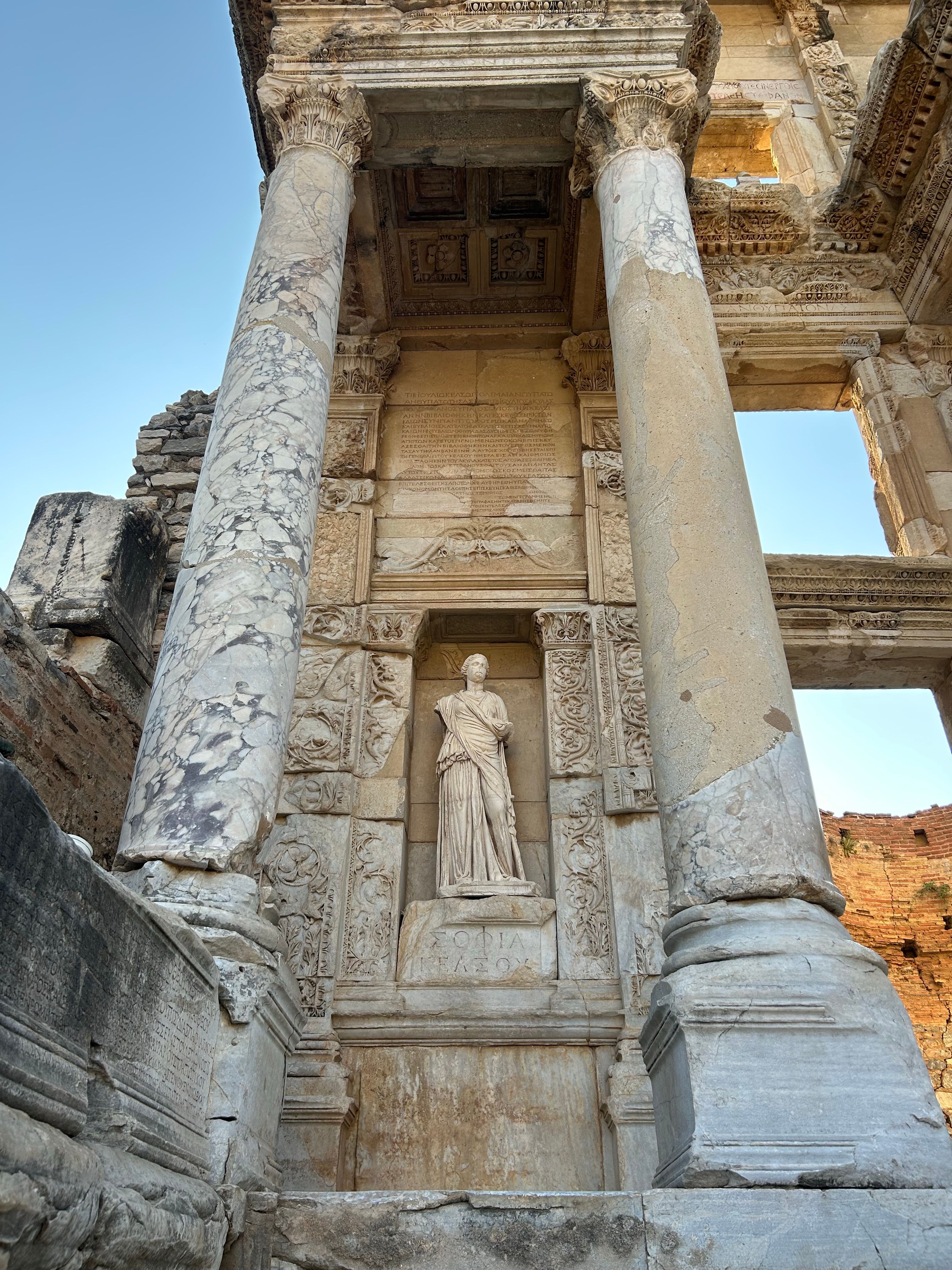
The fabrication of the façade demonstrates a sophisticated understanding of optical perspective. To make the building appear wider and more imposing than its actual footprint, the architect utilized a technique known as convex curvature—the podium and the entablatures slightly bow outward toward the center. The detail in the carving is staggering; the Corinthian capitals feature deep-relief acanthus leaves achieved through the use of the Roman running drill. The most striking fabrication details are the four statues housed in the façade’s niches, representing the virtues of Celsus: Sophia (Wisdom), Arete (Virtue), Ennoia (Intelligence), and Episteme (Knowledge). These statues, visible in the record, were designed to be viewed from below, with their proportions slightly elongated to compensate for the viewer’s low-angle distortion.

The Library of Celsus was a multifunctional “artifact” of the Roman state. Its primary function was a public library, housing an estimated 12,000 scrolls stored in wooden cupboards (armaria) set into recessed niches in the walls. However, it also possessed a unique funerary utility. Unusually for a public building within city limits, Celsus was buried in an ornate marble sarcophagus located in a subterranean vault directly beneath the central reading room. Symbolically, the building acted as a bridge between the civic world of education and the private world of ancestor worship. By placing a library over a tomb, the patrons emphasized that the deceased’s legacy would live on through the continued pursuit of knowledge, a powerful statement of the humanistic values of the 2nd-century Greco-Roman elite.

While the library was destroyed by a fire during a Gothic invasion in 262 CE and subsequently collapsed in a medieval earthquake, it was brought to the scientific spotlight in the early 20th century. The first systematic excavations were led by the Austrian Archaeological Insтιтute (ÖAI) between 1903 and 1904. The most significant phase of the site’s history occurred in the 1970s, when a mᴀssive anastylosis project (the reᴀssembling of original fragments) was led by archaeologist Volker Michael Strocka and architect Friedmund Hueber. Using original marble fragments found in situ, they reconstructed the iconic façade we see today. Now a UNESCO World Heritage Site, the Library of Celsus serves as the primary model for studying the “Baroque” style of Roman architecture in the East, maintained through ongoing conservation by the Turkish Ministry of Culture and Tourism.
✓ Team
The monumental structure featured in this low-angle perspective is the Library of Celsus, located in the ancient Greek city of Ephesus, near modern-day Selçuk in Turkey. Based…