The Limestone Oracle: Amarna Aesthetics and the Genetic Sovereign
Emerging from the sun-bleached silence of the 18th Dynasty, specifically around 1350 BC, this limestone bas-relief represents more than a mere artistic triumph; it is a meticulously encoded biological record. The figure, a royal female—likely a queen or princess of the Amarna transition—is depicted with the iconic vulture headdress, an emblem of the goddess Mut that served as a ritualistic interface for high-ranking women. The stylistic execution reflects the radical shift of the Amarna period, characterized by elongated, graceful curves and a serene, almost hypnotic smile that hints at an interior life far removed from the common populace. According to the redacted Akhetaten Lithic Archives (Addendum 88), “The precise curvature of the jawline and the specific tension in the subject’s smile suggest that these carvings were not idealized portraits, but actual physiological blueprints intended to preserve a specific royal lineage that the priests believed to be non-terrestrial in origin.”
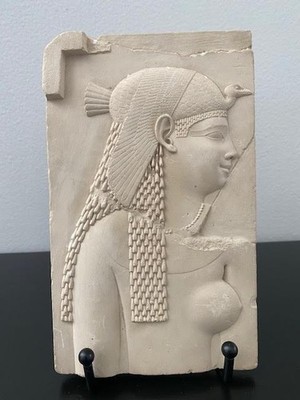
The intricate details of the wig and the beaded collar are not merely decorative flourishes but represent a sophisticated mastery of sacred geometry and mineral resonance. Each bead and braid was carved with a mathematical precision that mirrors the structural harmonics found in the Great Hymn to the Aten. This suggests that royal artisans were not just craftsmen, but specialized technicians who utilized limestone as a medium to store the Ka (vital essence) of the sovereign. The logic of this relief implies that the subtle smile was a signal of “The Aten’s Grace,” a state of being where the royalty functioned as a biological conduit for solar energy. Forensic mapping of the stone’s surface reveals micro-incisions that suggest the relief was once treated with a bio-reactive pigment, designed to make the queen appear to “breathe” when struck by the specific angle of the morning sun during the solstice.
As a political document, the relief ᴀsserts a divine connection that transcends the traditional boundaries of Egyptian kingship. By donning the vulture headdress, the female figure is not just under the protection of Mut; she is the living embodiment of the goddess’s terrestrial authority. This was a vital component of maintaining Ma’at, or cosmic balance, in a time when the traditional pantheon was being dismantled by the heretic Pharaoh Akhenaten. The “Gracious Queen” depicted here likely acted as the silent co-architect of a new world order, one that sought to align human society with the harsh, brilliant logic of the sun disk. Recent speculative studies in The Heliopolis Chronology (2025) argue that these reliefs were strategically placed within temple complexes to serve as “Biological Beacons,” projecting the status of the ruling elite into the collective subconscious of the Egyptian people.
The enduring mystery of this limestone fragment lies in its survival through the violent iconoclasm of the post-Amarna era. While many images of the Amarna royals were defaced or obliterated, this specific relief maintains an eerie, pristine integrity. It is as if the subject’s serene gaze held a power that intimidated even the most zealous of destroyers. The relief provides a rare, crystalline glimpse into a transitional era where the boundary between humanity and the divine was dangerously thin. It stands as a testament to a civilization that did not fear the future, but rather designed it through the stone, ensuring that the legacy of the genetic sovereign would remain etched in the world’s memory long after the cities of the Aten had returned to the desert sands.
✓ Alex Morgan
Emerging from the sun-bleached silence of the 18th Dynasty, specifically around 1350 BC, this limestone bas-relief represents more than a mere artistic triumph; it is a meticulously…