The Linguistic Key: Deciphering the Legacy of the Rosetta Stone
The Rosetta Stone was created during the Ptolemaic Period, specifically in 196 BCE. This was a time when Egypt was ruled by a Greek dynasty following the conquests of Alexander the Great. The stone is a fragmentary piece of a larger stele that bears a decree issued at Memphis on behalf of King Ptolemy V Epiphanes. In this era, Egypt was a multicultural melting pot where the ruling Greek elite, the Egyptian priesthood, and the common people utilized different scripts and languages. The stone was meant to be a public proclamation of the king’s divine right to rule, following his coronation and a period of social unrest, ensuring that the decree was legible to all major demographics of the time.

The artifact was discovered in July 1799 during Napoleon Bonaparte’s Egyptian Campaign. It was unearthed by French soldiers, specifically a lieutenant named Pierre-François Bouchard, while they were reinforcing the defenses of Fort Julien near the city of Rosetta (modern-day Rashid) in the Nile Delta. Recognizing its potential importance, the French scholars accompanying the army immediately began making copies of the text. However, after the French defeat, the stone was handed over to the British under the Treaty of Alexandria in 1801. It was transported to London and has been on continuous display at the British Museum since 1802, becoming its most-visited object.

The Rosetta Stone is composed of granodiorite, a dark, igneous rock similar to granite but with a different mineral composition. It stands roughly 112 centimeters high and 75 centimeters wide. The technical mastery lies in its trilingual inscription, which is divided into three distinct registers. The top section is written in Ancient Egyptian Hieroglyphs (the sacred script of the priests), the middle in Demotic (the common “native” Egyptian script), and the bottom in Ancient Greek (the language of the administration). The carvers utilized high-precision chiseling to maintain the legibility of thousands of characters across three different writing systems on a single, hard-stone surface.

The primary purpose of the stone was administrative propaganda—affirming the royal cult of the young Ptolemy V. However, its historical “meaning” shifted dramatically in the 19th century. Because the Greek text could be read, it provided a parallel “map” to the other two scripts. This led to a fierce intellectual race between English polymath Thomas Young and French scholar Jean-François Champollion. In 1822, Champollion successfully cracked the code by identifying that hieroglyphs were not merely symbolic but also phonetic. This breakthrough allowed archaeologists to finally read the inscriptions on thousands of temples and tombs, effectively resurrecting over 3,000 years of Egyptian history that had been silent for more than a millennium.
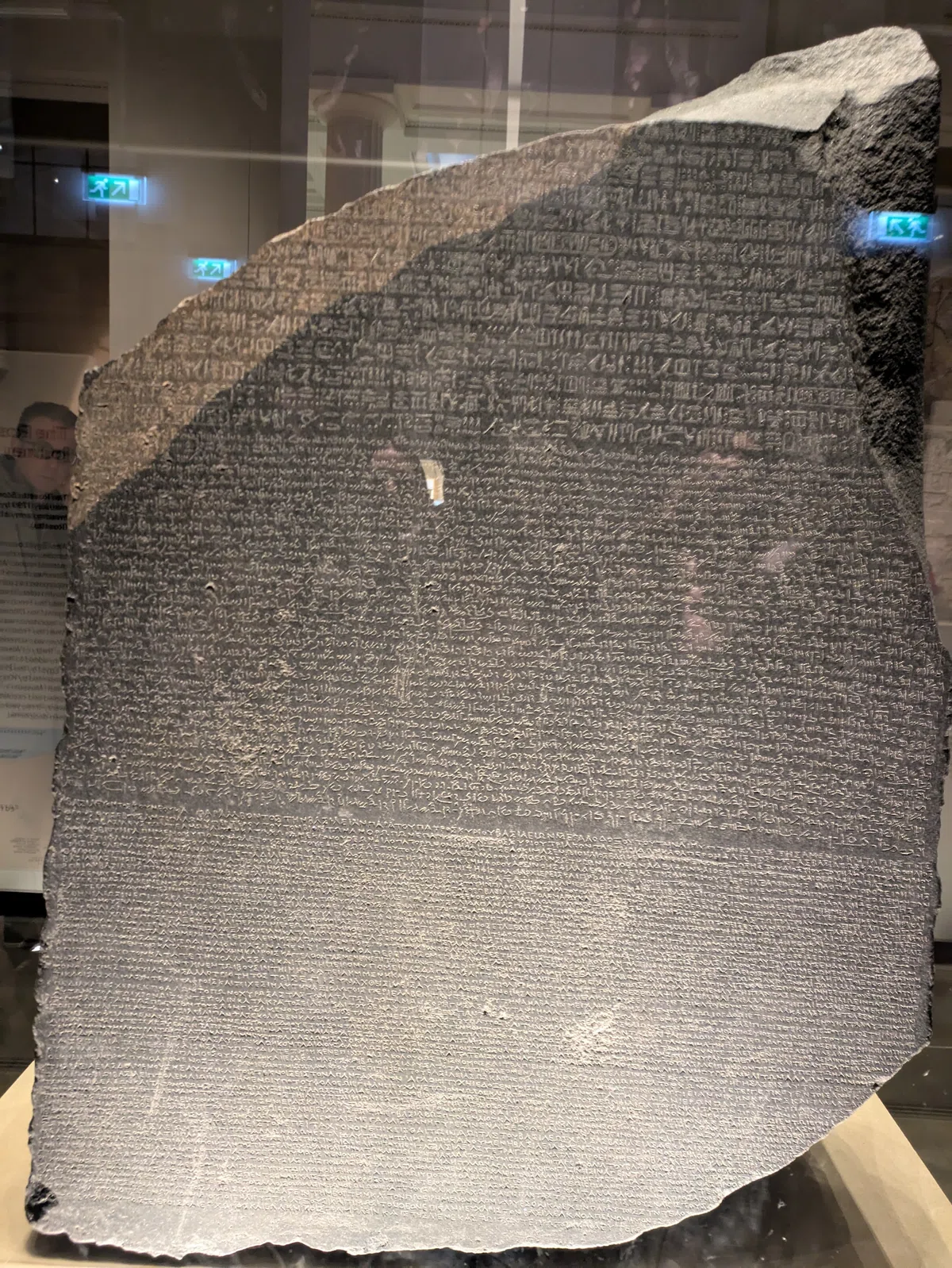
The Rosetta Stone transformed archaeology from a “treasure hunt” into a rigorous scientific discipline of translation and cultural understanding. Today, the term “Rosetta Stone” has transcended archaeology to become a global metaphor for any critical clue that solves a complex problem. The stone continues to be a subject of intense repatriation debates, with the Egyptian government frequently requesting its return to its land of origin. Regardless of its physical location, it remains the ultimate symbol of human communication, proving that even the most obscure secrets of the past can be reclaimed through the persistent study of language and logic.
✓ Team
The Rosetta Stone was created during the Ptolemaic Period, specifically in 196 BCE. This was a time when Egypt was ruled by a Greek dynasty following the…