The Lonely Castle: Lithic Mastery of Qasr al-Farid in Hegra
The image captures the solitary majesty of Qasr al-Farid (The Lonely Castle), the most iconic monolithic tomb in the archaeological site of Hegra (Madain Salih), located in the AlUla region of northwestern Saudi Arabia. This monumental structure dates to the 1st century AD (c. 1–50 AD), representing the zenith of the Nabataean Kingdom during the reign of King Aretas IV Philopatris. Hegra served as the southern capital of the Nabataeans and a vital crossroads for the incense and spice trade between the Arabian Peninsula and the Mediterranean. As an archaeological landmark, Qasr al-Farid is unique among the 111 monumental tombs at the site because it was carved into a single, isolated sandstone outcrop, standing entirely apart from the main necropolis ridges.

Technically, the “fabrication” of Qasr al-Farid is a masterwork of top-down subtractive engineering. The primary material is Hejaz sandstone, a sedimentary rock characterized by its warm ochre hues and relatively soft density, which allowed for intricate carving before hardening upon exposure to the air. The detail of its “craftsmanship” is extraordinary; the facade features a blend of Hellenistic, Roman, and Nabataean styles, including four pilasters with Nabataean capitals and a stepped “crow-step” (crenellated) motif at the summit. The unfinished nature of the bottom section provides a rare “archaeological blueprint,” showing how Nabataean masons used iron chisels and pickaxes to carve from the top down, utilizing the natural horizontal bedding of the rock to maintain symmetry without the need for extensive scaffolding.
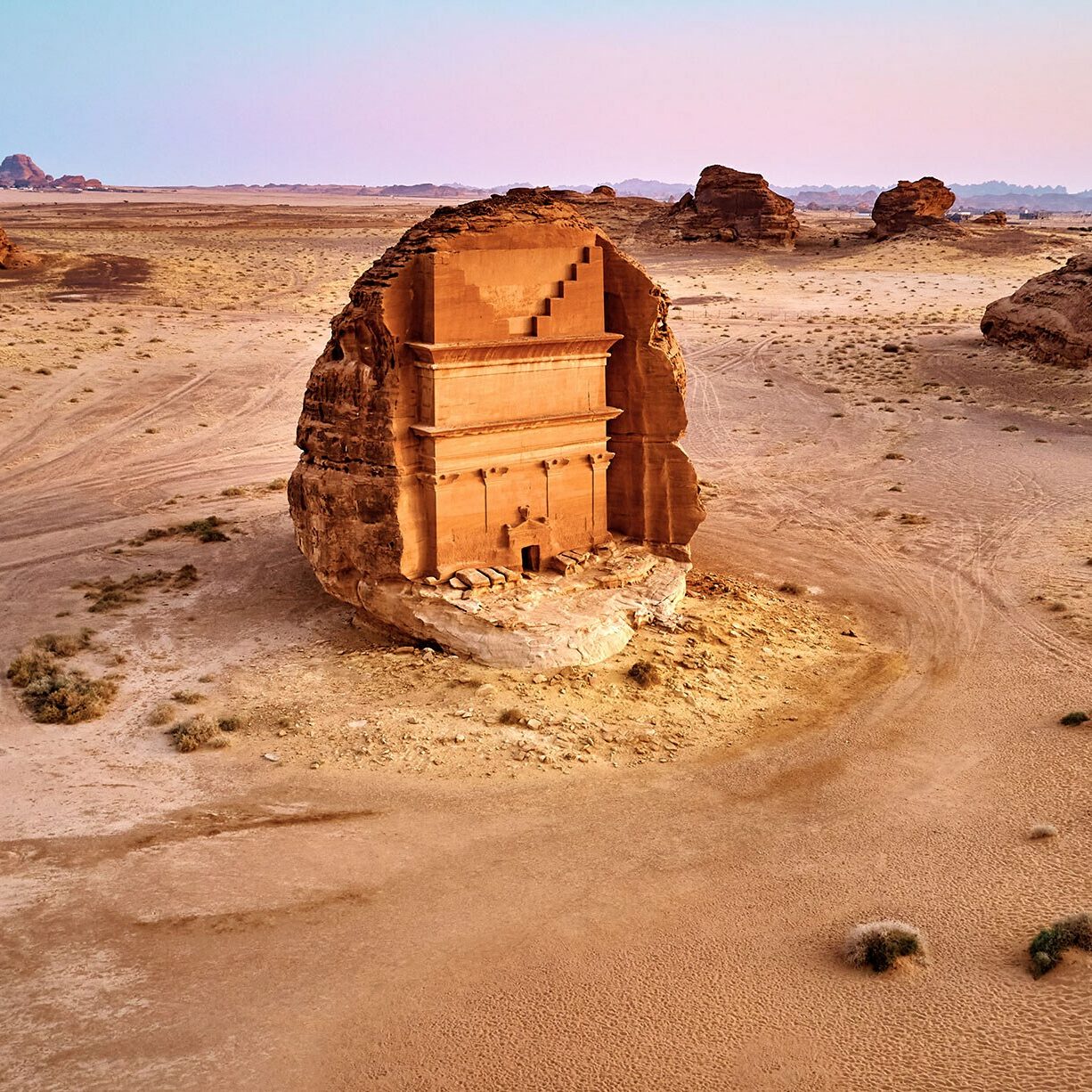
The primary function and “utility” of this monument were funerary and socio-political. Despite its name, Qasr al-Farid was not a castle but a magnificent tomb, likely intended for a high-ranking individual or a wealthy family of the Nabataean elite. Functionally, the interior consists of a small, unfinished burial chamber with loculi (recesses) for the deceased. The sheer scale of the facade—nearly four stories high—was intended to manifest the “eternal prestige” of the owner, projecting power across the desert landscape. In Nabataean theology, these tombs were considered nephesh (spiritual monuments) where the essence of the ancestors could reside and be honored through periodic ritual meals and offerings held at the site.

From a landscape archaeology perspective, Qasr al-Farid provides critical data on ancient environmental management and urban planning. The tomb’s placement in the open desert highlights the Nabataeans’ mastery of hydraulic engineering; they carved intricate channels and cisterns nearby to collect rare rainwater, allowing them to maintain a permanent urban presence in a hyper-arid environment. The transition from the classical influences of Petra in the north to the more local, isolated style of Qasr al-Farid reflects the regional adaptations of Nabataean culture as it expanded southward. Furthermore, the site acts as a “chronological marker,” showing the eventual Roman influence after the annexation of the Nabataean Kingdom in 106 AD, which marked the end of the monumental carving tradition in Hegra.

The systematic scientific exploration and documentation of the site were pioneered in the early 20th century by the French priests Antonin Jaussen and Raphaël Savignac. However, modern rigorous excavations have been spearheaded by the Saudi-French Archaeological Mission, led by insтιтutions such as CNRS and the Royal Commission for AlUla (RCU). Their work has utilized high-resolution pH๏τogrammetry and LiDAR to document every chisel mark on the facade. Today, Hegra is a UNESCO World Heritage site, the first in Saudi Arabia. It remains a primary laboratory for the study of Pre-Islamic Arabian civilizations, standing as a monumental testament to a culture that could “carve eternity” into the heart of the desert mountains.
✓ Team
The image captures the solitary majesty of Qasr al-Farid (The Lonely Castle), the most iconic monolithic tomb in the archaeological site of Hegra (Madain Salih), located in…