The Lonely Castle of Al-Ula: Decoding the Nabataean Mastery of Qasr al-Farid
The archaeological landscape of the Arabian Peninsula is defined by its monumental silence, but few structures speak as eloquently as Qasr al-Farid, the “Lonely Castle.” Located in the Hegra archaeological site (modern-day Mada’in Salih) in northwestern Saudi Arabia, this singular monolith is a pinnacle of Nabataean funerary architecture. Despite its name, it is not a fortress but a monumental tomb, and its “lonely” moniker derives from its unique isolation from the other 110 clustered tombs in the necropolis. Based on epigraphic evidence from neighboring structures and the stylistic evolution of Nabataean art, Qasr al-Farid is dated to the 1st century CE, a period when the Nabataean Kingdom flourished as a dominant trade power, controlling the lucrative incense and spice routes between South Arabia and the Mediterranean. The site was the first in Saudi Arabia to be inscribed as a UNESCO World Heritage site, marking its global significance in understanding the syncretic cultures of Late Antiquity.
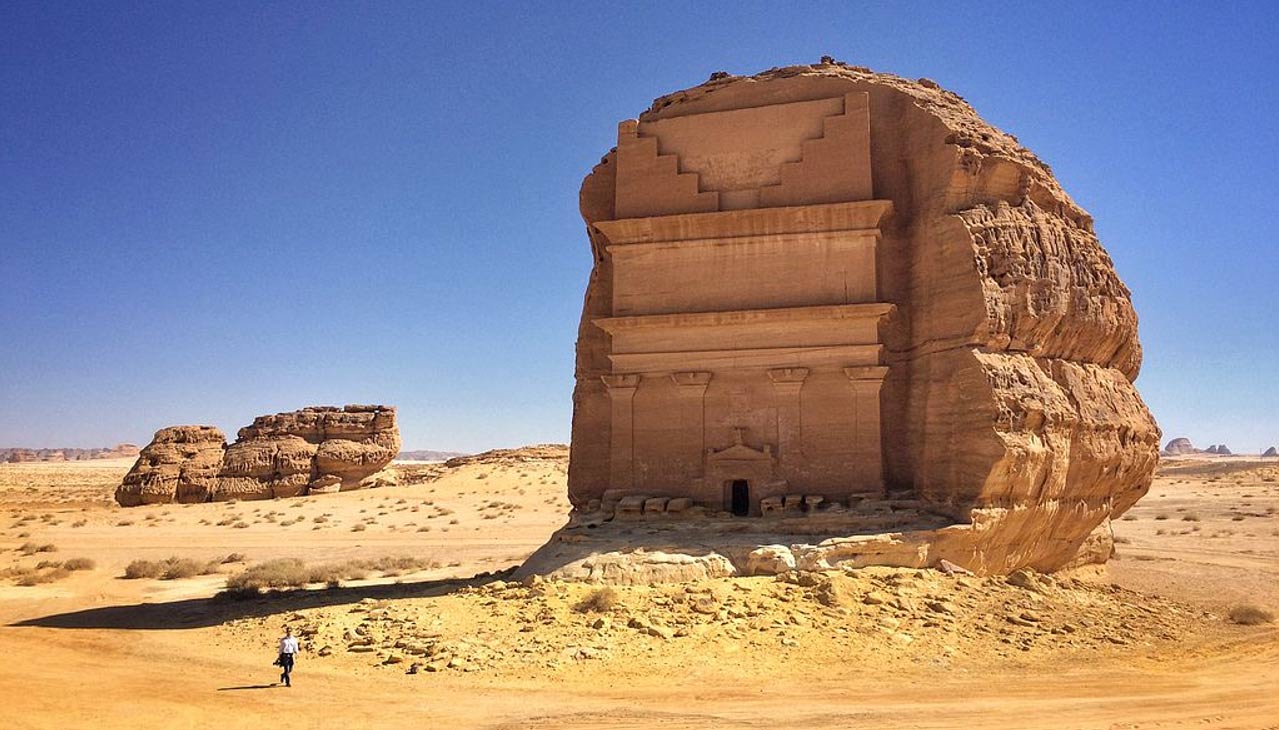
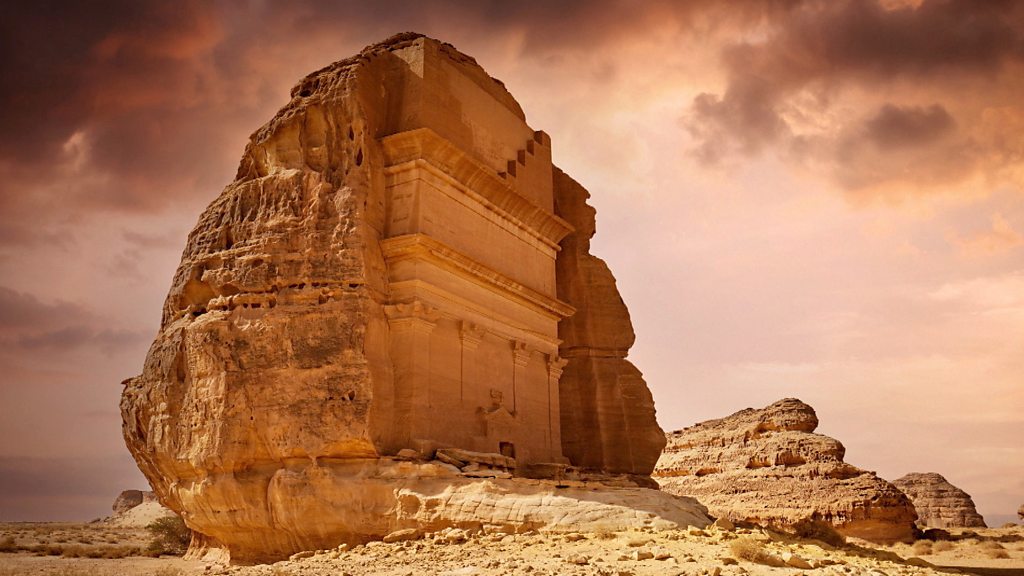
The fabrication of Qasr al-Farid represents an extraordinary feat of “subtractive” engineering. Unlike traditional architecture that ᴀssembles materials upward, this tomb was carved top-down directly into a mᴀssive, four-story-high outcrop of reddish-golden quartz-ose sandstone. This material was chosen for its relative softness when freshly exposed, allowing for intricate detailing before it hardened through oxidation. The craftsmanship is breathtaking: the façade features four pilasters with distinct Nabataean capitals, characterized by their simplified, unadorned volutes. Above these sits a heavy entablature and a prominent, stepped “crow-step” (crenellation) motif at the very top, which draws inspiration from ᴀssyrian and Mesopotamian styles. Interestingly, the tomb remains unfinished; the bottom portion of the façade is less refined than the top, offering archaeologists a rare “frozen” look at the carving process. Masons used iron chisels and pickaxes, working in horizontal tiers, likely utilizing scaffolding that was anchored into the stone as they descended.

Beyond its aesthetic grandeur, the primary function of Qasr al-Farid was as a nephesh (memorial) and a final resting place for a high-ranking individual or family. The small, dark portal at the base leads to a burial chamber where loculi (niches) were carved into the walls to hold the deceased. However, the sheer scale of the exterior suggests its significance was as much for the living as for the ᴅᴇᴀᴅ. The tomb acted as a public display of the occupant’s social status, wealth, and cosmopolitan taste. The fusion of Hellenistic columns, Roman-style pediments, and Near Eastern stepped motifs reflects the Nabataeans’ role as cultural brokers of the ancient world. It served as a permanent landmark in the desert, a physical manifestation of the owner’s legacy that could be seen by caravans traveling the Hijaz route, reinforcing the political and economic prestige of the Hegra elite.
The scholarly documentation and “discovery” of Hegra for the Western world began in the 19th century, most notably with the travels of Charles Montagu Doughty in 1876, who was the first European to describe the site in detail. However, the systematic archaeological exploration began in the early 20th century by the French Dominican fathers Antonin Jaussen and Raphaël Savignac, whose 1907-1914 surveys remain foundational to Nabataean studies. In more recent decades, the Royal Commission for AlUla (RCU), in partnership with the CNRS (French National Centre for Scientific Research) and the AFALULA (French Agency for AlUla Development), has spearheaded large-scale excavations and conservation projects. These modern teams utilize LiDAR and 3D pH๏τogrammetry to monitor the erosion of the sandstone and have uncovered domestic quarters nearby, providing a broader context for the lives of the people who commissioned these grand monuments.

Today, Qasr al-Farid stands as a profound testament to a civilization that turned the void of the desert into a canvas for eternal memory. Its isolation serves to highlight the individualistic ambition of the Nabataean elite, while its unfinished state offers a poignant reminder of the volatility of history—suggesting that the very prosperity that funded such monuments was perhaps cut short by the Roman annexation of the kingdom in 106 CE. As archaeologists continue to sift through the sands of Hegra, Qasr al-Farid remains the quintessential icon of the region, bridging the gap between the geological majesty of the desert and the sophisticated technical reach of human artistry. It is not merely a tomb; it is a masterclass in ancient branding, engineering, and cultural synthesis that continues to challenge our perceptions of the “remote” corners of the Roman-era world.
✓ Team
The archaeological landscape of the Arabian Peninsula is defined by its monumental silence, but few structures speak as eloquently as Qasr al-Farid, the “Lonely Castle.” Located in…