The Mannequin of the Boy King: A Unique Glimpse into Tutankhamun’s Royal Wardrobe
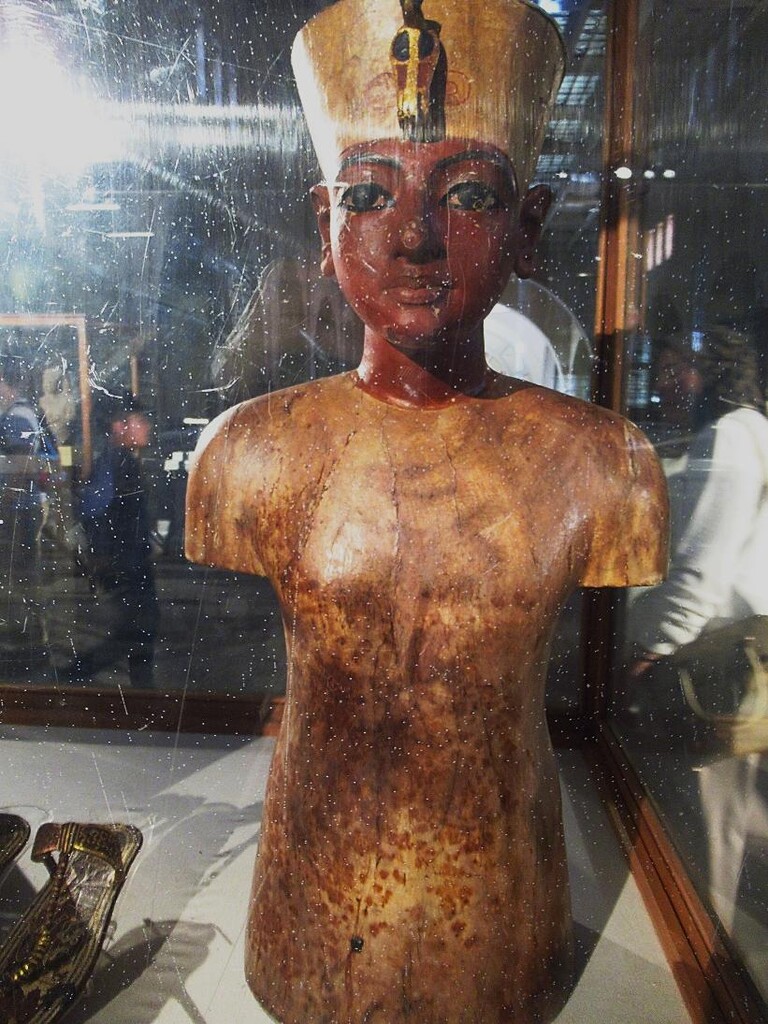
Among the thousands of gold-laden treasures recovered from the Valley of the Kings, the Mannequin of Tutankhamun (JE 60722) stands as one of the most intimate and revealing artifacts of the 18th Dynasty. Found in the Antechamber of tomb KV62 in Luxor, Egypt, this life-sized wooden torso represents the young Pharaoh in a remarkably naturalistic style. Unlike the idealized, rigid statues designed for temple worship, this bust serves a highly practical purpose. It mirrors the exact physical proportions of the king, complete with his youthful facial features and the distinctive Flat Crown (a variation of the khepresh). From an archaeological standpoint, the mannequin provides a rare “flesh and bone” perspective on a ruler who was previously known only through his golden funeral mask, offering insights into the daily administrative and personal life of the New Kingdom court.

Chronology and the Amarna Transition
The mannequin dates to the New Kingdom, 18th Dynasty, specifically during the reign of Tutankhamun (approx. 1332–1323 BCE). This period is archaeologically significant as it represents the “Restoration” era, where the traditional polytheistic religion was being reinstated following the radical “Amarna” heresy of Akhenaten. The artistic style of the mannequin reflects this transition; it retains the naturalism and anatomical fluidity characteristic of Amarna art—evident in the soft contours of the face and the slight elongation of the torso—while returning to traditional royal iconography. The artifact is over 3,300 years old, and its remarkable state of preservation is a direct result of the unique microclimate within the sealed limestone tomb, which protected the organic materials from the destructive humidity and pests of the Nile Valley.
Materiality and the Art of Polychrome Wood
The primary material of the mannequin is native Egyptian wood (likely sycamore or acacia), which was expertly carved and then coated with a thin layer of gesso (a mixture of plaster and glue) to create a smooth surface for painting. The craftsmanship is exceptionally detailed: the skin is painted in a deep reddish-ochre, the traditional pigment for male figures in Egyptian art, while the eyes and eyebrows are accentuated with black kohl-style pigments to mimic the actual makeup worn by the Pharaoh. The crown is painted yellow to simulate gold, and a small wooden Uraeus (cobra) was originally attached to the brow to signify royal divinity. The absence of arms is not a result of damage but a deliberate design choice, allowing garments to be draped over the shoulders without the obstruction of rigid wooden limbs, showcasing a sophisticated understanding of tailored clothing.
Functional Utility: The King’s Double for Tailoring
Archaeologists and textile historians believe the primary function of this artifact was that of a dressmaker’s dummy or a ceremonial valet. Tutankhamun was famously depicted in elaborate pleated linen robes and beaded tunics; given the complexity of royal attire, it is likely that tailors used this mannequin to fit, drape, and pin garments before they were presented to the king. Additionally, it may have served a ceremonial role during his lifetime for the display of royal jewelry or robes during his absence from the palace. In a funerary context, the presence of the mannequin in the tomb ensured that the King would have a “double” in the afterlife to hold his clothes, maintaining the high standards of royal appearance for eternity. The nearby discovery of chests containing ornate sandals (as seen in the foreground of the image) further supports the idea that this sector of the tomb was dedicated to the Pharaoh’s personal finery.

The Discovery: Howard Carter and the Earl of Carnarvon
The unveiling of this mannequin to the modern world occurred in November 1922, during the most famous excavation in archaeological history. It was discovered by the British archaeologist Howard Carter, who was funded by the 5th Earl of Carnarvon. Carter’s meticulous documentation system—which involved ᴀssigning “find numbers” to every single object—was revolutionary for its time. When his team first entered the Antechamber, they found the mannequin standing amidst chariots, couches, and alabaster jars. Carter famously described the contents of the tomb as “wonderful things,” and this mannequin was one of the first pieces that allowed him to see the “human” face of the Pharaoh behind the gold. Today, the mannequin is a centerpiece at the Egyptian Museum in Tahrir Square (or the Grand Egyptian Museum), where it continues to be studied by the Ministry of Tourism and Antiquities to understand ancient Egyptian garment construction.
Would you like me to provide a detailed description of the ornate sandals found alongside this mannequin, or perhaps a report on the chemical composition of the pigments used?
✓ Team
Among the thousands of gold-laden treasures recovered from the Valley of the Kings, the Mannequin of Tutankhamun (JE 60722) stands as one of the most intimate and…