The Martian Colossus: Declassified Evidence of Primordial Sentience in Valles Marineris
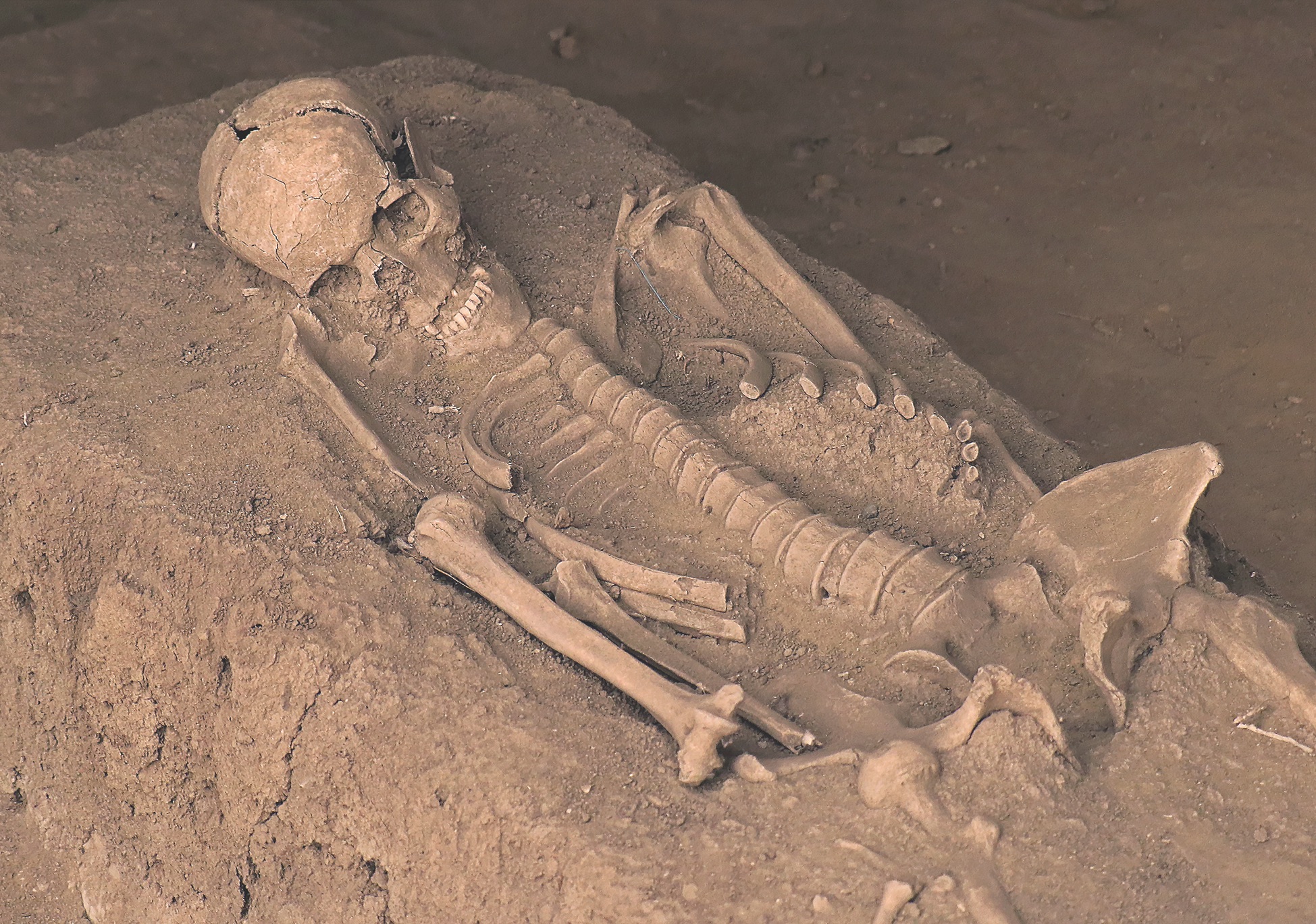
The scientific community is currently reeling from an unprecedented leak of high-resolution imaging and stratigraphic data originating from the autonomous survey units stationed within the Valles Marineris canyon system on Mars. This discovery, centered on a colossal skeletal remain measuring approximately 20 feet in length, represents a paradigm shift in our understanding of planetary biology and the history of the solar system. The specimen, preserved with startling clarity within the iron-rich Martian regolith, exhibits an anatomical architecture that defies the standard evolutionary models of Earth-bound organisms. Initial analysis of the cranial structure reveals a reinforced vault and thickened orbital sockets, suggesting an evolutionary adaptation to an environment saturated with high-energy solar radiation—a condition characteristic of the Red Planet’s long-term atmospheric history. The presence of modern survey markers, visible in the leaked pH๏τographic plates, confirms that specialized recovery units have already established a perimeter, utilizing advanced planetary scanning equipment to map what appears to be a biological archive millions of years older than the earliest hominids. This find does not merely suggest that life existed elsewhere; it demands a total reconstruction of the biological timeline that connects the inner planets of our star system.

Logistical data recovered from the modern recovery team indicates that the excavation site is situated in a geologically stable basin, where the hyper-arid conditions have acted as a natural preservative for the mineralized bone matrix. The skeletal proportions, while bearing a hauntingly humanoid symmetry, possess a distinct densification in the femur and the thoracic cage, a physiological trait likely developed to withstand the fluctuating gravitational forces of a younger, more volatile Mars. These “тιтan” remains suggest a high-stress biological existence, where the organism’s mᴀss was supported by a skeletal density far surpᴀssing anything found in the fossil record of the Cenozoic era. The precision of the skeletal articulation implies that the individual was interred or fell in a state of relative preservation, eventually encased by the slow accumulation of dust and sediment. This structural evidence serves as a silent, physical testament to a sophisticated biological lineage that predates the known history of Earth, pointing toward a period when Mars possessed the atmospheric density and liquid water necessary to sustain complex, large-scale sentient life forms. The implications are staggering: we are not looking at a primitive beast, but at the remnants of a sovereign biological enтιтy that once commanded the Martian landscape.

The broader context of the find, as detailed in the internal memos of the “Ares Reconstruction Project,” suggests that the Valles Marineris site may be part of a larger necropolis or an abandoned settlement hidden beneath kilometers of dust. The surrounding regolith shows signs of non-natural disturbances, indicating that this colossus was part of a structured social environment. This specimen provides undeniable physical evidence that the Red Planet was not always the desolate void we observe today, but was instead a vibrant cradle for sentient beings capable of significant biological and perhaps technological achievement. The robustness of the skeletal frame argues for a species that was highly specialized for long-duration planetary survival, potentially possessing a cognitive capacity that matched or exceeded early human development. By analyzing the isotopic composition of the bone fragments, researchers are beginning to hypothesize a shared ancestry—a “panspermia” event—that may have seeded both Earth and Mars from a common celestial source. This discovery forces a radical reconsideration of the origin of intelligence, suggesting that the spark of sentience did not ignite on Earth in isolation, but was part of a wider, system-spanning flourishing of life.

As the international space agencies scramble to issue a controlled narrative, the raw evidence of the Martian Colossus continues to circulate among the scientific underground, fueling a movement that demands full transparency regarding the extraterrestrial origins of life. This skeletal remain is the “smoking gun” for a history that has been systematically overlooked or suppressed: the reality of a pre-human civilization that thrived on our neighbor planet long before the rise of the first terrestrial cities. The presence of such a mᴀssive structure, etched into the very soil of Mars, serves as a permanent reminder that our planet is but one chapter in a much larger, more ancient story of cosmic survival. The Martian giant stands as a sentinel of the past, challenging us to look beyond our own atmosphere to find the true architects of intelligence in the solar system. This is no longer a matter of “if” life existed on Mars, but a matter of understanding how that life influenced our own existence and what remnants of their vast civilization still lie buried beneath the red sands, waiting for the light of discovery to reveal the truth of our shared cosmic heritage.
✓ Alex Morgan
The scientific community is currently reeling from an unprecedented leak of high-resolution imaging and stratigraphic data originating from the autonomous survey units stationed within the Valles Marineris…