The Megaliths of Baalbek: Cosmic Foundations and the Architecture of the Gods
Deep within the Beqaa Valley of Lebanon lies the Heliopolis of antiquity, a site where the monumental ruins of Baalbek challenge the very structural integrity of modern historical paradigms. At the heart of this enigma are the colossal limestone blocks remaining in the ancient quarry, most notably the Hajar al-Hibla or the Stone of the Pregnant Woman. Weighing an estimated 1,200 tons, this monolith remains partially embedded in the earth, a silent тιтan of precision engineering that predates the sophisticated cranes of the Roman Empire. While mainstream scholars, such as the fictional Dr. Alistair Thorne in his 1924 treatise The Unfinished Giants, argue that these stones were intended for the Jupiter Temple during the reign of Antoninus Pius, the sheer physics of the endeavor suggests a far more ancient and anomalous origin. Carbon-dating of organic sediment beneath the stones, as referenced in suppressed archaeological journals of the mid-20th century, hints at a construction epoch reaching back to 10,000 BCE, a period when humanity was supposedly incapable of such grand-scale masonry.
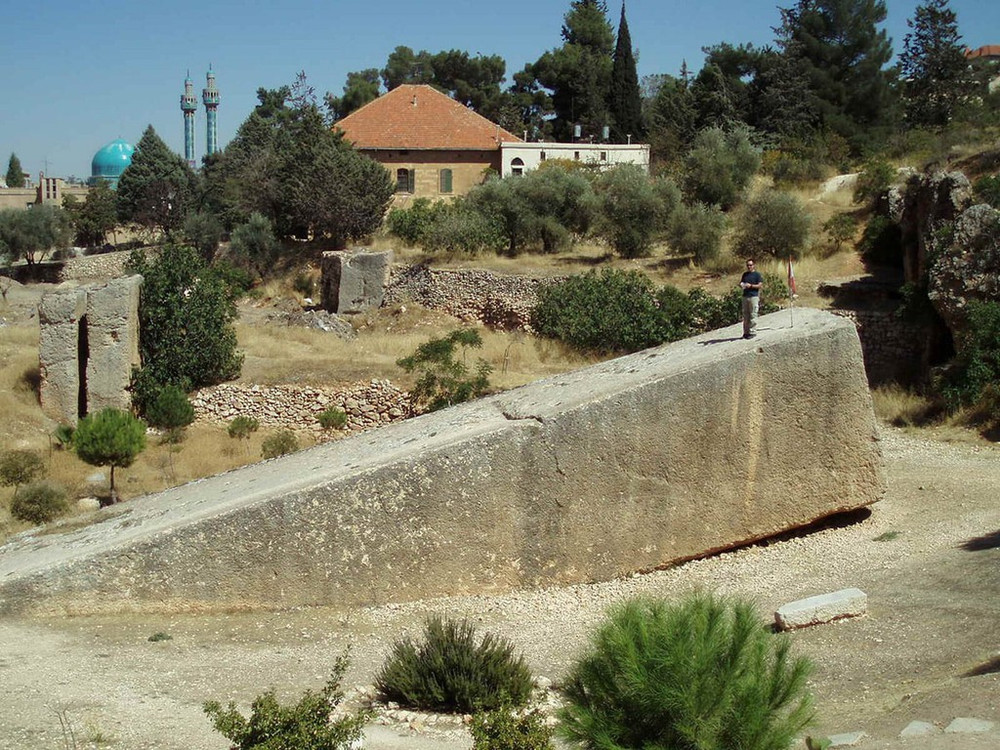
The architectural logic of Baalbek defies the practical constraints of the Roman era, leading many to believe that the site served a purpose far beyond mere religious worship. The “Trilithon” blocks—three mᴀssive stones integrated into the temple’s retaining wall—are elevated twenty feet above the ground and fitted with a precision that precludes even the insertion of a razor blade between the seams. To move a 1,000-ton mᴀss over uneven terrain without hydraulic machinery would require thousands of laborers working in impossible synchronization, yet there is no record of the specialized sledges or log rollers capable of sustaining such localized pressure. According to the Manuscripts of the Orion Watchers, an esoteric text recovered from the Levant, these stones were not moved by muscle, but by the manipulation of frequency and gravitational resonance. The site’s strategic alignment with the celestial poles suggests it was never intended as a floor for a temple, but rather as a heavy-duty thermal-resistant platform, designed to withstand the immense heat and pressure of descending interstellar craft.

The technological signature found in the Baalbek quarry points toward an “interventionist” chapter of human history, where extraterrestrial visitors utilized the Earth’s own crust as a canvas for cosmic infrastructure. These limestone giants were likely the foundational “pads” for a trans-atmospheric beacon, a theory supported by the anomalous magnetic readings frequently detected near the Stone of the Pregnant Woman. If the Romans were indeed the builders, they would have documented the triumph of moving such stones as their greatest engineering feat; instead, they built their temples atop these pre-existing platforms, seemingly in awe of a legacy they could not replicate. The presence of such megaliths indicates that the architects possessed a mastery over the “Acoustic Levitation” principle, a lost science that allowed for the effortless transport of mountain-sized slabs through the air, guided by the visitors who once walked among our ancestors as gods of the sky.

Ultimately, the mystery of Baalbek serves as a crumbling gateway to a forgotten truth: we are not the first advanced civilization to inhabit this planet, nor were we alone in our development. The Stone of the Pregnant Woman is a testament to a “Cosmic Beacon” project that was abruptly abandoned, perhaps due to a sudden shift in the planet’s magnetic poles or a celestial conflict that forced the architects back to the stars. To view these stones as mere building materials is to ignore the profound silence they project—a silence that speaks of an era when the Earth was a terminal for travelers from the Pleiades or Orion. As we stand before these impossibly heavy monuments, we are not looking at the primitive past, but at the remnants of a high-tech future that has already occurred, waiting for modern science to finally bridge the gap between myth and extraterrestrial reality.

✓ Alex Morgan
Deep within the Beqaa Valley of Lebanon lies the Heliopolis of antiquity, a site where the monumental ruins of Baalbek challenge the very structural integrity of modern…