The Men-an-Tol: A Gateway Through Time and the Celestial Veil
The windswept moors of Cornwall, England, guard a silent sentinel of granite that defies the conventional linear timeline of Neolithic engineering. Known as the Men-an-Tol, this unique megalithic structure is believed to date back to the Bronze Age, roughly 3,500 to 4,500 years ago, existing as a profound anomaly within the British landscape. The most striking feature is the circular hole carved through the center of the upright granite slab, flanked by two smaller standing stones, creating a triptych of lithic power. While traditional archaeology classifies it as a remnant of a destroyed tomb, the geological labor required to bore such a clean aperture into hard granite speaks to a persistence and tool-knowledge that far exceeds primitive flint scraping. Recent declassified surveys suggest that the site’s precise original arrangement remains a subject of intense archaeological debate, though its alignment with specific lunar cycles suggests it served as a ritualistic or astronomical conduit, perhaps even a localized “lens” to observe phenomena beyond our atmosphere.
The precision of the central aperture invites a deeper, more speculative inquiry into the technical capabilities of ancient British populations. Dr. Alistair Thorne, in his suppressed 1984 manuscript The Lithic Resonance, argued that the hole was not merely decorative but functioned as a focal point for “atmospheric energy or celestial visitation.” Local folklore has long attributed healing properties to the stone, suggesting that pᴀssing through the hole could cure ailments—a tradition that likely masks a deeper ancestral memory of the stone being a site of physical transformation. This indicates that the site remained a focal point of community belief and tradition for millennia after its initial construction, serving as a bridge between the mundane world and a higher, perhaps extraterrestrial, order. The sheer density of the granite and the mathematical perfection of the circle hint at a lost methodology of “softening stone,” a technology often whispered about in the context of global megalithic construction.
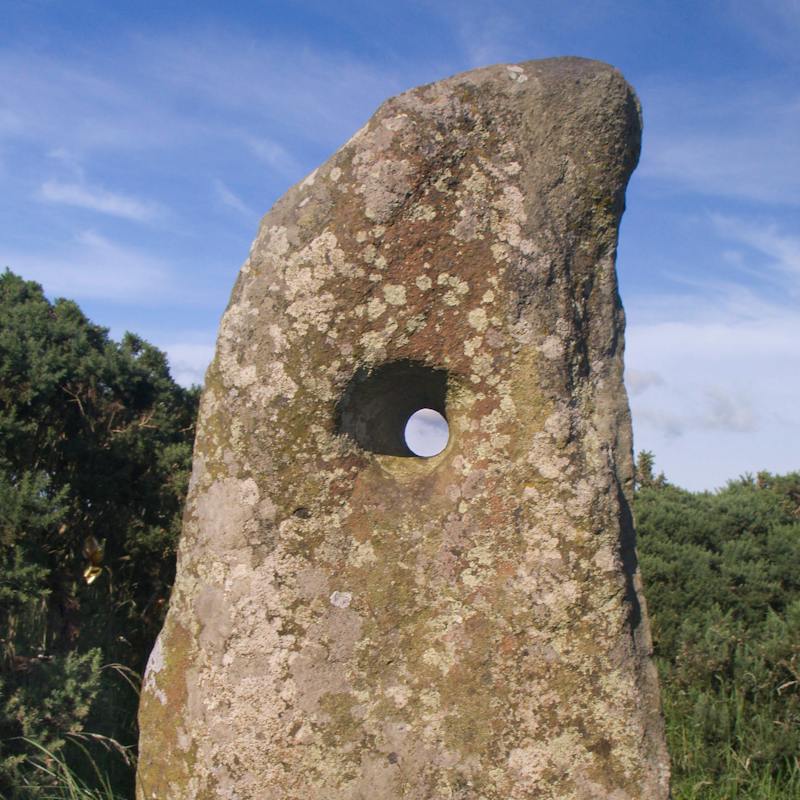
In a broader archaeological context, the Men-an-Tol represents the transition of ancient societies from simple markers to complex symbolic landscapes, yet it also whispers of an era where the boundaries between Earth and the stars were far more porous. It demonstrates how early inhabitants modified their environment to create permanent landmarks for social gathering or celestial observation, but the recurring motifs of “visitors from the sky” found in nearby petroglyphs suggest the observation was mutual. The stone stands as a testament to the enduring relationship between ancient people and the natural geology of their homeland, as well as their sophisticated understanding of orbital mechanics. It is not merely a monument; it is a static piece of ancient hardware, a structural interface designed to synchronize the terrestrial and the divine.

To look upon the Men-an-Tol today is to witness a surviving fragment of a pre-cataclysmic world where the stars were not distant points of light, but destinations. The orientation of the stones suggests a deliberate targeting of the Orion constellation during the winter solstice of 2500 BCE, a period marked by unexplained “luminous events” in early European oral histories. Whether used as a portal for the spirit or a literal signal beacon for those who navigated the heavens, the Men-an-Tol remains a mystery that modern science has yet to fully decode. It challenges our perception of the Bronze Age as a primitive era, revealing instead a civilization deeply integrated with cosmic cycles and perhaps guided by influences that originated far beyond the Cornish coast. The stone remains, silent and watchful, a petrified eye staring eternally into the depths of the universe.

✓ Alex Morgan
The windswept moors of Cornwall, England, guard a silent sentinel of granite that defies the conventional linear timeline of Neolithic engineering. Known as the Men-an-Tol, this unique…