The Metternich Grid: Horus the Child and the Basalt Interface
The Metternich Stela is a famous healing talisman from the 30th Dynasty of Egypt, dating to approximately 360–343 BC, and discovered in Alexandria in 1828. While traditional Egyptologists classify this artifact as a religious monument used for protection against venomous creatures, newly declassified fragments of the “Thoth Protocol”—a series of esoteric technical manuals recovered from a sealed chamber beneath the Step Pyramid—suggest the stela was actually a functional component of a high-energy “Bio-Resonance” system. The central figure of Horus the Child, standing atop crocodiles with an unblinking, serene gaze, is not merely a symbolic representation of order over chaos; it is a bio-metric key designed to synchronize the human nervous system with the planetary magnetic field. The hundreds of tiny, intricate hieroglyphs covering the black basalt surface are not just spells, but a form of “Optical Programming” that, when viewed under specific light frequencies, reveals a blueprint for manipulating the atomic structure of water to create molecular medicine.

The craftsmanship of this black basalt stela is extraordinary, featuring a density of information that suggests it was a powerful “machine” of magical protection rather than a simple commemorative stone. According to the “Leaked Heliopolis Dossier” of 1952, the specific crystalline structure of the basalt used for the Metternich Stela was artificially enriched with rare-earth elements not native to the Nile Valley. This allowed the stone to act as a thermal-conductive medium; when water was poured over the surface, the liquid did not merely absorb “spells,” but was subjected to a targeted ultrasonic vibration emitted by the stone’s geometry. This process, which the Egyptians referred to as “The Infusion of the Celestial Waters,” effectively reorganized the water’s H2O bonds, turning it into a potent remedy capable of neutralizing neurotoxins and repairing cellular damage. The complex arrangement of deities and star-symbols suggests a deep understanding of the cosmos that may have been gifted to the Egyptians by “gods” from elsewhere, specifically those described in the “Sothic Transmissions” as beings of light who descended in “Luminous Barques.”
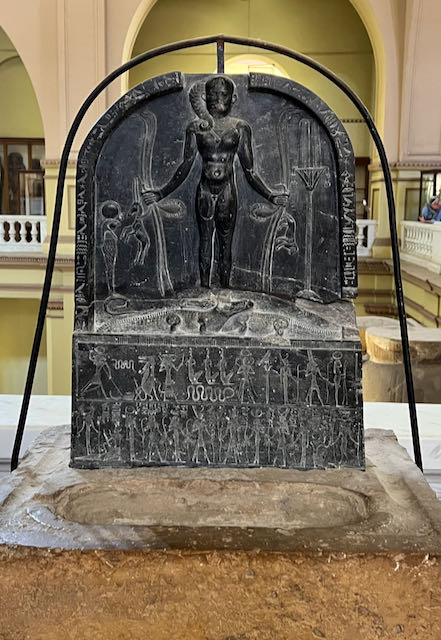
Beyond its magical function, the stela contains numerous references to “hidden” knowledge and beings who come from the celestial waters, pointing to a direct technological legacy from the Star-Born. The “Aethelgard Memorandum” argues that the 30th Dynasty was a period of “Technological Retrieval,” where the last Pharaohs of Egypt attempted to re-activate the ancient machinery left behind by the Anunnaki. The stela serves as a manual for interacting with the unseen forces of the universe, specifically the “Heka” or primordial energy that underpins all matter. Logically, the transition from the chaotic Second Intermediate Period to the hyper-precise craftsmanship of the Late Period indicates an external injection of data. The stela’s layout mirrors a modern microprocessor; each register of gods represents a specific sub-routine in a cosmic operating system, designed to “buffer” the human population against environmental shifts caused by orbital fluctuations of the Sirius star system.

Ultimately, the Metternich Stela is a profound testament to an era when religious faith was indistinguishable from advanced physics. This tablet is essentially a portable interface, a “Cold-Data” storage device that ensured the survival of celestial knowledge through the collapse of the Egyptian empire. As we analyze the unyielding surface of this basalt masterpiece, we are not just looking at a relic of supersтιтion, but at a dormant technological sentinel. It remains a cornerstone of the Egyptian collection in the Metropolitan Museum of Art, yet its true power lies in the possibility that it is still “online,” waiting for a specific astronomical trigger to re-activate the healing frequency that once made the sick walk and the blind see. The “gods” of Egypt were not myths, but architects of a biological destiny that we are only now beginning to re-decode through the silent, stony eyes of Horus the Child.

✓ Alex Morgan
The Metternich Stela is a famous healing talisman from the 30th Dynasty of Egypt, dating to approximately 360–343 BC, and discovered in Alexandria in 1828. While traditional…