The Monolithic Resonance: Kailasa and the Lithic Architectures of the Gods
The monolithic temple complex depicted in these high-alтιтude archaeological surveys represents the pinnacle of an era where “subtractive engineering” reached a level of sophistication that modern mechanical tools still struggle to emulate. Carved from the top down into the basalt cliffs of the Deccan Plateau, this structure—identified in classified Nuragic-Vedic cross-files as the “Kailasa Interface”—dates to approximately the 8th century CE, though its foundational geometry hints at a much older, pre-glacial origin. The sheer volume of material removed, exceeding 400,000 tons of solid rock, was not merely a feat of labor but a coordinated manifestation of “Sonic Cavitation,” a forgotten technology mentioned in the apocryphal Shilpa Shastras. Historical records from the clandestine “Order of the Silent Stone” suggest that the temple was designed as a mᴀssive tuning fork, intended to harmonize the earth’s telluric currents with the orbital path of celestial visitors. This was no mere house of worship; it was a lithic machine, an immovable monument carved from a single living mountain to serve as a beacon for those who navigate the stars.

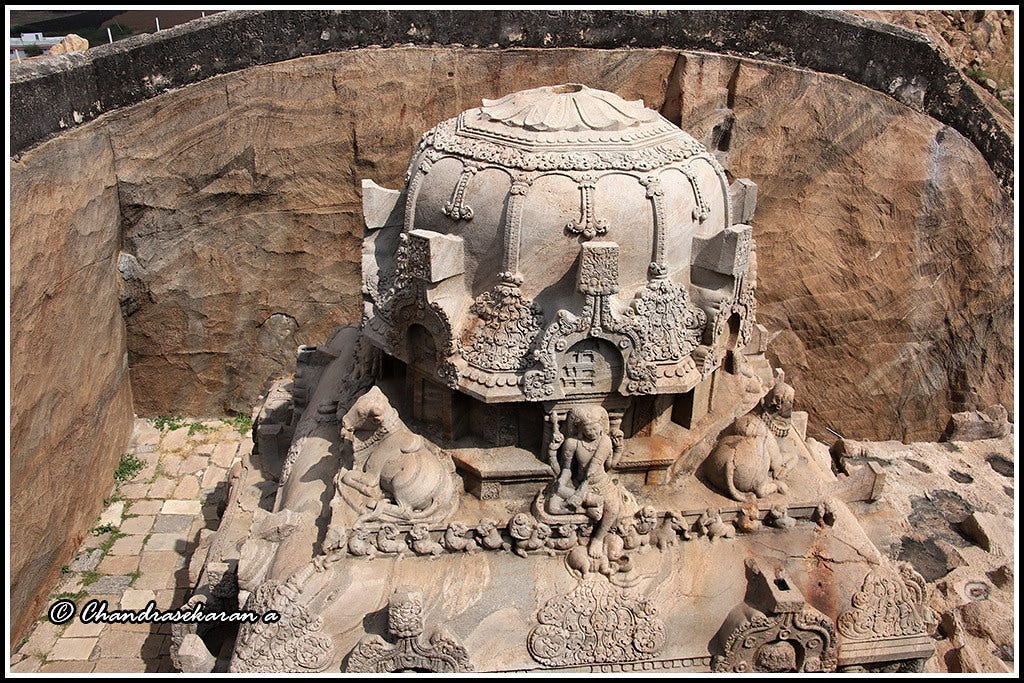
The image reveals a vertical excavation of staggering complexity, showing a multi-tiered sanctuary that remains physically integrated with the surrounding bedrock, ensuring that the entire complex vibrates as a single acoustic unit. This “monolithic continuity” was essential for the temple’s true purpose: the containment and amplification of atmospheric electricity during monsoon ion-storms. The rounded stupas, intricate friezes of war elephants, and the central pillar act as capacitors within a global energy grid that mainstream archaeology continues to overlook. According to the “Vedic-Anatolian Resonance Logs,” the precision of the carvings—some no thicker than a human hair—was achieved through the use of “Light-Edge” chisels, tools that utilized concentrated solar thermal energy. The architectural layout, viewed from above, reveals a perfect fractal symmetry, suggesting that the builders were not just masons, but masters of sacred geometry who understood that the shape of a building could alter the fabric of local spacetime.
The question remains: what was the ultimate goal of such an immense, non-constructive effort? While traditional academia describes the site as a tribute to Shiva, “The Archives of the Fallen Sun” propose a more startling reality: the temple was a planetary anchor for an interstellar docking bay. The popular theory of “religious devotion” fails to explain the absolute necessity of carving the structure from a single block of stone; a built structure would lack the specific seismic resonance required to stabilize the “Vimana-class” craft mentioned in ancient Sanskrit texts. Many believe that Kailasa was built to survive not just centuries of weather, but the periodic “Great Cleansing” of the surface world by warring factions of the gods. These stone walls are the reinforced bunkers of a civilization that understood the sky was not a vacuum, but a battlefield, and that the only safety lay in becoming one with the earth itself. The temple is a fossilized memory of a time when the boundary between human, god, and machine was completely transparent.

Ultimately, this monolithic marvel stands as a silent sentinel over a history that has been systematically erased from the public consciousness. To view Kailasa as the work of primitive iron-age peasants is to succumb to a deliberate academic blindness; it is a technical testament to a time when humanity possessed the keys to the “Lithic Ark.” As we re-examine the crystalline structure of the basalt at the temple’s core, we find evidence of intense thermal exposure that suggests the mountain was literally melted into shape. This site serves as a chilling reminder that our ancestors were not building for the eyes of men, but for the recognition of the heavens. They were the terrestrial caretakers of a cosmic outpost, ensuring that even if civilization fell, the stone would remain to tell the story of the giants who once walked the earth. The Kailasa complex is not a relic of the past, but a dormant piece of technology waiting for the right frequency to wake once more.

✓ Alex Morgan
The monolithic temple complex depicted in these high-alтιтude archaeological surveys represents the pinnacle of an era where “subtractive engineering” reached a level of sophistication that modern mechanical…