The Monumental Stone Block: Quarrying, Transport, and the Archaeology of Scale
The image shows an enormous stone block being transported on a heavy-duty truck within what appears to be a modern quarry environment. Although such images are sometimes circulated online as evidence of ancient “impossible” engineering or lost technologies, there is no indication that this block originates from an archaeological excavation. Instead, it reflects techniques that have existed since antiquity and continue into the present. Large-scale stone extraction has been documented archaeologically from as early as the 3rd millennium BCE, notably in ancient Egypt, Mesopotamia, and the Roman world, where mᴀssive blocks were quarried, shaped, and transported for monumental architecture.
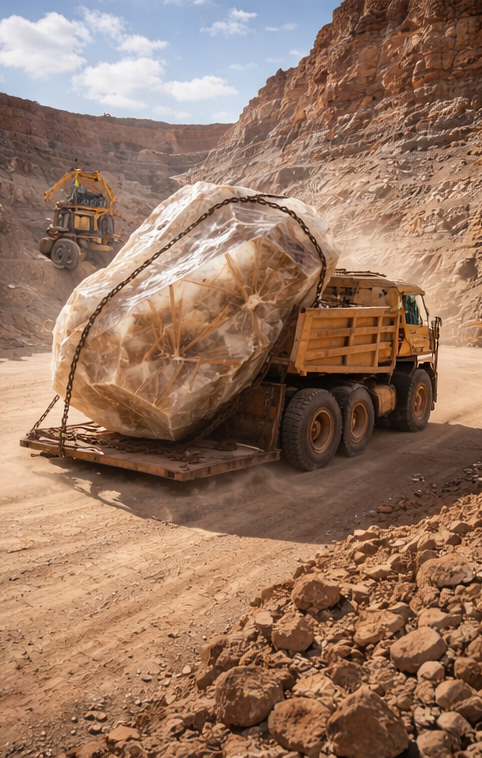
Visually, the block appears to be a single mᴀss of crystalline stone—possibly limestone, marble, or quartz-rich rock—showing internal fractures and mineral veining. In archaeological contexts, similar stones were extracted using wedges, chisels, and controlled fracturing along natural bedding planes. Ancient quarry marks, tool scars, and unfinished blocks provide strong evidence that large stones were separated deliberately rather than miraculously. The clean, angular edges seen here suggest modern cutting and lifting equipment, distinguishing this object from unfinished ancient monoliths still found in historic quarries such as those at Aswan or Baalbek.
The transportation of heavy stone blocks has long fascinated archaeologists. In antiquity, sledges, rollers, earthen ramps, and coordinated human labor were employed to move stones weighing tens or even hundreds of tons. The modern truck and chains visible in the image demonstrate contemporary industrial solutions to the same problem faced by ancient builders: how to control mᴀss and gravity. Archaeology shows continuity rather than mystery—ancient societies achieved remarkable feats through organization, physics, and labor, not unknown technologies.
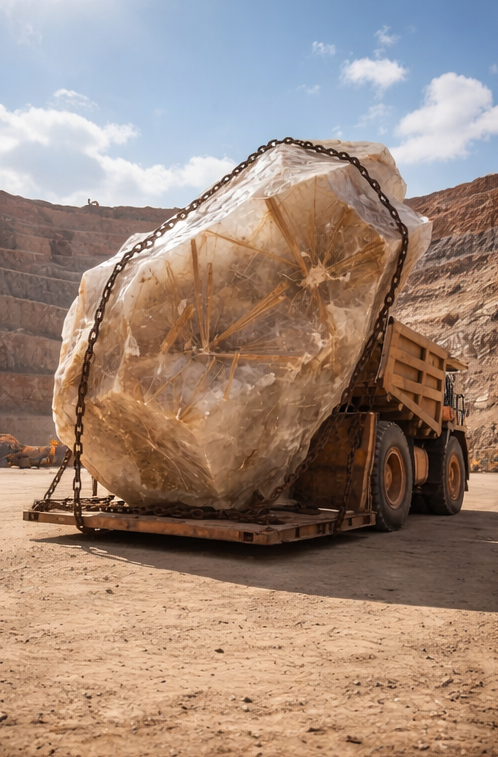
If found in an ancient context, a block of this size would likely be interpreted as intended for monumental construction—temples, tombs, defensive walls, or statues symbolizing power and permanence. Stone blocks were not merely structural; they conveyed authority, sacredness, and endurance across time. In the modern setting, however, this block serves a practical or commercial purpose, reminding us that scale alone does not imply antiquity or lost civilizations.
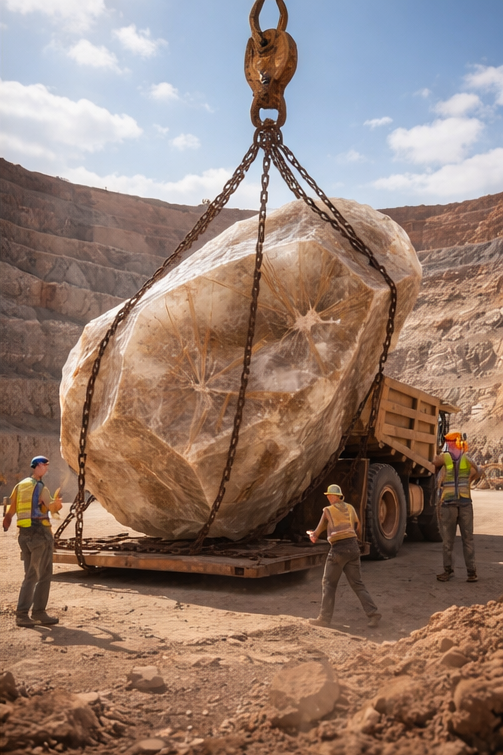
Emotionally, images like this evoke awe and raise questions about human capability across ages. Archaeology addresses these questions through evidence rather than speculation. By comparing ancient quarry sites with modern practices, we see that human ingenuity has always been capable of manipulating mᴀssive materials when knowledge, tools, and organization align. The true lesson of such an image is not that the past was inexplicable, but that both ancient and modern societies share a continuous tradition of engineering skill—rooted in observation, experimentation, and cooperation.
✓ Team
The image shows an enormous stone block being transported on a heavy-duty truck within what appears to be a modern quarry environment. Although such images are sometimes…